Culture

Lauren Daigle’s Christmas Cheer Doesn’t Pause for a Pandemic

Ahead of her first televised special, the chart-topping Christian artist told CT her music has taken on special meaning in 2020.

Christianity Today December 4, 2020
Courtesy of BYUtv

This is Lauren Daigle’s third year reigning as Billboard’s top Christian artist. But her music—from powerful reminders of God’s presence to the comforting nostalgia of Christmas—has struck her differently in 2020.

In an interview with Christianity Today, the singer talked about seeing her recordings in a new light, describing the songwriting process as a “prophetic exchange” with God. She marvels at how the Lord has used her songs, which broke records on the Christian charts, to speak into a moment she never could have imagined.

“It’s wild how sometimes God will write through you. You don’t necessarily know what’s on the other side. When you see the time in which [a song] was meant to live, you know you couldn’t have done this if you tried,” the singer said.

Daigle points specifically to “Rescue,” from her 2018 Grammy-winning album Look Up Child, which begins, “You are not hidden / There’s never been a moment you were forgotten / You are not hopeless / Though you have been broken, your innocence stolen.” She said a forthcoming release, “Hold On to Me,” was written before the pandemic but will take on new meaning for weary listeners when it comes out next year.

Christmas music has always been special to Daigle and some of her favorite to sing. She says the texture and character in traditional Christmas songs make it easy to get lost in the wonder of the season. This year, fans have cued up their Christmas playlists early and are eager for familiar holiday cheer after a difficult year.

In 2016, Daigle released Behold: A Christmas Collection, which reached the 29th spot on the Billboard 200. Her versions of Christmas favorites like “What Child Is This?,” “The Christmas Song,” and “Winter Wonderland” paid tribute to her musical influences and her Louisiana home.

Four years later, Behold still “represents the nostalgia of what I was raised on,” she told CT. “That goes to the core of who I am as a creative.”

She’ll be singing songs from the album as well as hits like “You Say” during an upcoming BYUtv special, Christmas Under the Stars, premiering on December 6. During a year when many people will be apart from loved ones, Daigle is excited to be able to share the kinds of classic songs that make the holidays special for her, celebrating in her native Lake Charles.

“I love the way it feels and the nostalgia that it brings for so many people,” she said. “Just to be part of bringing that into people’s homes over the Christmas season, it means so much.”

In addition to the songs recorded before a live audience, the hour-long special—Daigle’s first televised concert—will also include more intimate performances filmed in a studio setting.

In early November, Daigle performed at an outdoor worship service held by musician Sean Feucht in New Orleans’s French Quarter. Critics decried Daigle’s appearance at an event with thousands of unmasked spectators at a time the COVID-19 cases were spiking in the city.

Daigle said she gathers every year with her immediate family on Christmas Eve for games and gifts and that there’s always plenty of laughter and Cajun food with her “vivacious” family.

On Christmas Day, Daigle’s extended family gathers for more feasting and fun. While the extended family gathering might be smaller this year, Daigle said she will still spend time with as much of her family as she can. Her family prioritizes relationships, especially with elderly loved ones who might be around only for a few more family holidays.

“Let’s be smart, let’s be wise, and if someone’s sick, stay home,” she said. “But if not, let’s still get together and lavish love on each other.”

Culture

Netflix’s ‘Voices of Fire’ Reveals Power of Sung Gospel

Choir director Patrick Riddick on how he saw God’s presence in the show’s rehearsals.

Christianity Today December 4, 2020
Antony Platt / Netflix

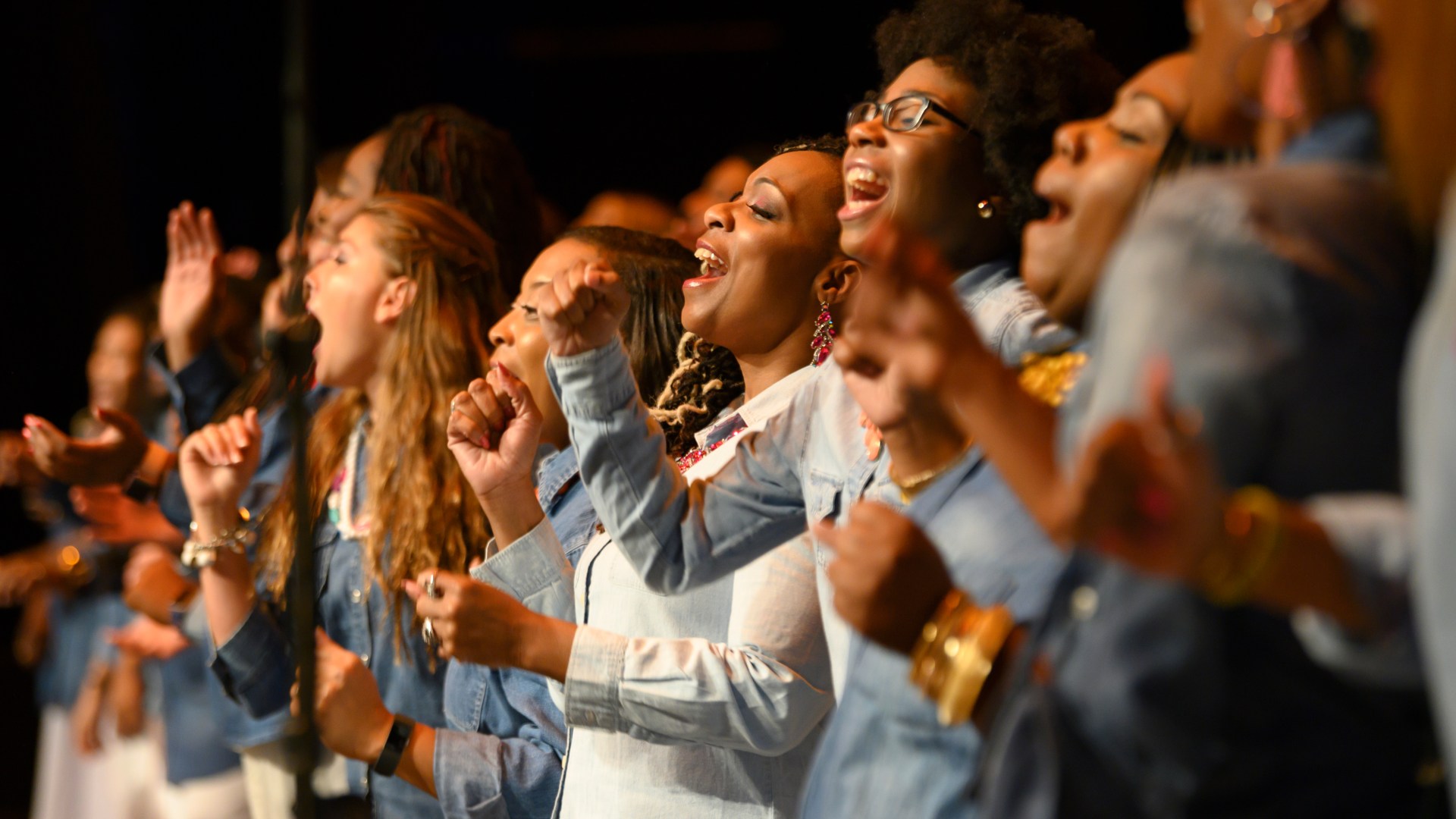
In the new Netflix show Voices of Fire , Grammy Award winner Pharrell Williams and his uncle, Bishop Ezekiel Williams, envision a diverse choir that will draw people to God through gospel music. As they hold auditions to find talent in Pharrell’s hometown of Hampton Roads, Virginia, they witness how the sung gospel changes the lives of its singers.

Kathryn Kemp, author of three books on gospel music, interviewed the choir’s director Patrick Riddick, also a pastor, about how he saw God at work in the show.

I see that God has blessed and used you from a young child to share the gospel first in song, then through sermons. How did that experience help you bring a nontraditional gospel choir to the understanding and appreciation needed to sing gospel music?

It was kind of a one-two punch. It helped me tie together all I had experienced and knew about music, and I was able to use that to create illustrations concerning the Word of God. Some of the singers had never gone to church. Some of them had never sung gospel. And so, as I began to teach music, I began to marry it with the Word. And then experience came in, and the experience was undeniable—what they were experiencing because of that. Having the preached Word background as well causes me to be more sensitive to the purpose of what we do musically, especially in gospel music. With that awareness and that sensitivity, it just makes it easier to administer it to the singers.

Are there any divine moments that stand out to you from the show?

During the rehearsals, there were these singers that were novices or had never experienced gospel music before. And some of them were not Christian. We were in our first or second rehearsal, and I had them blending. And then I was teaching them that blending and singing together corporately is the greatest kind of worship. God commands corporate worship; there’s something about when we all get together. And they began to grasp that. And the moment their sound changed because they became unified musically and in the Spirit—you begin to see tears fall. Some of them didn’t even understand, and they began to lift their hands in the moment. And some of them began to come up, because Bishop was there, and say, “I don’t know what’s going on, but I want more of this. Tell me about this.” That started about the second rehearsal, and it continued in every rehearsal that we had while we were shooting.

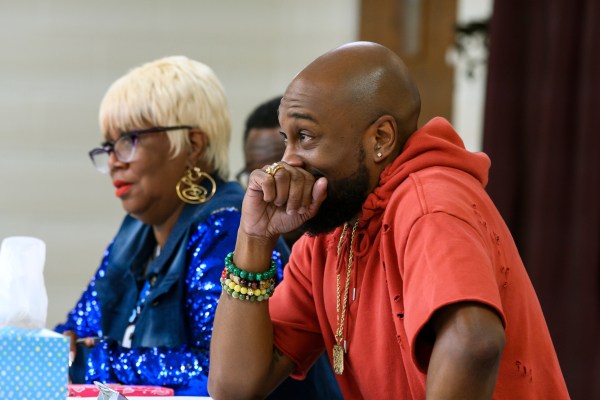
(L to R) Vocal coach Peggy Britt and choir master Patrick Riddick in 'Voices of Fire.'Antony Platt / Netflix
(L to R) Vocal coach Peggy Britt and choir master Patrick Riddick in ‘Voices of Fire.’

What is happening now with the choir in light of the pandemic?

Not as much right now. We’re actually talking about how we can safely come together and do some things to be productive because we have been down during the pandemic. We’re just concerned for some of the spiritual lives of some of the singers as well as, of course, the musical readiness of the choir in general. We met maybe once or twice. But as soon as we can get back together—everyone is saying, “We just miss it. We just wanted to come. … We want to worship when we come together to pray”—it’s going back to how it was.

One of the criticisms of 21st-century gospel performance is that an invitation to bring Christ into your life is rarely heard. How can salvation, redemption, and confession be brought into the concert atmosphere of gospel music?

I believe that it can be, and it should be. I know, for myself, I do it, but that has to be the objective of the person. I think a lot of what the problem is, is that everything has become so mainstream. And with all due respect, you have a lot of persons that run the various record labels that are not Christian, but within that record label, there is a Christian music division. And so then the pressure is put on the singer to simply be an artist. What is happening is people are being programmed as artistic-performing robots, and it’s moved the whole objective of gospel music, which is to share the good news of Jesus Christ. And so it is our duty when we go to perform—make a way, let it be known, “Yes, I thank God for this opportunity, but ultimately the opportunity still came from God. I’m blessed to do what he sent me here to do.”

Do you feel like God was present in this project?

The Scripture says, “The blessing of the Lord brings wealth, without painful toil for it” (Prov. 10:22). It’s easy. It’s organic. It seems like everything just falls in place. And truly with this endeavor, it was just seamless. The only struggle was that we had a little bit of time to turn it around by the time we got to the concert. But outside of that, it was just a spiritual ride that you know God was truly the captain of a ship.

Books
Review

Thomas Jefferson Tried to ‘Fix’ the Bible. He Only Succeeded in Making It Sad.

The third president’s attempts to revise Scripture offer a warning about our own tendency to “edit” the truth.

Christianity Today December 4, 2020
Illustration by Mallory Rentsch / Source Images: WikiMedia Commons / National Museum of American History

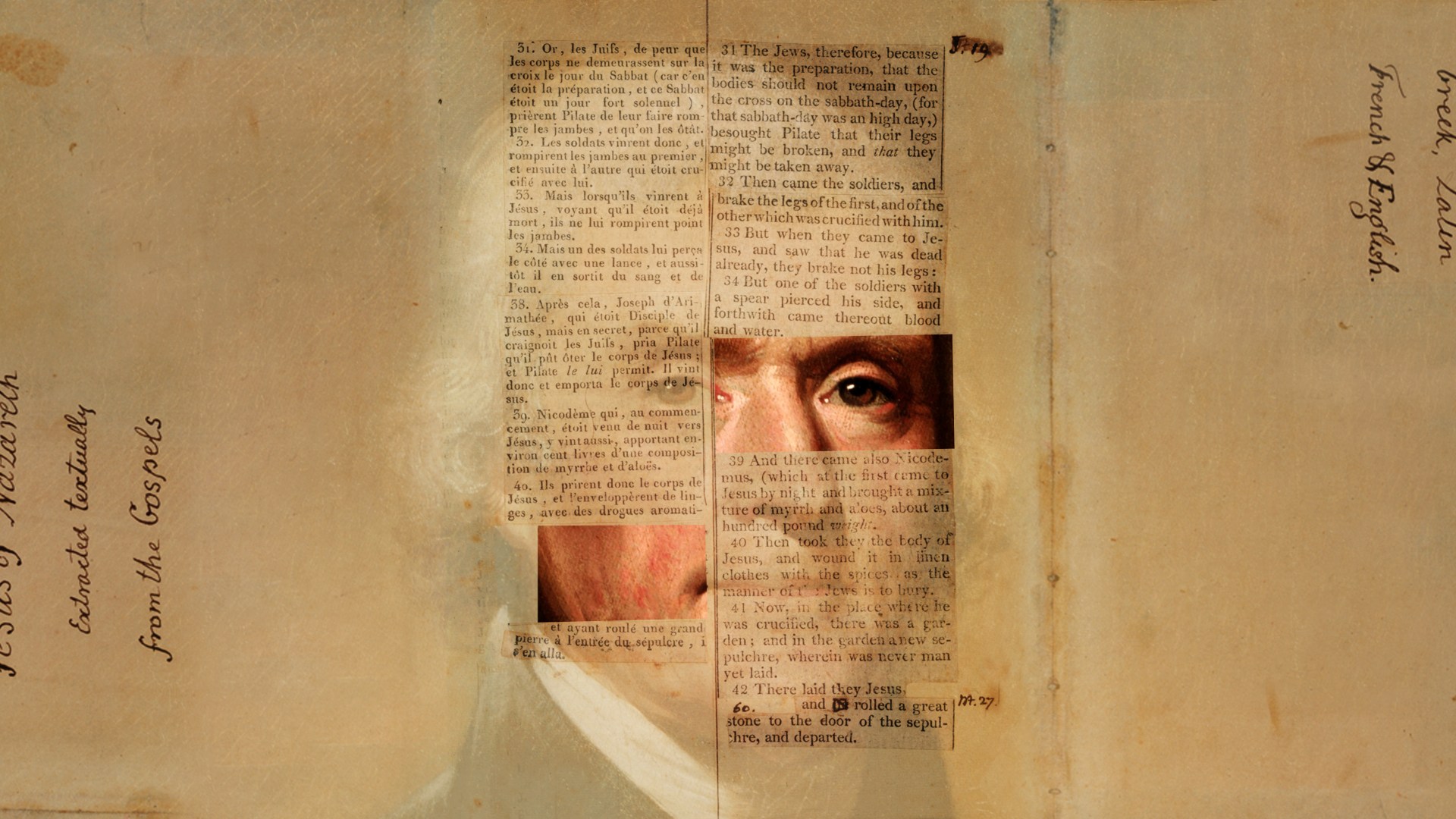
I first heard of Thomas Jefferson’s Bible as a warning. I was a teenager in a Bible study, and one of the pastors of the church brought up the third American president and his effort to “fix” the Scripture. Jefferson—who wrote the immortal words of the Declaration of Independence that “all men are created equal” and are “endowed by their creator with certain unalienable rights”—took for himself the liberty of editing the Gospels. He cut them up, using a sharp knife to excise what he saw as the problematic parts of the sacred text.

The Jefferson Bible: A Biography (Lives of Great Religious Books)

The Jefferson Bible: A Biography (Lives of Great Religious Books)

Princeton University Press

236 pages

$13.22

But, the pastor said, don’t we all kind of do that? We have our favorite verses. And there are other parts of the Bible we ignore. Whether or not we wield actual scissors, we have to be careful, because it’s so easy to mutilate the Word of God.

There is certainly some truth to this, but it turns out it is not as easy to “fix” the Scripture as that pastor imagined. Jefferson, at least, had a hard time of it, according to a fascinating new book by Peter Manseau, the curator of American religious history at the Smithsonian Institution’s National Museum of American History. The Bible resisted Jefferson’s cuts, and the truth is stronger than its would-be editors.

The Jefferson Bible: A Biography is part of an excellent Princeton University Press series on the “lives of great religious books.” This installment follows titles on John Calvin’s Institutes of the Christian Religion, Dietrich Bonhoeffer’s Letters and Papers from Prison, and C. S. Lewis’s Mere Christianity, not to mention “biographies” of the biblical books of Genesis, Exodus, Job, Song of Songs, and Revelation. Manseau, in his volume, traces the origin of this particular, peculiar “great religious book” to Jefferson’s childhood Anglicanism. In that world, colonial Virginia law punished the heresy of doubting the divine authority of Scripture, while a burgeoning liberty movement questioned the government’s right to criminalize belief.

A Hard Gospel

Jefferson, like many at the time, shed his orthodox Christianity in stages. He started by doubting the Trinity. Then Old Testament miracles. Then New. He eventually embraced a religious skepticism that was held in check only by the same force that compelled him to conceal the fact that he had fathered multiple children with his deceased wife’s enslaved half-sister: public opprobrium. What would people think?

Jefferson hid his infidelities to conform with the mores of his day even as he spoke about the importance of intellectual boldness, heralded revolutions big and small, and mulled the idea of editing the Gospels to, as he put it, “winnow this grain from its chaff.”

His first effort at revising the text came while he was president—in a 46-page booklet he called The Philosophy of Jesus. The volume has been lost to history, but at one point he explained the project in detail to his frenemy John Adams. He said he had extracted, reduced, and cut down the gospel until the only thing left was “the most sublime and benevolent code of morals that has ever been offered to man.”

It was an easy process, Jefferson said. He cut the text up verse by verse, and the good parts stuck out “as diamonds in a dung hill.”

It wasn’t until 1820, more than a decade out of office, when he finished the fuller second version of his edited gospel. He called it The Life and Morals of Jesus of Nazareth. He read from it devoutly, Manseau says, until he died in 1826.

But the Jefferson Bible may have proved the opposite of what Jefferson intended. It doesn’t show Jesus to be a great moral teacher once his story is stripped of the miracles, exorcisms, and other acts that the former president found hard to believe. It presents Jesus rather as someone who didn’t do anything. As Manseau writes, “Jefferson’s is a hard gospel. The blind to not see; the lame do not walk; the multitudes will remain hungry if loaves and fishes must be multiplied to feed them. Even those who look to Jesus for forgiveness of sins are left wanting.”

The Jefferson Bible begins with the heading “Chapter 2.” The former president dispenses with Matthew’s genealogy, Mark’s reference to the prophecy about a voice crying in the wilderness, Luke’s narrative about an angelic announcement to a virgin named Mary, and John’s proclamation that “the light shines in the darkness, and the darkness has not overcome it” (1:5).

Instead, Jefferson cuts straight to the Roman Empire requiring everyone to return to their home city to be taxed. Joseph takes Mary to a manger in Bethlehem, and a baby is born. This Christmas scene has neither angels nor shepherds, star nor magi. The birth is revised to be unremarkable.

Jefferson allows the line “and the child grew, and waxed strong in spirit, filled with wisdom,” but excises the rest of the verse: “and the grace of God was upon him” (Luke 2:40, KJV).

Nor, in Jefferson’s revision, is the grace of God visible in Christ’s ministry. In Matthew 12:12, Jesus proclaims that “it is lawful to do well on the sabbath days” (KJV), but we don’t see him actually doing well. The following verse, in which Jesus heals a man with a withered hand, disappears. Jefferson’s version has Jesus commenting that a blind man is not blind because of any particular sin of his own or his parents (John 9:3), but he doesn’t give the blind man sight (v. 6). It shows Jesus allowing a woman to anoint his feet with her tears and an alabaster box of expensive oil (Luke 7:36–38), but he withholds the words “Your sins are forgiven” (v. 48). In Jefferson’s version Jesus dies and remains dead.

“The text often has a feeling of a series of jokes without their punch lines,” Manseau writes. “Jefferson apparently never contended with the possibility that, without all the stories he rejected, it’s unlikely we would have heard of Jesus at all.”

A snip here and there doesn’t “fix” the text. It just leaves weird holes. And perhaps this temptation is common, as my pastor suggested. We seek to make the Scripture sublime with our revisions, but we only succeed in making it sad.

No Easy Fix

In all likelihood, Jefferson’s attempts to fix the Scripture would be just as forgotten as our own if not for the fact of his being Jefferson—author of the Declaration of Independence and champion of a new, robust religious liberty that came, for many, to be a defining feature of America. Manseau’s history follows the fate of the singular book as it is subsequently discovered and rediscovered and as various people attempt to turn it into an icon of American religion. The former president’s revised gospel is sometimes held up as evidence of the great Christian devotion of the Founding Fathers, as in David Barton’s discredited The Jefferson Lies. More often, the spliced words are presented as a symbol of the freedom guaranteed by the First Amendment. Cyrus Adler, a predecessor of Manseau’s at the Smithsonian, wrote that the book was evidence that in America “all people may worship God according to the dictates of their own conscience.”

Manseau, for his part, hesitates to turn the “great religious book” into a simple icon. He notes how often such efforts fail. How often they end up strangely misshapen, serving unintended conclusions and undercutting their own points. Just as Jefferson could not quite reconfigure the gospel to fit his preferences, Americans cannot quite “fix” Jeffersonian history to be more useful. The truth—whether it’s the truth of Jesus’ life and morals or the truth of a Founding Father’s personal hypocrisy—will escape your grasp.

That is not to say that the truth cannot be known—only that it cannot be contained and controlled. This is, I think, the lesson of Manseau’s history. The Jefferson Bible, it turns out, does offer us a warning. It’s this: You will know the truth, and the truth will set you free. But, as the popular saying goes, not until it’s finished with you.

Daniel Silliman is news editor for Christianity Today.

Ideas

Christian Political Exile Persists No Matter the President

Staff Editor

The Trump era was not a new Babylon, and the Biden era will be no new Jerusalem. (And vice versa.)

Christianity Today December 4, 2020
Illustration by Mallory Rentsch / Source Images: RiverNorthPhotography / Pool / Nastasic / Mark Makela / Getty Images

Nearly 600 years before the birth of Christ, the city of Jerusalem was besieged, conquered, and razed by the Babylonian empire. The victorious invaders captured the king, destroyed the temple, and took thousands of Israelites into exile in Babylon.

Christians have long looked to stories and prophecies from the Exile era for guidance in how to live as “foreigners and exiles” (1 Pet. 2:11) whose “citizenship is in heaven” (Phil. 3:20). There’s the wisdom of Daniel, the shrewdness of Esther and Mordecai, the righteousness of Shadrach, Meshach, and Abednego. The exile framework for examining our lives and conforming them more to Christ can be especially useful in times of political and social upheaval, and this year is certainly one of those times.

The presidential election results bring exile to mind for many American Christians. For those on the political right, the victory of President-elect Joe Biden may seem like the start of a season of hardship. Author and legal scholar F. LaGard Smith made this link explicit in a recent contribution to The Christian Post, warning that our country is “headed to Babylon” because of how a Democratic administration will facilitate an ongoing “national moral rebellion” that will curtail religious liberty. For those on the political left or center, meanwhile, the defeat of President Donald Trump may seem a kind of release and restoration, an opportunity to return to older, better patterns of life, as the Israelites did when they were finally able to rebuild Jerusalem.

I too am troubled by the drift of public opinion on religious liberty, and I too am glad Trump will leave public office—that is, I understand why both perceptions make sense. But I also think both are built on too delimited an idea of exile, one that turns on the erratic shifts of national politics rather than a distinctive vision of the Christian life.

We are not headed to Babylon. We’re already there. For American Christians, the United States is not our true home.

We are not headed to Babylon. We’re already there. For American Christians, the United States is not our true home. Scripture insists that to be a Christian, by definition, is to be foreign to any earthly nation (1 Pet. 1:17). America is no exception; nor is any American president. The Biden administration is not a new exile, and the Trump administration was no Jerusalem.

That is a difficult truth. For all the advantages of representative government like ours, it presents a unique temptation to Christian faithfulness that many of our forebears in the faith never faced: We can wield power. We can elect politicians who promise to serve our interests as we see them. We can be lulled into deriving our security from our leaders.

This lulling effect knows no partisan bounds, so it must equally be said that we are not heading home from Babylon now. The Trump administration was not a new exile, and the Biden administration will be no Jerusalem.

More moderate, independent, and progressive Christians may not be swayed by the overt civil religion popular among some conservatives. That should not be mistaken for invulnerability to the temptations of democracy and its illegitimate claims on our allegiance. It is one thing to be pleased by the prospect of incoming policies we believe will improve on the old. (No doubt Daniel had preferences among the several kings he served.) But if any election outcome makes us feel newly at home in our political system—if it has us sighing in relief, “Ah, now we’ll be okay”—something in us is awry. It suggests we’ve forgotten to look for our real ruler’s final return, triumph, and redemption of the whole of creation (Rom. 8:19–21; Rev. 21:3–5). It is a sign we have lost an exilic attitude that should identify followers of Jesus.

The Old Testament texts on exile can help us to cultivate that attitude, to answer the question that is as urgent now as then of how to live in this strange land with its strange customs and ethics and rulers and gods. Some of the exiles in Babylon chose assimilation, some resistance or escape. But in a letter to remnants of the Jerusalem community, the prophet Jeremiah offered a different message from God:

Build houses and settle down; plant gardens and eat what they produce. Marry and have sons and daughters; find wives for your sons and give your daughters in marriage, so that they too may have sons and daughters. Increase in number there; do not decrease. Also, seek the peace and prosperity of the city to which I have carried you into exile. Pray to the Lord for it, because if it prospers, you too will prosper. (Jer. 29:5–7)

To this Jeremiah added warnings as well: Don’t be deceived by lies, he wrote, and don’t forget that you are God’s people whom God will rescue. This exile is not forever, it is not the end of God’s plan for human history, and it should not end his people’s hope (Jer. 29:8–14).

There’s a tension here: Put down roots—but remember you are not at home. Never give Babylon loyalty you owe only to God—but remember to work and pray for its good. Which of these reminders we require may vary with each election, but no matter who is in office, that is the exilic attitude we need.

This is not to say politics doesn’t matter. Politics can be a literal matter of life and death! If we have not learned that lesson from two decades of constant war, the past nine months of pandemic should have made it clear. Nor is there no difference between these two administrations. I’m often inclined to declare a “plague o’ both your houses,” but they’re not identical houses.

In the midst of that difference, however, and the accelerating pace of change in our political life, there is—or should be—a truer and deeper constancy for Christians. “Jesus Christ is the same yesterday and today and forever” (Heb. 13:8), and we are always equally called to a rooted, generous, and peaceful faith.

Bonnie Kristian is a columnist at Christianity Today.

News

Southern Baptists Keep Quarreling Over Critical Race Theory

Even among Christians who agree Scripture comes first, there’s a debate over whether to learn from or reject secular theories that see racism as structural.

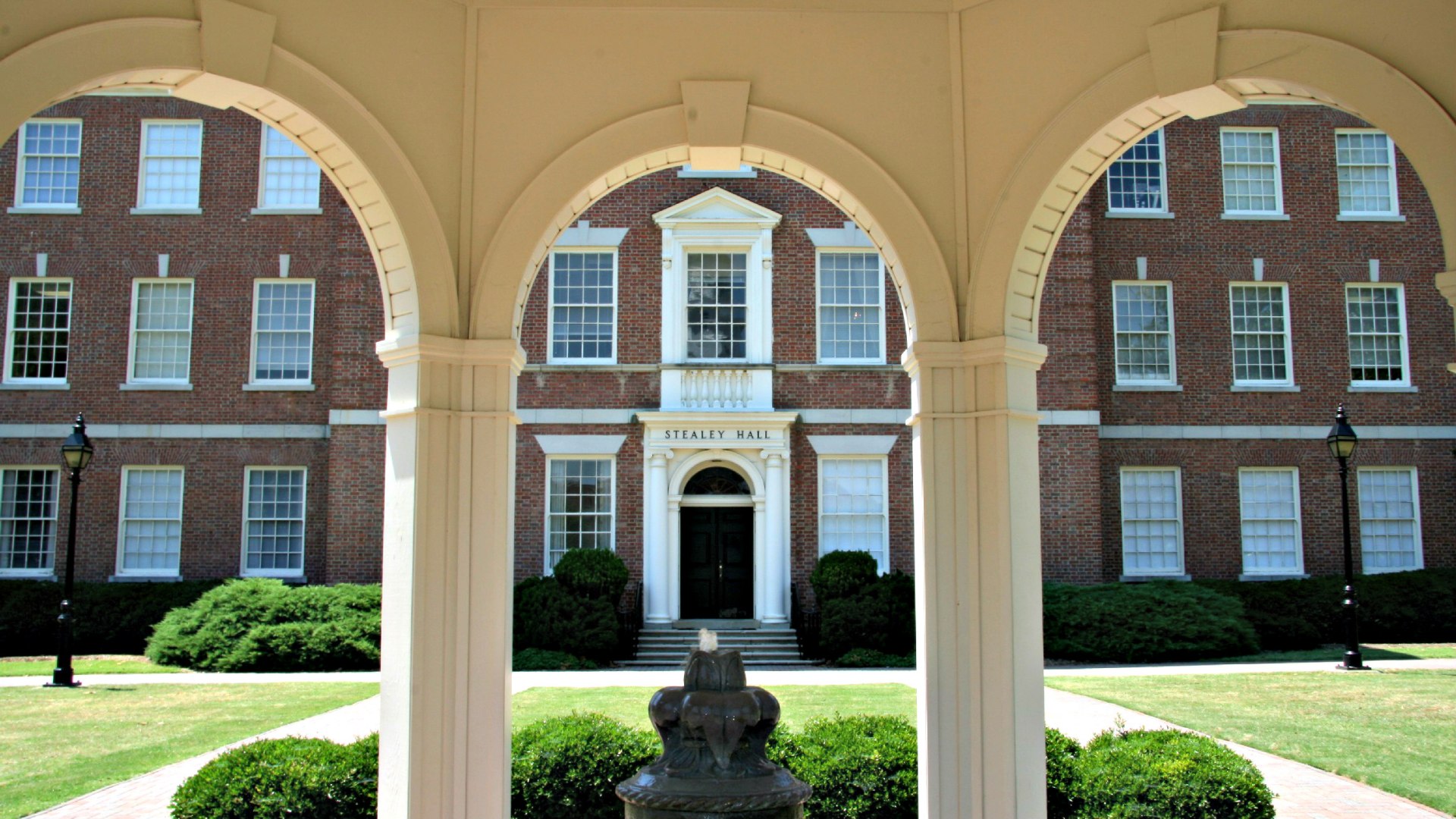
Southeastern Baptist Theological Seminary

Southeastern Baptist Theological Seminary

Christianity Today December 3, 2020
laowaikevin / Flickr

A year and a half after passing a controversial resolution on critical race theory, Southern Baptists are debating the topic again.

Seminary presidents issued a statement last week saying that “affirmation of Critical Race Theory, Intersectionality and any version of Critical Theory” is incompatible with the Baptist Faith and Message, the denomination’s core beliefs.

Their statement launched another wave of discussion around the place of critical race theory in Christian discourse and teaching, with fellow Southern Baptists and Christian leaders outside the denomination weighing in.

The term “critical race theory” (CRT) is frequently ill defined. According to scholars, it is an approach to the issue of racism that analyzes systems and biases embedded in social structures.

In the resolution approved at the 2019 annual meeting, the Southern Baptist Convention (SBC) referred to the theory as “a set of analytical tools that explain how race has and continues to function in society” and clarified that it could only be employed “subordinate to Scripture.”

“Some in our ranks inappropriately use the label of ‘CRT!’ to avoid legitimate questions or as a cudgel to dismiss any discussion of discrimination. Many cannot even define what CRT is,” tweeted SBC president J. D. Greear on Thursday. “If we in the SBC had shown as much sorrow for the painful legacy that sin has left as we show passion to decry CRT, we probably wouldn’t be in this mess.”

To certain Southern Baptists, the SBC has not done enough to dismiss critical race theory, allowing secular thinking to overtake a biblical worldview. Concerns over the influence of critical race theory were a factor in the formation of the new Conservative Baptist Network in February, and Tom Ascol’s Founders Ministries has also called out the theory as evidence of a “wavering” commitment to the sufficiency of Scripture.

Especially after last year’s resolution, they fear the theory is being promoted through seminaries and SBC entities that have become increasingly outspoken on racial justice issues.

But for others in the SBC, the push to decry critical race theory distracts from what they see as more pertinent issues for their denomination in 2020, such as confronting racism.

The latest iteration of the debate—which spurred a response from the committee responsible for last year’s resolution—suggests the SBC could be discussing the topic again at its 2021 annual meeting, currently scheduled to be held in Nashville in June.

After the committee referenced one of his recent sermons in their statement, pastor Tony Evans clarified that he doesn’t dismiss critical race theory. “I did not say, nor imply, that CRT or other ideologies lack of beneficial aspects—rather that the Bible sits as the basis for determining that,” Evans said. “I have long taught that racism, and its ongoing repercussions, are real and should be addressed intentionally, appropriately and based on the authority of God’s word.”

Southern Baptist Bible teacher Beth Moore responded to the seminary presidents’ statement by asking what rejecting critical race theory entails.

“I’ve repeatedly asked this question in good faith in direct messages to various SBC leaders & have yet to receive a clear, concise, consistent answer. Please, for those of us seeking to understand, define CRT in, say, 4 sentences. Is preaching against racism ‘any version’ of it?”

Writing for The Witness: A Black Christian Collective, Jemar Tisby worried that objections to critical race theory as a framework for thinking about racial injustice have been used to keep Christians from talking about systemic racism, Black Lives Matter, white privilege, and more.

Tisby, the author of the bestselling book The Color of Compromise, referred to critical race theory as the “theological and ecclesiastical equivalent of the ‘Red Scare.’” He said, “Slap anyone with the label ‘Critical Race Theory,’ and they automatically become enemies of the church.”

Black leaders applying Scripture to racial issues or leading diversity initiatives at SBC seminaries have faced backlash from more conservative members of the denomination who accuse them of succumbing to secular and Marxist ideologies.

Before making their position clear through last week’s statement, leaders have had to address the criticism head-on. Last year Daniel Akin—president of the Southeastern Baptist Theological Seminary, known for its Kingdom Diversity Initiative—tweeted that he had “no concerns” that any SBC seminaries were “pursuing Cultural Marxism, intersectionality, liberation theology or a social gospel.”

https://twitter.com/DannyAkin/status/1123410875493298176

He specifically defended Southeastern’s vice president for diversity and theology, Walter Strickland, as committed to scholarship that’s “fully consistent with theological orthodoxy and that honors the Holy Scriptures.”

Akin recently joined fellow presidents in repeating their rejection of critical race theory. Albert Mohler, the president of Southern Baptist Theological Seminary, said:

The issues of Critical Race Theory and Intersectionality have arisen within the last two years as issues of controversy in the larger world, and this controversy has reached into the Southern Baptist Convention.

We stand together in stating that we believe that advocating Critical Race Theory or Intersectionality is incompatible with the Baptist Faith & Message, and that such advocacy has no rightful place within an SBC seminary. I think it speaks loudly to Southern Baptists that we take this stand together.

President Donald Trump issued an executive order in September describing a critical theory approach, labeling it “anti-American,” and rejecting hierarchies based in race and sex in this country.

Just as the president emphasized a belief in the inherent equality of every individual (“all men are created equal”), Christians against critical race theory often bring up the divine worth in every image bearer, equal under God. They worry that it puts the dominant culture in the unbiblical position of always having to repent, said Rod Martin, who belongs to the Conservative Baptist Network.

The SBC’s resolution tries to balance acknowledging the shortcomings of a non-Christian approach while also believing “as with other secular theories, not every observation is wrong, sinful or unhelpful. But even insights that describe the social dynamics of our society accurately remain insufficient to address the sinful heart of man.”

When the topic of cultural engagement came up last year, Kevin Smith, executive director of the Baptist Convention of Maryland-Delaware, told CT the disagreement within the SBC is partly about “sinful, divisive personality, ethnocentrism, political convictions, and overzealous arrogance” and partly “disagreeing over how we apply loving our neighbor.”

In a statement shared by Southeastern provost Keith Whitfield, the committee responsible for the critical race theory resolution said they had repeatedly been called on to clarify and respond to concerns over the past 18 months. “We now wait and see what the 2021 convention in Nashville will bring, and we trust the will of the messengers.”

News

2020’s Most-Read Bible Verse: ‘Do Not Fear’

In an uncertain and difficult year, a record number of people searched for healing, fear, and justice.

Christianity Today December 3, 2020
DigitalVision / Getty

During the hardest moments of a particularly difficult year, Bible searches soared online, and a record number of people turned to Scripture for passages addressing fear, healing, and justice. The popular YouVersion Bible App saw searches increase by 80 percent in 2020, totaling nearly 600 million worldwide.

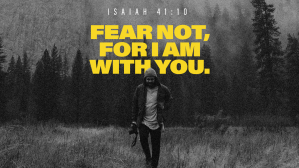
Isaiah 41:10 ranked as the most searched, read, and bookmarked verse on the app: “So do not fear, for I am with you; do not be dismayed, for I am your God. I will strengthen you and help you; I will uphold you with my righteous right hand.”

“Through every hardship, people continue to seek God and turn to the Bible for strength, peace, and hope,” said YouVersion founder Bobby Gruenewald. “While 2020 is a year so many say they’d like to forget, we see it as a year to remember how God used the Bible App to help so many people who are searching for answers.”

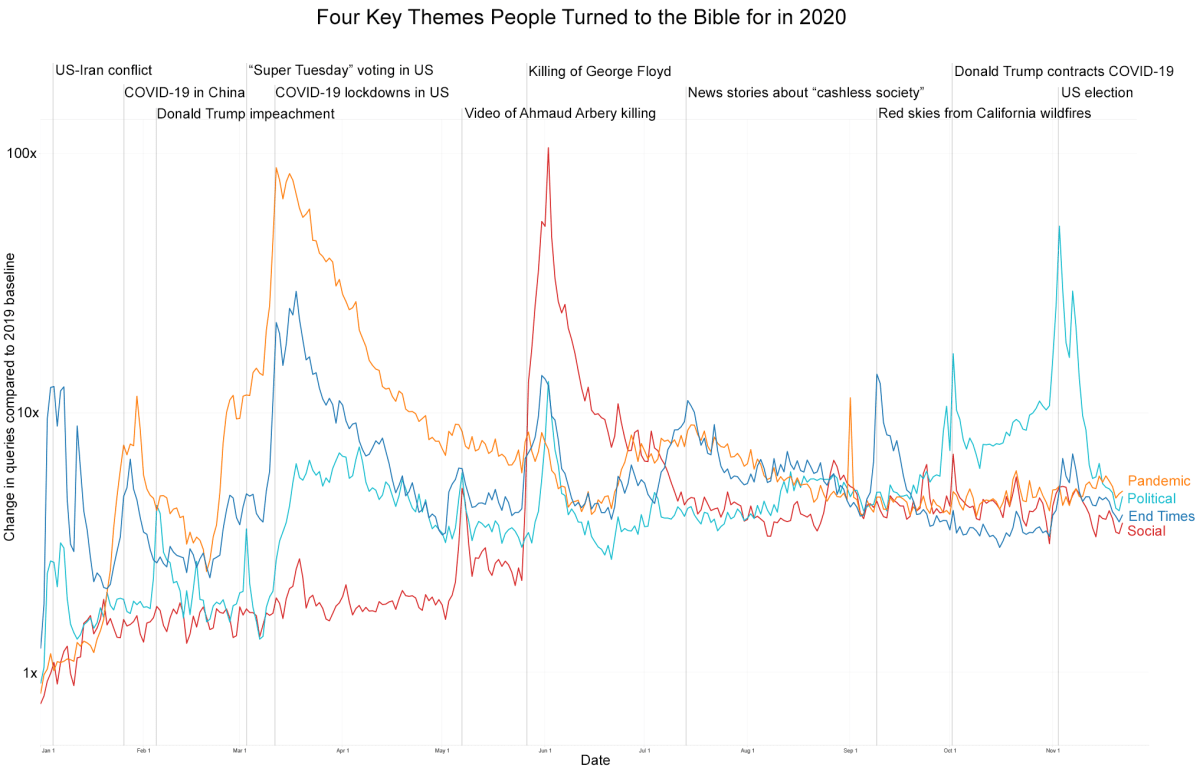
Bible searches spiked corresponding to major events, with “fear” becoming the app’s top search term in the first few months of the year, “justice” in the spring, and “healing” trending throughout the year.

The Bible Gateway site reported similar search trends. Pandemic-related verses about God taking away sickness got around 90 times more queries than average when US COVID-19 lockdowns began in March.

The site also saw queries related to racism, justice, and oppression spike to 100 times the average in the week following George Floyd’s death, and verses related to government authority up at least 50 times the average on Election Day.

While John 3:16 and Jeremiah 29:11 topped the Bible Gateway rankings for the top verses—as they have in most years—2 Chronicles 7:14 jumped up to the No. 3 spot: “If my people, who are called by my name, will humble themselves and pray and seek my face and turn from their wicked ways, then I will hear from heaven, and I will forgive their sin and will heal their land.” The passage has been commonly cited in prayers for President Donald Trump and was the top-searched verse around his election in 2016.

Bible Gateway searches for “fear” and “fear not” grew this year over last, with “fear” ranking sixth on the most popular English keyword searches.

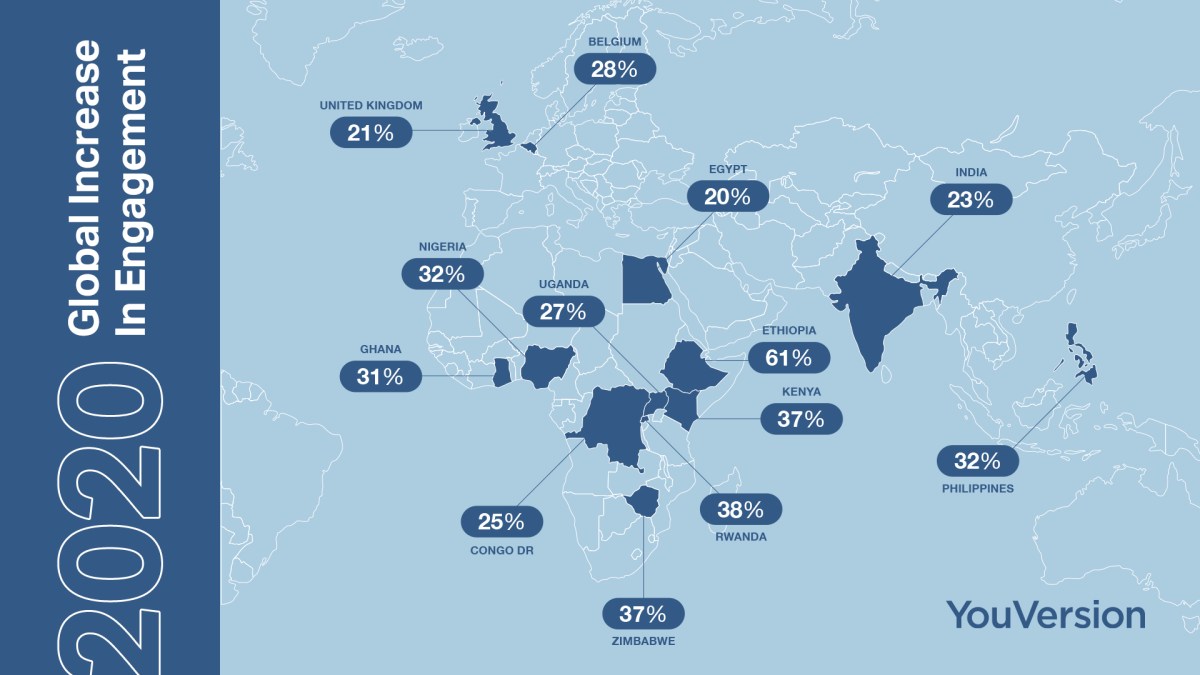
Isaiah’s assurance to “do not fear,” which was the Bible App’s top verse globally both this year and in 2018, also ranked as the No. 1 verse in the US, India, South Africa, the Netherlands, and the Philippines. In Ghana, the top verse was Philippians 4:8 (“Do not be anxious …”), and in Kenya, Romans 8:28 (“in all things, God works for the good …”).

Both countries were among several nations in sub–Saharan Africa where overall Bible reading surged on the app in 2020—up more than a third over last year. In Ethiopia, Bible engagement grew by 61 percent, according to YouVersion.

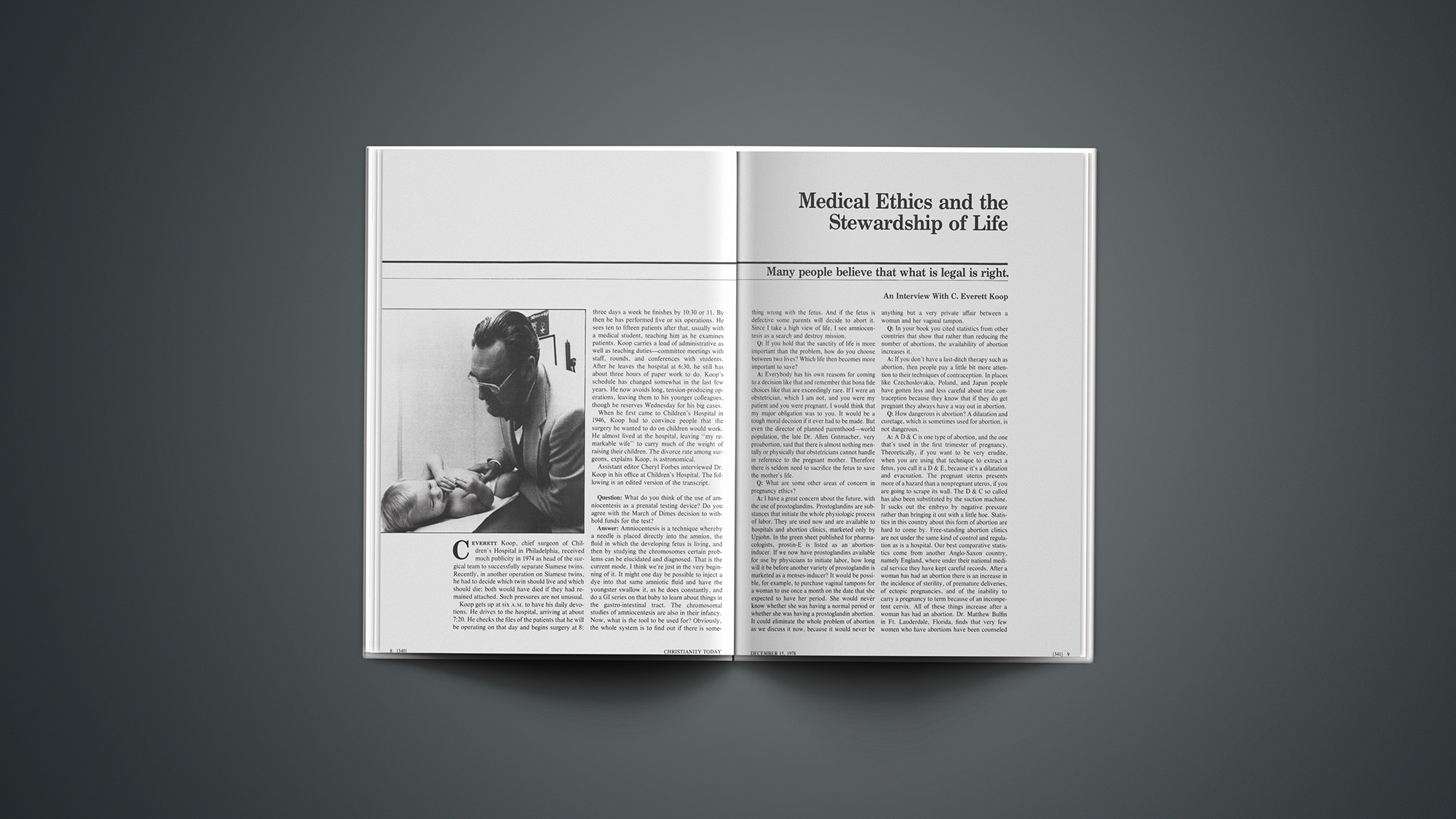
This article originally appeared in the December 15, 1978, issue of Christianity Today, three years before Koop, who died yesterday, was nominated to serve as U.S. Surgeon General.

C Everett Koop, chief surgeon of Children's Hospital in Philadelphia, received much publicity in 1974 as head of the surgical team to successfully separate Siamese twins. Recently, in another operation on Siamese twins, he had to decide which twin should live and which should die; both would have died if they had remained attached. Such pressures are not unusual.

Koop gets up at six A.M. to have his daily devotions. He drives to the hospital, arriving at about 7:20. He checks the files of the patients that he will be operating on that day and begins surgery at 8; three days a Week he finishes by 10:30 or 11. By then he has performed or six operations. He sees ten to fifteen patients after that, usually with a medical student, teaching him as he examines patients. Koop carries a load of administrative as well as teaching duties—committee meetings with staff, rounds, and conferences with students. After he leaves the hospital at 6:30, he still has about three hours of paper work to do. Koop's schedule has changed somewhat in the last few years. He now avoids long, tension-producing operations, leaving them to his younger colleagues, though he reserves Wednesday for his big cases.

When he first came to Chi1dren's Hospital in 1946, Koop had to convince people that the surgery he wanted to do on children would work. He almost lived at the hospital, leaving "my remarkable wife" to carry much of the weight of raising their children. The divorce rate among surgeons, explains Koop, is astronomical.

Assistant editor Cheryl Forbes interviewed Dr. Koop in his office at Children's Hospital. The following is an edited version of the transcript.

What do you think of the use of amniocentesis as a prenatal testing device? Do you agree with the March of Dimes decision to withhold funds for the test?

Amniocentesis is a technique whereby a needle is placed directly into the amnion, the fluid in which the developing fetus is living, and then by studying the chromosomes certain problems can be elucidated and diagnosed. That is the current mode. I think we're just in the very beginning of it. It might one day be possible to inject a dye into that same amniotic fluid and have the youngster swallow it, as he does constantly, and do a GI series on that baby to learn about things in the gastro-intestinal tract. The chromosomal studies of amniocentesis are also in their infancy. Now, what is the tool to be used for? Obviously, the whole system is to find out if there is something wrong with the fetus. And if the fetus is defective some parents will decide to abort it. Since I take a high view of life, I see amniocentesis as a search and destroy mission.

If you hold that the sanctity of life is more important than the problem, how do you choose between two lives? Which life then becomes more important to save?

Everybody has his own reasons for coming to a decision like that and remember that bona fide choices like that are exceedingly rare. If I were an obstetrician, which I am not, and you were my patient and you were pregnant, I would think that my major obligation was to you. It would be a tough moral decision if it ever had to be made. But even the director of Planned Parenthood—world population, the late Dr. Allen Gutttmacher, very proabortion, said that there is almost nothing mentally or physically that obstetricians cannot handle in reference to the pregnant mother. Therefore there is seldom need to sacrifice the fetus to save the mother's life.

What are some other areas of concern in pregnancy ethics?

I have a great concern about the future, with the use of prostaglandins. Prostaglandins are substances that initiate the whole physiologic process of labor. They are used now and are available to hospitals and abortion clinics, marketed only by Upjohn. In the green sheet published for pharmacologists, prostin-E is listed ask an abortion-inducer. If we now have prostaglandins available for use by physicians to initiate labor, how long will it be before another variety of prostaglandin is marketed as a menses-inducer? It would be possible, for example, to purchase vaginal tampons for a woman to use once a month on the date that she expected to have her period. She would never know whether she was having a normal period or whether she was having a prostaglandin abortion. It could eliminate the whole problem of abortion as we discuss it now, because it would never be anything but a very private affair between a woman and her vaginal tampon.

In your book you cited statistics from other countries that show that rather than reducing the number of abortions, the availability of abortion increases it.

If you don't have a last-ditch therapy such as abortion, then people pay a little bit more attention to their techniques of contraception. In places like Czechoslovakia, Poland, and Japan people have gotten less and less careful about true contraception because they know that if they do get pregnant they always have a way out in abortion.

How dangerous is abortion? A dilatation and curettage, which is sometimes used for abortion, is not dangerous.

A D&C is one type of abortion, and the one that's used in the first trimester of pregnancy. Theoretically, if you want to be very erudite, when you are using that technique to extract a fetus, you call it a D&E, because it's a dilatation and evacuation. The pregnant uterus presents more of a hazard than a nonpregnant uterus, if you are going to scrape its wall. The D&C so called has also been substituted by the suction machine. It sucks out the embryo by negative pressure rather than bringing it out with a little hoe. Statistics in this country about this form of abortion are hard to come by. Free-standing abortion clinics are not under the same kind of control and regulation as is a hospital. Our best comparative statistics come from another Anglo-Saxon country, namely England, where under their national medical service they have kept careful records. After a woman has had an abortion there is an increase in the incidence of sterility, of premature deliveries, of ectopic pregnancies, and of the inability to carry a pregnancy to term because of an incompetent cervix. All of these things increase after a woman has had an abortion. Dr. Matthew Bulfin in Ft. Lauderdale, Florida, finds that very few women who have abortions have been counseled on what some of the subsequent dangers are.

What should you tell a woman who is contemplating abortion?

She should be shown photographs of exactly what she is aborting. She also needs some spiritual guidance. Many women early on in pregnancy go through a time of depression when they do not want the child. If they have only one kind of counseling available—to abort—women may live to regret it.

What about an unmarried, pregnant Christian?

That's where we Christians are reprehensible. I've been involved for a long time and was instrumental in founding the Evangelical Child and Family service in Philadelphia largely because of my concern for Christian unwed mothers. One would expect that evangelical Christians, having understood the grace of God, would be most gracious under these circumstances. They are not. They are judgmental and it's to our detriment that this can be said of us. My son and his wife took to live with them a Christian girl who was pregnant and carried her child to term. She knew she couldn't raise the child, so I made arrangements for it to be adopted by a Christian couple who were on cloud nine at the prospect. I knew of another unwed pregnant woman who joined a very conservative, fundamentalist, independent church in the suburbs because she wanted to be in a Christian community when her child was born. I was afraid that the poor girl would get the cold shoulder. To my absolute amazement and delight, that congregation rallied around her. They provided her with babysitting and child care until she could finish her education to become a teacher. She is now raising that child herself. It could not have been possible without that church. Unfortunately, such experiences are exceptions.

Would you always recommend adoption?

In general, yes. There just aren't many babies around to adopt these days. People are willing to adopt racially different babies, ethnically different babies, even handicapped children. I don't think having a single parent is nearly as good for a child as the usual arrangement.

That might be a blessing sprung from the curse.

Oh, it's a blessing, but many childless couples will not be able to have it. I wrote the introduction for a book published by Good News Press called Chosen Children. It's the trials and tribulations of parents who adopted handicapped children and made it work. The outstanding emotional experiences in my pediatric surgical career have been to get to know parents who went out of their way to adopt handicapped children.

Explain the difference between birth control and contraception.

Birth control is a big umbrella that covers any kind of plan or procedure that prevents birth. Contraception is a form of birth control; abortion is a form of birth control. Many people use the terms contraception and birth control as if they were synonyms; they're not. The morning-after pill is not a contraceptive, but it is a birth control medication. An IUD is not a contraceptive; it is something that's effective in birth control.

And you would not approve of those two methods.

I would not. They affect the already fertilized egg.

Is there a problem with the use of the word fetus?

Fetus is a perfectly good Latin word for an unborn baby. It was used primarily in medical circles. I am convinced that we are using certain words to depersonalize the unborn baby. It doesn't pose such a problem when you decide to kill it. It's easier to kill a fetus than an unborn baby.

What other language problems are there?

You never see the term unborn baby used in proabortion circles. The most flagrant semantic fraud that has been carried out is one by obstetricians who changed the definition of pregnancy. The definition of pregnancy when I went to medical school and when you were born was that period of time between fertilization of the egg, or conception, and delivery of the baby. Now, pregnancy is called that period of time between implantation of the fertilized egg in the uterine wall and the delivery of the baby. If pregnancy doesn't begin until implantation, and you prevent implantation as with an IUD, the patient doesn't have to face the fact that she is destroying a fertilized egg that could have become a baby. The IUD used to be called IUCD, interuterine contraceptive device, but the word contraceptive was removed long ago, because IUDs aren't contraceptive. An IUD acts after the egg is fertilized by a sperm. The IUD sits in the uterus and prevents the egg from nestling onto the wall and getting its blood supply.

Are medical students different today?

In talking on rounds to medical students who have never known medicine when abortion was illegal, I find that they have an entirely different concept of the worth of human life—it' cheap.

What do you tell these medical students?

I tell them that when I was in their place the very word abortionist was a loathsome thing; now the abortionist is likely to be the professor of obstetrics in the medical school. There was a time when everybody believed that it was wrong to destroy an unborn baby. Now a great many people feel that it is right to do that. Many people believe that what is legal is right. There are thousands of women who would never have an abortion, I am sure, if the law said it's wrong.

What would you consider extreme measures to save an infant's life?

Let's say that a newborn has a situation where so much of his intestine is destroyed that there is not enough left to support life. It would be possible to put that child on total intravenous nutrition and keep him alive for many months but with the ultimate understanding that eventually one would run out of veins and the child would eventually die because you could no longer provide nutrition. To use that type of nutrition would be to me in that circumstance extraordinary care that I would elect not to use. Knowing that the situation was hopeless anyway, I would provide just the usual (not extraordinary) care and the youngster would therefore not live as long. However, no active step would be taken to shorten the child's life and he would be treated with all the love and care and compassion that we had.

Do you differentiate between certain extraordinary means and others, then?

I'm best known for a series of operations on newborn babies, children born without a rectum, with intestinal obstruction, with no connection between throat and stomach, with their abdominal organs in the umbilical cord. It would not be possible for me to have achieved the survival statistics I have if I didn't use extraordinary care. But even in that category there are patients that I know are not going to make it and in them I would taper the extraordinary care. There are three things that I must know to make a decision. I must know the patient, his disease, and how the patient responds to the disease. I've never killed anyone, but I have frequently been relieved when a child under my care has died. I have told the family that this is a blessing in disguise. But that doesn't entitle me to distribute showers of blessings to other people by destroying their children, even though they have big hardships ahead of them.

What should the relationship between doctor and patient be?

There are two different kinds of conversations that take place. There are pediatricians who go to parents at a most difficult time. Picture the emotional situation. You've been waiting for nine months. All that's in your mind is the Gerber baby with the pink cheeks, but what you've got is what they call wrongful life. In this emotional disappointment the physician comes in and explains that the baby will not have a life worthy to be lived and that he thinks it should not be fed. That is a terrible decision to have a mother and father make about their own child. If they're dealing with a pediatrician who would like to see all children born normal, but if they're not born normal he'd rather see them die, as I would not, then you get one kind of information. Some intensive care physicians in newborn nurseries claim that 14 per cent of their patients die because treatment was deliberately withheld. If this were twenty-five years ago, I would say that a lot of doctors would have done this reluctantly. But that's not the case now. When I first came into this branch of surgery, I was the sixth person in the country who practiced pediatric surgery exclusively. When I came to this hospital there were babies who died without a surgical consultation—babies that I could have fixed. A lot of people think that the deformity they see is a lethal one. It's not. These children live on and on. Even if you don't feed a child it sometimes takes a month for it to starve to death. The film Who Shall Survive, put out by Johns Hopkins, showed the decision-making process on the part of the staff and the family to let a mongoloid child with intestinal obstruction die. The intestinal obstruction could have been fixed by a twenty minute operation, which has about a 98 percent effectiveness. Mongolism is not curable. Mongoloid children are mentally deficient; some are educable, some are not. They are loving, cute little kids, but a great burden to their parents. So they decided that they would let this child die.

They put the baby in a corner of the ward and hung up a sign that said "nothing by mouth." It took twenty-eight days, as I recall, for the child to die. When this film was showed at the Kennedy Center I am told that a jury of twelve men not only condemned the decision but also the inhumane way in which it was done.

How do you deal as a Christian and doctor with the distrust many people feel toward doctors?

I deplore the attitude that the doctor knows it all and doesn't consider the patient capable of understanding his explanation. I am on the side of the layman when he has a physician like this. I can't think of anything more reprehensible than the attitude of that kind of physician. I approach a family as intelligent human beings who are entitled to know everything they can understand about their child and his problem. I draw pictures on the wall of my examining room to explain things. They and I are allies against the disease that affects their child. I seldom have a distrusting parent. The rapport that I have with parents is great and when something goes wrong they don't say, "This is the fault of that magician Koop, who hasn't told us anything." They say they knew this was one of the possibilities. We have a law that says that a patient is entitled to informed consent. But it has always been my position as a Christian physician that it was a Christian's obligation to give the information to his patient that permitted his consent to be informed.

You encourage your patients to ask questions?

I do. I not only encourage them to ask questions, but I give all the answers about that particular problem that I have learned over the years parents ask. I frequently say facetiously to my patients that they now know as much as their pediatrician does about this problem. I thoroughly enjoy my relationship with the parents and their children. If you told me that I could never operate again, that would not bother me. But if you told me I couldn't have a relationship with patients' families I would be upset. That's where I really get my kicks. That's what I enjoy. I enjoy more than anything in the world taking parents who have a sore point of anxiety about their chíld's health and relieving it. You can't always straighten out the problem, but you can straighten out the anxiety.

How do you feel about the state getting involved with parents who want to remove their children from doctor-recommended treatment?

I think that in general a patient has the right to choose what will be done with his body. I think that's moral and ethical, and I think that if a patient decides that he will not take his physician's advice, that's his business. Now you can extend that to the minor child who is not able to make his own decisions. In general you can say it is the right and the privilege of the parents to make the decision about what will be done with their child. The law supports that. If I were to do something to your child without your permission, legally that is assault and battery. Now, there are lines that have to be drawn and I'm willing to draw them. If parents come to me and say that they don't want to go through with this treatment for their child, then I have got to decide what the consequences will be. If the problem is something that can wait I would not press the issue. But if it's cancer chemotherapy, I would sit down with them and find out why they didn't want it and what they thought it could and couldn't do. In most circumstances I would probably convince the family that it was the right thing to do, or I would agree with the parents that it was the wrong thing to do. I might even suggest to them that they stop chemotherapy. But then you have a situation like a Jehovah's Witness, who will not permit you to give a life-saving blood transfusion to his dying child with a ruptured ulcer. In that case I would go to court to get an order to care for the child.

What about a case where the parents take the child off prescribed cancer therapy and the state takes the child away from the parents?

It's a horrendous problem that I would try to avoid. But there are some parents with real hangups and no matter how hard you try you can't win them all. When you're talking about cancer chemotherapy you're up against an emotional circumstance. You're dealing with a child who may die with or without chemotherapy. The side effects of it are terrible—he gets bald, needs transfusions, looks like death warmed over. Some parents aren't emotionally able to put their child through that. I try to put my ethical and moral decisions in the same stewardship category that I put my money and my time. If I have a patient with a life or death problem, I consider that he is given to me as a steward.

The state is encroaching on medicine. If we could just keep such matters in the realm of trust between doctor and patient we'd be way ahead. There is a certain trust in medicine that you acknowledge when you go to see a doctor. There are a lot of things that I know you don't know and you've got to trust me to use the things that I know for you and your welfare. A difficulty that has now come on the scene is the living will. That takes the problem out of the realm of trust and puts it into the form of a contract. It works to the detriment of the patient and the physician. The language of the living will can be confusing. For one thing, you or I could be in our terminal illness right now and not know it. Well, you don't want decisions made next month based on a terminal illness that won't kill you for another twenty years. Just the word terminal is difficult. Or, if you have a living will and I am in an accident ward when you are brought to me, I might be concerned that if I do certain things it may violate that living will. What if you weren't restored to health after treatment? Or suppose you and I are both in a car accident. You have a living will and I don't. Well, the doctors treat me first, because I don't have one. I could get the care you probably ought to get. You might die and I might get the very vegetative existence you were trying to avoid.

How do you know when you go to a doctor that he is trustworthy?

When I retire I plan to write a book called How to Find Good Medical Care. You'll need to wait till then for an answer.

Do you think that there is such a thing as passive euthanasia?

No. Passive euthanasia is a cop-out. I was asked to separate Siamese twins. They had a single heart and were both dying. If we hadn't operated they both would have died. It was possible to separate them but in so doing one being would have to die. It took me about ten minutes after I knew the facts to make up my mind about what should be done. One child would have ended up with a four-chambered heart and been viable and one would have ended up with a two-chambered heart and been dead already. My reasoning was that one child was parasitic on the other and if I didn't get rid of the parasite the other would die. Although I didn't enjoy what I did, there was a moment in that operation when I put a hemeostat on the carotid artery of the baby girl and she died. I was talking to a lawyer about this several weeks ago in a public debate. He thought that what I did was totally out of keeping with my prolife stance. It may be out of keeping, but it's not out of keeping with my ethics or with what I understand my role to be as a steward. He asked why I didn't just cut the blood vessel and let her bleed to death. Then I wouldn't have had to say that I caused her death by putting the ligature on her blood vessel. That to me is nothing but a cop-out. You'd be trying to say that she bled to death passively versus being killed actively. In either event it was my willful decision that made it happen.

If you could save a patient by plugging him into a machine but don't, isn't that passive euthanasia?

No. But it's called passive euthanasia by those who would like active euthanasia to follow it immediately.

Well, what would you call it?

I call it the withholding of therapy that might be considered heroic or extraordinary. That's what physicians do all the time, but they don't consider that they are practicing euthanasia of any kind. Take my mother—an 86-year-old Christian lady, widowed for eighteen years, arthritic, riddled with cancer, who wanted nothing better than to go to heaven. At a fine hospital, where the blood tests that they carried out on her last illness cost ,000, she died of kidney failure. It would have been possible to keep my mother alive for probably a month in coma with dialysis. So there's a therapy available, but I think that the decision to withhold it was just about as easy as to decide to take a glass of water when you're thirsty. It had nothing to do with euthanasia. There's no time when feeding a patient could be called heroic. There's no time when giving an intravenous to a dried up old lady could be considered heroic. But there are times that you make decisions in different circumstances because of age and other things. I decided not to give an aged uncle of mine extraordinary care. I told the doctor to give him the best nursing care that he could. It meant giving him water but it did not mean giving him an IV. So there an IV was an extraordinary thing. I had a young patient who was dehydrated. He would have died without an IV, and he had about sixty years of life left. Not to have started an IV immediately would have been wrong. Try to write that in a book of instructions for residents. You can't. What was extraordinary yesterday is ordinary now. Who would have thought when they put the first pacemaker in somebody's chest to keep his heart going that there would be literally 100,000 people walking around this country today with pacemakers? There was a day when oxygen was extraordinary. The terms have to be tailored to the individual circumstances and they also have to be tailored to the skills of the physician. For a general practitioner dealing with a patient in a community hospital in a town of 10,000 what he would consider extraordinary and what I would, working in the middle of a very sophisticated medical center, are two entirely different things.

What do you think of denying women on welfare abortion?

It's victory for the wrong reason. I know that the prolife people were very jubilant over the passage of the Hyde Amendment. And if I'm against abortion I guess I have to be pleased over that too, because it means that about 475,000 abortions that were funded by the government will not be done if the law is adhered to. But I hate to have it come about on the basis of an economic decision. I would much rather have it come about on the basis of a moral and ethical decision.

Don't you think that such jubilation is hurting the prolife cause?

Yes. It puts the prolife person who is jubilant over the Hyde Amendment into the position where he can be criticized about the poor.

You do a lot of counseling on death and dying. What do you tell parents?

There's nothing more difficult in life than to lose a child. I've been through this and I would say that it is the most devastating of experiences. You expect to bury your mother and father. Every married couple knows that one of them will die before the other under most circumstances. But you don't expect that you're going to have to bury your children. And therefore when a child is dying it is not only a tremendous emotional episode for the family, but it is an affront to the community.

I consider this counseling unpleasant but rewarding. You can guide parents through the last year of their chi1d's life and end up so that they are comfortable with their position and don't bear any animosity toward the hospital. You can also help their friends recognize that the medical profession in general and that hospital in particular did the best they could. That's just the way I try to teach our residents to be an ally with the parents against the disease that affects the child. I ask the resident to work with the parents of a dying child in such a way that they will come back and work in the hospital as a volunteer.

It's one of the best opportunities for Christian witness that one could have. I have to bring parents to understand what I had to understand when I lost my own child. There is no place for "what if" and "if only" kinds of questions. I understand from what I can reconstruct about my twenty-year-old son's death that if he could have taken the clip off his belt and hooked it into a piton, a two-second maneuver, he wouldn't have been killed. I could plague myself for the rest of my life with "if only" he had done it or "what if" he had the time to do it.

Families that are going to lose a child from something such as a tumor lose their child twice. They lose him when you finally make clear to them what the prognosis is and they lose him when his death finally takes place. The second death is a lot easier than the first death many times. One of the difficult things about a child who dies is that it isn't over as it is when your grandmother dies. Parents have problems with anniversaries. I have parents who call me on the anniversary of their child's death or they call me every year on the day after Thanksgiving, because it's become a custom. I receive more Christmas cards from parents of dead children than I do from parents of living children. There is what I call a ritual of closing the circle in families who lose a child in a hospital like this. They have to come back and talk to the doctor or they have to come back to the place where it all happened. That wraps the thing up neatly and they can put it to rest in a different part of their lives, where it's not going to produce acute anxiety and pain all the time.

Another thing that I'm very concerned about is the child who is expected to die and doesn't. That family is really an abandoned family. Let's say that Janey was expected to die of a tumor and sure enough the radiation therapy took hold and two years later she's called cured. Whereas the whole system is geared to the support of the parent whose child might die and whose child does die, few recognize the tremendous hole in the life of the family who has been living in the expectancy of a death and they suddenly realize that it's not going to happen. All the supports that were bolstering them up are withdrawn because the child is cured and they're almost frantic. These people have to be let down very, very carefully. l find that this is the time when families fall apart. The tragedy of the impending death of a child will keep an unstable marriage together but as soon as they're told their child is cured, then parents separate and the thing falls apart. The cured child as a patient is just beginning to get some of the attention he deserves.

You're working on a film with Francis Schaeffer. What's it about?

Francis Schaeffer and I have been working for about a year and a half now on a project called "Whatever Happened to the Human Race?" There is a book manuscript written and we have already filmed forty-five-minute documentary movies. The first three of these cover the subject of abortion, infanticide, and euthanasia. The last two are Schaeffer's alone and in them he presents his own Christian base and presents some authoritative answers based upon the Word of God to the problems we raise. We plan to take these films in the form of a two-day seminar in twenty cities in America, beginning in Philadelphia in the fall of 1979.

Overall, the app tracked 43.6 billion chapters of the Bible read in 2020, with half a billion verses shared, its highest on record.

In the spring, CT reported how Easter Sunday was the app’s biggest day ever and how YouVersion was able to offer online worship platforms to stream services to millions of Christians during the early weeks of the pandemic.

The app continued to show steady and growing engagement, even as surveys on Bible readership indicated a decline due to COVID-19.

An American Bible Society (ABS) survey found the percentage of daily Bible users dropped to 8.5 percent in June, down from 14 percent at the beginning of the previous year, according to its 2020 State of the Bible report. According to ABS, 65 percent of Bible readers said they prefer to read the Bible in print over digital.

News

Refugee Ministries Hope to Rebuild Under Biden

After drastic cuts over the past four years, they need to rally partners and volunteers to be ready for a jump in refugee admittance.

Christianity Today December 2, 2020
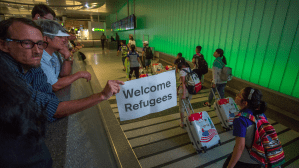
Ross D. Franklin / AP

After President-elect Joe Biden reiterated his pledge to raise the refugee ceiling to 125,000, resettlement agencies are making plans to restore their efforts to “welcome the stranger.”
Under the Trump administration, the refugee ceiling dropped by 80 percent, down to a record low of 15,000, and agencies drastically scaled back operations as they lost out on the funding that accompanies new refugees.

Biden’s remarks come as exciting news to Christians working in refugee resettlement, though the prospect of an influx of refugees to the US poses a challenge to the system after four years of decline.

“We’re encouraged by President-elect Biden’s ambitious commitment to refugee resettlement,” said Scott Arbeiter, president of World Relief, one of nine nongovernmental organizations resettling refugees in the US. “I appreciate the message this commitment sends to the world—that the US is ready to lead once again—and we at World Relief will be working with our church partners to prepare to welcome as many as we can in 2021 and, hopefully, continue to grow that effort in the years that follow.”
After years of growth, the evangelical agency shut down eight of its local offices and laid off over a third of its staff during the Trump administration. Overall, a third of the nation’s resettlement agencies have either stopped resettling refugees or have closed their doors completely over the past four years.

“To be sure, returning to such a high level of resettlement after several years of historic lows will be very challenging, particularly because the national infrastructure for resettlement has been dramatically reduced,” Arbeiter says.

Now, there aren’t as many offices, staff, and volunteers working to process and assist refugees admitted to the US. Even with the reduction in entrants, there’s a backlog of families waiting for their paperwork to make it through the pipeline. Some leaders and advocates think it may take two presidential terms to rebuild the program back to what it was pre-Trump.

“The new administration will have to invest in both the overseas and domestic side of refugee resettlement in order to get anywhere near 125,000,” said Paedia Mixon, CEO of New American Pathways, a resettlement agency in Atlanta. “These investments will take time to produce results.”

The resettlement landscape has lost expertise and networking relationships as offices shut down and leaders and staff moved on to other work.

In less than five years, Jose Vega saw both of its offices in Florida shut down. Vega was the director of the Miami office for two years before it closed in 2017 and then became the director of the Jacksonville office, which closed in 2019. Both times, he had to let go of nearly all of his staff members before having to close the office altogether.

Vega, a Paraguayan immigrant and World Relief’s first Hispanic director, saw suffering on both sides of the refugee resettlement equation.

There’s “a picture of the people you have on your staff and a picture of the people that are over there in the refugee camps who are waiting,” Vega said. “If you put those things together, you find that there are a lot of people being affected and a lot of suffering going on.”

Vega, who now works as a medical chaplain and Baptist pastor, says the church can lead the way in listening to and learning from refugees rather than fueling misconceptions.

Church partnerships

Meeting the rising demand of refugee levels will require greater involvement of the community in order to create more sustainable support systems, leaders say. Because while the government controls the number of refugees admitted, most resettlement agencies also rely on the generosity of private donors and grant opportunities to continue their operations.

World Relief offices have spent years building partnerships with local churches and ministries, and they will be even more reliant on these networks for financial support, tangible resources, and a steady volunteer base until they are able to secure the funding necessary to ramp up to receive and welcome such a large influx of incoming refugees in the long-term.

“Our largest challenge will be rapidly increasing our current capacity, from resettling less than 100 people annually to potentially over 600 within a year or two,” said Susan Sperry, the executive director of World Relief in the Chicagoland region. “We plan to mobilize more staff, volunteers, churches, and community partners to provide the support refugees need as they resettle.”

In other words, it will not only take time to ramp up to the higher levels of refugees; it will also require willing hands and hearts dedicated to helping displaced people make their home in the US. And a big part of that effort will be achieved through advocacy and education in the community of faith.

Two-thirds of white evangelicals believe the US does not have responsibility to accept refugees, according to a 2018 Pew Research survey, but pastors and ministry leaders have mobilized behind the cause, citing both biblical directives and the desire to help Christians fleeing persecution in their home countries.

“I believe if the church prioritizes caring for the vulnerable, and if the church follows this prioritization with resources, this infrastructure can be rebuilt over the next several years,” says Kara Ulmer, the former director of World Relief Akron, which closed last year. “Then we will once again be known as a people who care, who love instead of fear, and who show hospitality to strangers. This is my hope and also the challenge before us.”

John Arnold, who served at the World Relief Atlanta office for over two decades before it closed last year, joined a new local nonprofit called the Welcome Co-Op, which provides logistics support for the remaining resettlement agencies in the area.

This month, its leaders will meet to discuss operations under the incoming Biden administration, making plans to secure further funding, expand the staff, find permanent warehouse space, buy vehicles and equipment, and finally build the website. The Welcome Co-Op is also moving forward with plans to open the first thrift store in Clarkston, the Atlanta suburb that has become a major hub for resettlement.

Despite the many obstacles World Relief and other refugee resettlement organizations will face, they are excited and optimistic about restoring the program and deepening their partnership with believers following God’s call to care for foreigners in need.

“There’s still a good percent of the population who thinks it’s wrong and will probably be critical of Biden,” he said. “But we know that God is for the foreigner and loves the foreigner more than we ever could, and so we’re excited about what that might look like.”

Moreover, Arnold believes that although some would attribute these changes to a different political party or president coming into power, he knows God is sovereign and can make things happen.

“We have to keep looking to him,” Arnold says. “We don’t know what the future holds or what’s going to happen, but there’s definitely a relief and a hope that there’s going to be a different future ahead of us, and that it will be even better than it was before.”

News
Wire Story

Bethlehem’s Inns Are Empty This Christmas

Tourism to the biblical city celebrated as Jesus’ birthplace remains halted with West Bank under lockdown.

Christianity Today December 2, 2020
Majdi Mohammed / AP

The coronavirus has cast a pall over Christmas celebrations in Bethlehem, all but shutting down the biblical town revered as Jesus’ birthplace at the height of the normally cheery holiday season.

Missing are the thousands of international pilgrims who normally descend upon the town. Restaurants, hotels, and souvenir shops are closed. The renowned Christmas tree lighting service will be limited to a small group of authorized people, as will church services on Christmas Eve.

“Bethlehem is dead,” said Maryana al-Arja, owner of the 120-room Angel Hotel on the outskirts of Bethlehem.

The hotel was the site of the West Bank’s first coronavirus outbreak—when a group of Greek tourists came down with the virus last March.

She kept her 25 workers on staff for several months but ultimately couldn’t continue to pay them. Al-Arja, who herself was infected with the virus, said she has been forced to close the hotel and lay off the entire staff because there is no sign of the pandemic ending or tourists visiting anytime soon.

“We had 351 tourist groups booked in our hotel this year, each one 150 people,” she said. “But they all canceled.”

Elyas al-Arja, the head of the city’s hotel association, said Bethlehem received some 3 million tourists in 2019. With Israel, the main entry point for international visitors to the region, banning tourists because of the coronavirus crisis, and the West Bank’s border crossing with Jordan closed to foreigners, that number is close to zero this year, he said.

“Sixty percent of the city relies on tourism, and their income disappeared when the tourists disappeared,” said al-Arja, a cousin of the Angel Hotel owner.

The Ambassador Hotel, which is located near the Church of the Nativity, built on the site where Christians believe Jesus was born, has reopened one floor in hopes that some local visitors may want to come celebrate in the coming weeks.

Mahmoud Tarman, the hotel’s receptionist, said the Ambassador has brought back eight of its 60 workers to serve local guests. But with the West Bank’s economy devastated by repeated lockdowns, it remains unclear how many people will come.

“At this time of the year, this empty hotel would be bustling with life. But as you see, there is no life, not even a Christmas tree yet,” he said as he pointed at the empty lobby.

The Palestinian Authority, which administers parts of the Israeli-occupied West Bank, this week imposed a new nighttime lockdown to help contain a spike in coronavirus cases. People must remain indoors from 7 p.m. until 6 a.m., and Bethlehem is included in the lockdown.

Officials say the lockdown could be extended through Christmas and into the new year if the infection levels don’t come down. The Health Ministry has reported a total of about 65,000 coronavirus cases in the West Bank, and over 620 deaths.

Bethlehem’s mayor, Anton Salman, said the city had planned to receive 3,000 invited guests, including local scout troops and musical bands from around the world that normally entertain visitors during Christmas Eve festivities.

He said the famed Christmas tree lighting, scheduled on Thursday, will be limited to just 15 guests, including local mayors, the district governor and the Latin Patriarch and other clergy. The 85-year-old Palestinian president, Mahmoud Abbas, who usually joins the celebration, has been invited but has not said whether he will attend.

Midnight Mass, a solemn event led by the Latin Patriarch that is usually attended by religious leaders, local VIPs and hundreds of pilgrims from around the world, has also been scaled back, Salman said. He said officials are still working on the guest list, but it is expected to include religious leaders and some foreign diplomats. The event will be closed to the general public but broadcast live for people to watch.

“No one can hold the responsibility of inviting large numbers of people to Christmas events,” he said. “Nothing will be the same during the pandemic.”

Theology

How to Do Advent When Nothing Seems Worth Celebrating

Our Immanuel doesn’t offer us an escape. He comes to suffer with us.

Christianity Today December 1, 2020
Illustration by Rick Szuecs / Source images: H Shaw / Haydn Golden / Rom Matibag / Janine Robinson / Unsplash / Envato

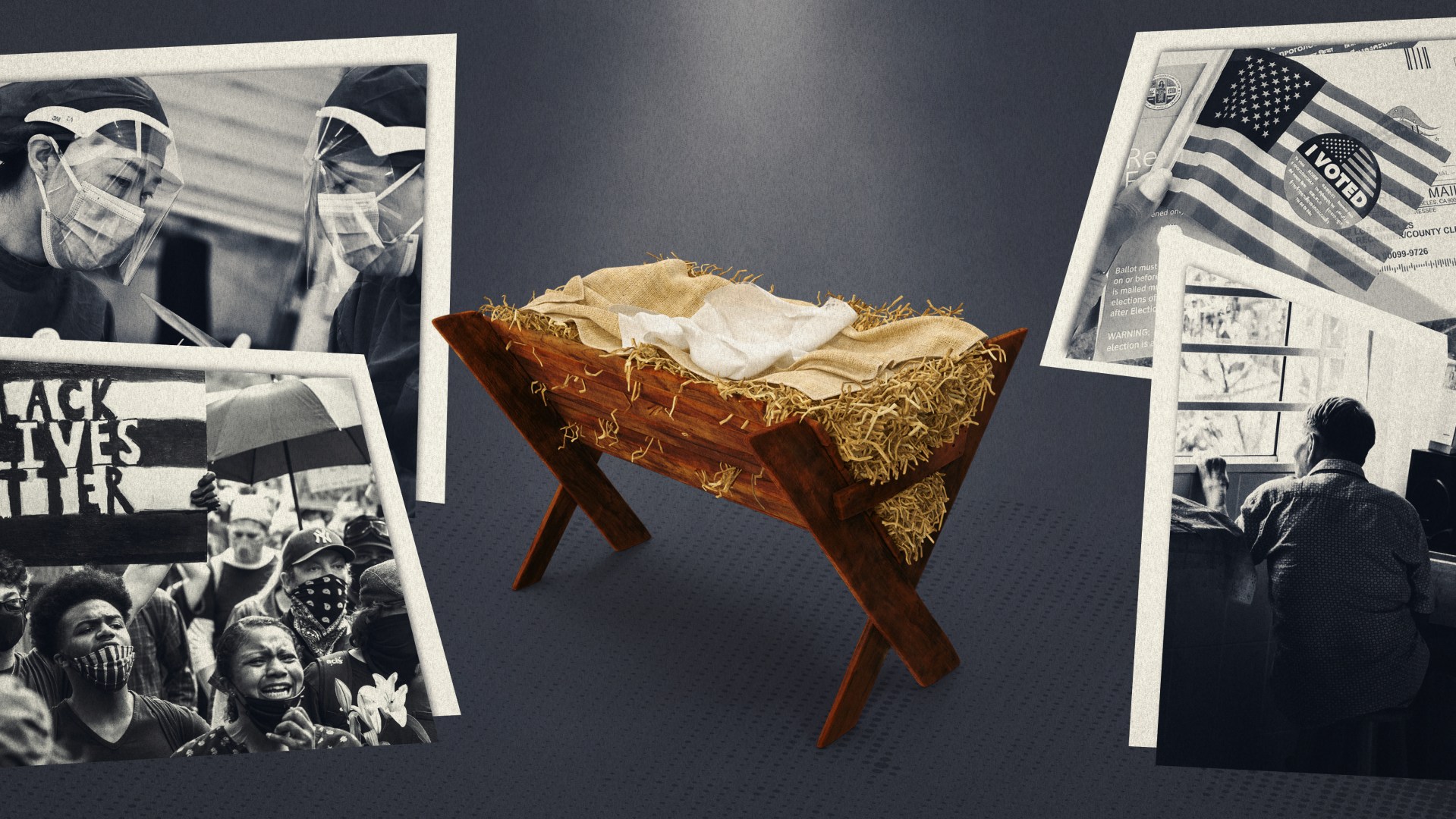
As we approach Christmas this year, we are confronted with an uncomfortable question: Is there really anything worth celebrating?

We’re now in the season of Advent, an annual rhythm meant to slow us down as we prepare to celebrate the birth of Jesus. Desiring an escape from the difficulties of this year, many of us declared several weeks ago that the Christmas season had already begun.

Advent is meant to be a time of hope, joy, love, and peace. These are beautiful virtues, but this year they risk sounding hollow. This time last year, while many Americans were worried about pumpkin pie and Black Friday deals, a deadly virus was silently starting to spread. Most of us knew nothing about it then, but with hundreds of thousands dead in our country alone, we certainly know about it now. Can we speak of hope in such a time?

In our efforts to curb this destruction, we’ve seen other predictable casualties, any one of which would be devastating in a “normal” year. Staggering numbers of people have lost their jobs. Business owners have shut their doors. Schools, in their shift to remote education, not only laid an added weight on struggling parents and teachers, but also restricted one of the most reliable safety nets for vulnerable and impoverished children. Can we speak of joy in such a time?

Perhaps unsurprisingly, all of the strain brought on by the coronavirus was then paired with yet another American summer marked by racial strife. Ahmaud Arbery, then Breonna Taylor, then George Floyd. Innocent black people were killed, and in several cases, video evidence allowed us to witness the horror. Can we speak of peace in such a time?

Protests arose demanding justice and change. In some cities, these protests became violent. Pundits rushed to interpret these events, often pointing fingers at the “bad guys” on the other side. In many of our churches, the broader societal rifts began to manifest as well . These rifts only deepened as we weathered yet another divisive presidential election.

Can we speak of love in such a time?

As we limp along to the close of 2020, a year marked by violence, injustice, division, and death, it is worth asking: What place does a quiet liturgy of Advent have in such a chaotic, turbulent world? I would argue that we need Advent now more than ever.

A Prophetic Promise

Contrary to the Hallmark myth, Christmas is not a season of good vibes and tasty treats (though I’m down for both). The context of Christmas is injustice and death—and it has been from the very beginning. To understand this, we need only remind ourselves of the circumstances surrounding the birth of Jesus.

At the time of Jesus’ birth, God’s people, Israel, had been in exile for 400 years. God had warned them, time and time again, that if they failed to listen to him, they would lose everything. But they would not listen. So God sent nearby nations—first Assyria, then Babylon—to act as his instruments of judgment.

The prophetic depictions of this time are nearly too graphic to imagine. We read of an entire people, God’s people, either killed or enslaved hundreds of miles from their homes. Of women being raped by the conquering armies (Lam. 5:11). Of parents so desperate for food that they eat their own children (Lam. 2:20). Of Israel’s last king forced to watch his sons slaughtered in front of him, only then to have his eyes gouged out—so the last image to remain, forever, would be that of his dead family (Jer. 52:10–11).

And then, after this gruesome conquest, came the long, lonely period of exile. God seemed silent. God’s people, surrounded by injustice and death, could only suffer and cry out in lament.

As we open the pages of the New Testament, the story begins to change. God’s silence has ended. No prophet or angel had spoken for centuries. But suddenly angels begin to appear, bringing a promise: God’s King is coming, and Israel’s long, lonely exile is coming to an end.

Isaiah captured the unlikely hope of this period with his prophetic promise, “The people walking in darkness have seen a great light; on those living in the land of deep darkness a light has dawned” (Is. 9:2). For those who for generations have existed in darkness, the promise of light might seem too good to be true. Would God’s people dare to hope again, after their hopes had been dashed so often before?

I confess, had I been a Jew in the first century, I would have found hope foreign, almost offensive.

And yet, the Gospels record many of God’s people responding in hope. Mary responds with confidence in God’s plan (Luke 1:46–55). Anna and Simeon rejoice at the sight of the newborn Jesus (Luke 2:25–38). These women and men hint that with Christ’s arrival, darkness really might give way to light. But this thrill of hope is tremulous and fragile. Jesus’ birth moves Herod to jealous anger, and he responds with horrifically familiar violence, murdering Jewish children in an attempt to kill Jesus (Matt. 2:16).

The injustices of the Exile, Matthew recognizes, have not disappeared:

A voice was heard in Ramah,

weeping and loud lamentation,

Rachel weeping for her children;

she refused to be comforted, because they are no more. (Matt. 2:18 ESV; Jer. 31:15)

To many readers, ancient as well as modern, this may seem like a failure. Certainly God’s first act to overturn this long period of injustice would be a decisive act of justice and victory? Instead, we see the weak and vulnerable put to the sword. We hear Rachel weeping, again, even as the Son of God comes to earth. Had something gone wrong?

You Do Not Weep Alone

The Christmas story is dark, but what prevents us from reading this story in despair is a name: “Immanuel.” First mentioned by the prophet Isaiah, “Immanuel” means “God with us” (Matt. 1:23; 7:14). Jesus’ birth delivers far more than Israel expected. They expected a king who would take them back to their homeland. And God sent that. But God sent much more: He sent himself.

Christmas commemorates the moment when God entered into our story in flesh and blood. He entered in the middle of the story, in the midst of injustice and death. This is good news for us, especially when we’re living a story of injustice and death, too.

Advent isn’t about an escape from the darkness of the world into a false bastion of tranquility. Advent is a discipline that trains us to experience longing, just as the Jews did before Jesus’ birth. Without this sense of real longing, Christmas offers no sense of real hope. And if we already sense longing for healing and lament over injustice, we are that much closer to the spirit of Advent than we first thought.

One day, God will end all injustice and death. But Christmas reminds us that God’s first step in ending injustice and death was to submit himself to injustice and death.

Many of us enter Advent this year crying out, “How long, O Lord?” We can be comforted knowing that we do not cry alone.

We cry with Rachel, for her children. We cry with Tamika Palmer, weeping for her daughter Breonna Taylor. We cry with Wanda Jones, weeping for her son Ahmaud Arbery. We cry with the hundreds of thousands of people whose loved ones have been taken by a plague.

And we cry with Jesus himself, who enters our suffering. He entered it then—poor in birth, persecuted in life, scorned in death. He enters it with us today as Immanuel, “God with us.”

So even as we weep, we do so with a thrill of hope. Hope does not stop our tears; hope gives them meaning. Hope does not remove our longing; in Christ, hope redirects it. That which we long for—justice, wholeness, healing—has a name. His name is Jesus, and he is near to the brokenhearted.

Chris Pappalardo is editor at The Summit Church in Raleigh-Durham, North Carolina. He is the co-author of One Nation Under God: A Christian Hope for American Politics and the author of a Christmas curriculum called Advent Blocks.

News

How to Fake a Fragment of the Dead Sea Scrolls

And other things you wanted to ask an expert in forged biblical antiquities.

Christianity Today November 30, 2020
Image courtesy of Colette Loll / Art Fraud Insights

The recent discovery of forged fragments of the Dead Sea Scrolls at the Museum of the Bible has called attention to the problem of faked antiquities. Evangelical collectors are thinking twice about spending money on rare bits of Bible history, fearing they could be expensive frauds, as Gordon Govier reports in the December issue of CT. But the problem is deeper than that, says George Washington University professor Christopher Rollston, an expert on ancient biblical inscriptions and the author of a forthcoming book on modern-day frauds. Forgeries corrupt what we think we know about the world of the Bible and create serious challenges for scholars trying to learn about the cultures that produced Moses, David, the prophets, and Christ’s first followers. Rollston thinks scholars have to be much more suspicious of forgeries and evangelicals should stop buying from the antiquities market.

How hard is it to forge a fragment of the Dead Sea Scrolls?

Forgers today have really become quite good. It’s not something that just anybody can do. And when just anybody attempts it, it’s painfully obvious that it’s a modern forgery and a particularly bad one.

Basically what is required is a good knowledge of the ancient language, whether that’s Hebrew, Aramaic, Greek, Latin, or Coptic; a very good knowledge of the script; and a really good knowledge of the medium as well. A forger has to know how a piece was produced, like the chemical composition of the ink and other technical aspects. But if someone knows the language quite well and knows the script and has access to a scanning electron microscope with extended depth-of-field determinations of the chemical composition of the patina and the inks, it’s not all that difficult.

Many forgers will presuppose they know more than they do about the script. I spend my life looking at script under the microscope, letter by letter. So not only do I know the angles of the strokes, I know how many strokes, the direction of the strokes, the order in which the strokes are made. Forgers will often assume they know the language so they know how the letters are made, and they really don’t.

Are most forgers in the field in some way, whether they’ve worked on excavations or have some graduate school experience?

The forgeries that we’ve seen produced in the last 40 years—the good forgeries—are definitely by people with training in the field. Forgers are people who have gone through or washed out of graduate programs. Or they’re just venal scholars—greedy scholars with no scruples. I think that’s what we have with the Dead Sea Scroll forgeries at the Museum of the Bible. These are sophisticated forgeries, and I think they’re from a senior scholar with a lot of experience.

The world of forgeries has really changed in the last 40 years. In the late 1960s a forgery appeared, for example, that we know as the Hebron Philistine documents. One scholar believed these were actually ancient pieces. Someone else said, no, this is basically a knockoff of the famous and good and ancient inscription known as the Siloam tunnel inscription.

Then about a decade later, Joseph Naveh, of the Hebrew University of Jerusalem, took a close look and said, “Look, it’s the Siloam tunnel inscription written backwards.”

I think the forger intended it basically as a joke. Even in the late 1960s and the early 1970s, forgeries were not too hard to detect. But by the mid-1970s, things had really changed, and the quality of forgeries started getting quite good.

How has the market for forgeries changed over the years?

There’s an ebb and flow, but there have always been collectors—people within Judaism and Christianity who have a deep interest in faith, the history of faith, and faith heritage—who have driven the market. Tourists to the Holy Land too. That’s driven the market for a couple hundred years.

When people are willing to pay a great deal of money, that’s the demand, and the supply ratchets up. You have more people who are willing to produce forgeries.

Inscriptions garner so much money that the motives are very strong. When you see fragments go for $125,000 each, that’s a lot of money. The ivory pomegranate was purchased by the Israel Museum for $550,000 in the ’80s. I’m told the Jehoash inscription was offered to the museum for $2 million. Venality is a big part of the equation.

The antiquities market tempts forgers, but does it also help scholars by creating an incentive for the recovery and preservation of antiquities?

There are people who make that case, but there are two problems with the market. The first is there are forgeries. The second is there are genuine antiquities that were pillaged. Whenever an inscription is pillaged from the ground, a great deal is lost.

When an inscription is excavated, we know the site from which it comes, we know the place on the site, we know the room on the building from which it comes, we know the other types of objects found in that building. We have carbon dates for some of those objects. We can draw enormous conclusions—verifiable, empirical conclusions—because we have all of that associated data. We know the context.

When something is pillaged and appears on the market, even if it’s genuine, that represents legions of information that has been lost and can never be recovered.

Do forgeries just hurt the collectors who pay lots of money for fakes, or do they also hurt biblical scholarship?

The damage that forgeries do can be enormous. It corrupts the data set we use to understand life in the biblical world.

You have people citing these forged modern inscriptions in attempts to say something about the ancient world of the Bible, the ancient languages, and the cultures of antiquity. And all this stuff—it’s not real, because it’s a forgery. But that information gets into books. It gets into articles. And once it gets that far, it’s hard to eradicate.

Forgeries dupe some very fine scholars at times. One forged inscription refers to a widow, and there have been many articles that reference that inscription, drawing conclusions about the status of women and what we can know about Judean culture on the basis of that inscription. But it’s a forgery. It’s not real data about antiquity.

When a piece from the market surfaces and it’s a probable or a certain modern forgery, based on my analysis, I debunk it rapidly. I try to get out there in a day or two at most. You have to immediately say, “This thing has some problems.” That way, people don’t publish on it, become invested in it, and commit to it, even though it might be a lost cause.

What can be done to stop the production of new forgeries?

There are laws that can be passed, cultural heritage laws. The problem is you have a law, as is the case in Israel, with various sorts of caveats and provisos, but basically, if a piece has been in a collection prior to the 1970s, then it can be sold. And that’s how the Dead Sea Scrolls forgeries were able to be purchased. They were purportedly part of the Kando family collection, and there was always lore about fragments that had been in the Kando family since they were involved in the original discovery of the Dead Sea Scrolls. So the fragments had this pedigree, and the law said they could be sold, and that’s the way these purchases were able to occur.

The very fact that they were able to occur shows you the vulnerable underbelly of the law. You can fake a pedigree. And that’s precisely what happened with these forgeries.

As far as scholarship is concerned, I have argued that when something comes from the market, we need to flag it immediately and we need to leave that flag there forever. The presupposition shouldn’t be that you have to prove inauthenticity. We need to presuppose it’s bad, flag it, and put a mark that says there’s unknown provenance so it signals to the reader forever that this is from the antiquities market. Scholars can argue that it’s authentic or probably authentic or possibly authentic.

The most important thing for scholars is just to be aware that there are some very good forgeries out there right now. The financial incentives are there for modern forgers to put the time and the work in to produce a really good forgery.

Apple PodcastsDown ArrowDown ArrowDown Arrowarrow_left_altLeft ArrowLeft ArrowRight ArrowRight ArrowRight Arrowarrow_up_altUp ArrowUp ArrowAvailable at Amazoncaret-downCloseCloseEmailEmailExpandExpandExternalExternalFacebookfacebook-squareGiftGiftGooglegoogleGoogle KeephamburgerInstagraminstagram-squareLinkLinklinkedin-squareListenListenListenChristianity TodayCT Creative Studio Logologo_orgMegaphoneMenuMenupausePinterestPlayPlayPocketPodcastRSSRSSSaveSaveSaveSearchSearchsearchSpotifyStitcherTelegramTable of ContentsTable of Contentstwitter-squareWhatsAppXYouTubeYouTube