Church Life

Researcher: Most Evangelicals Support Women in Church Leadership

Despite the ongoing debates over gender roles, surveys show significant agreement in favor of female Sunday school teachers, worship leaders, speakers, and preachers.

Christianity Today June 30, 2020
Pearl / Lightstock

In evangelical discourse, there are several issues that you can count on to stir up a heated debate. One is the role of women in the life of the church.

Take last year’s spat over Beth Moore speaking at a church on Mother’s Day, which came up again months later with John MacArthur’s viral “go home” line. Or the more recent discussion around author Aimee Byrd and Reformed complementarians’ pushback on social media.

Yet for all the debates around gender and leadership roles, for years researchers have found less of a divide on the topic among the people in the pews. The results of a recent survey once again indicate that most evangelical Protestants are in favor of seeing women take on more prominent positions in the church.

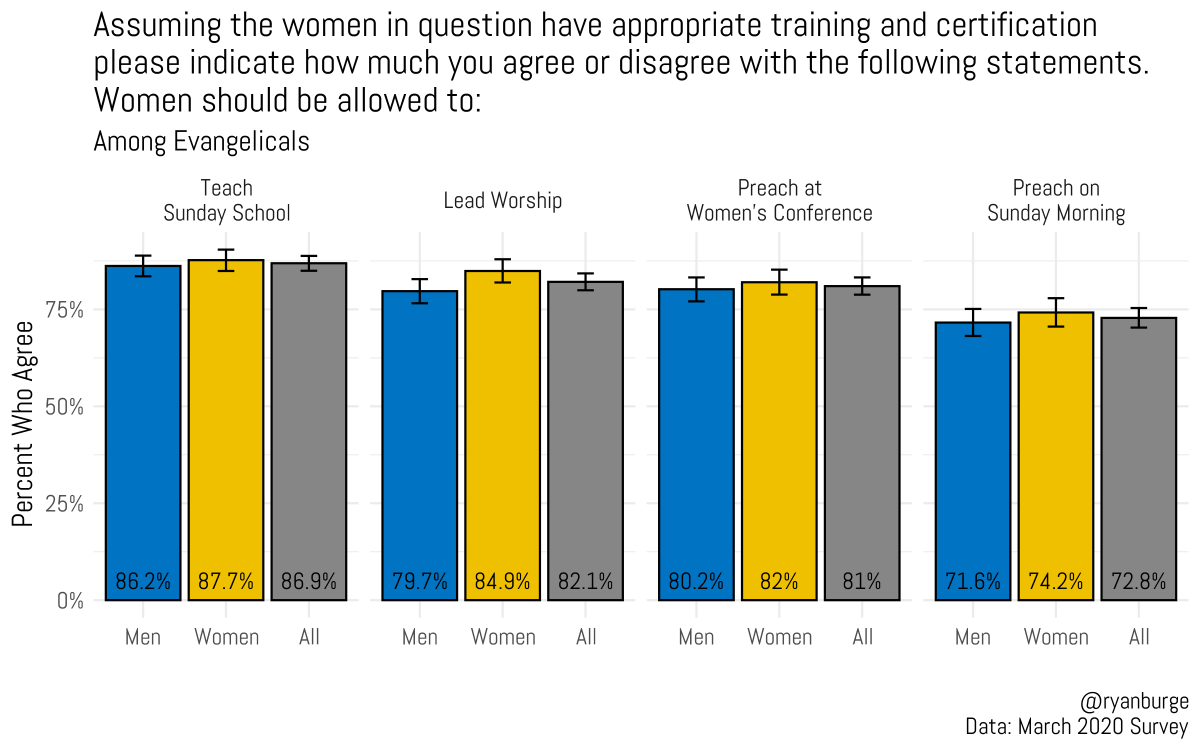
In a survey I fielded along with political scientists Paul Djupe and Hannah Smothers back in March, 8 in 10 self-identified evangelicals said they agree with women teaching Sunday school, leading worship at church services, and preaching during women’s conferences or retreats.

Slightly fewer endorsed women preaching during church services, but 7 in 10 were in favor, according to the research, conducted by a team of political scientists in March 2020.
This new research follows an analysis of 2011 survey data I published last year, which showed that significant majorities of major Christian traditions—including Southern Baptists—would support women as pastors.

Some commentators pushed back saying both that the 2011 data was dated and that the questions weren’t explicit enough about the types of roles for women in the church. The March 2020 survey was designed to allow respondents to indicate what kinds of leadership roles they are comfortable with women taking on.

A strong majority of evangelicals, men and women alike, supported women’s involvement in each of the roles queried, though women were slightly more in favor of each.

The most universally supported role was having women teach Sunday school, with 86.9 percent in favor. The debate over whether women can lead over mixed-gender Sunday school classes has gone on for years in certain evangelical traditions, including Baptist and Presbyterian denominations. It comes up on sites like 9Marks, Reformation21, and Desiring God, often hinging on whether the Sunday school setting is analogous to a church service or not.

Women preaching on Sunday morning got the least support, with 72.8 percent. Even some churches that do not permit women to serve as lead pastors and elders at times allow women to share on Sundays as guest speakers or preachers—making a distinction to between the “special teaching” they believe to be restricted to qualified male leaders and the “general teaching,” which can be presented by any church member, male or female.
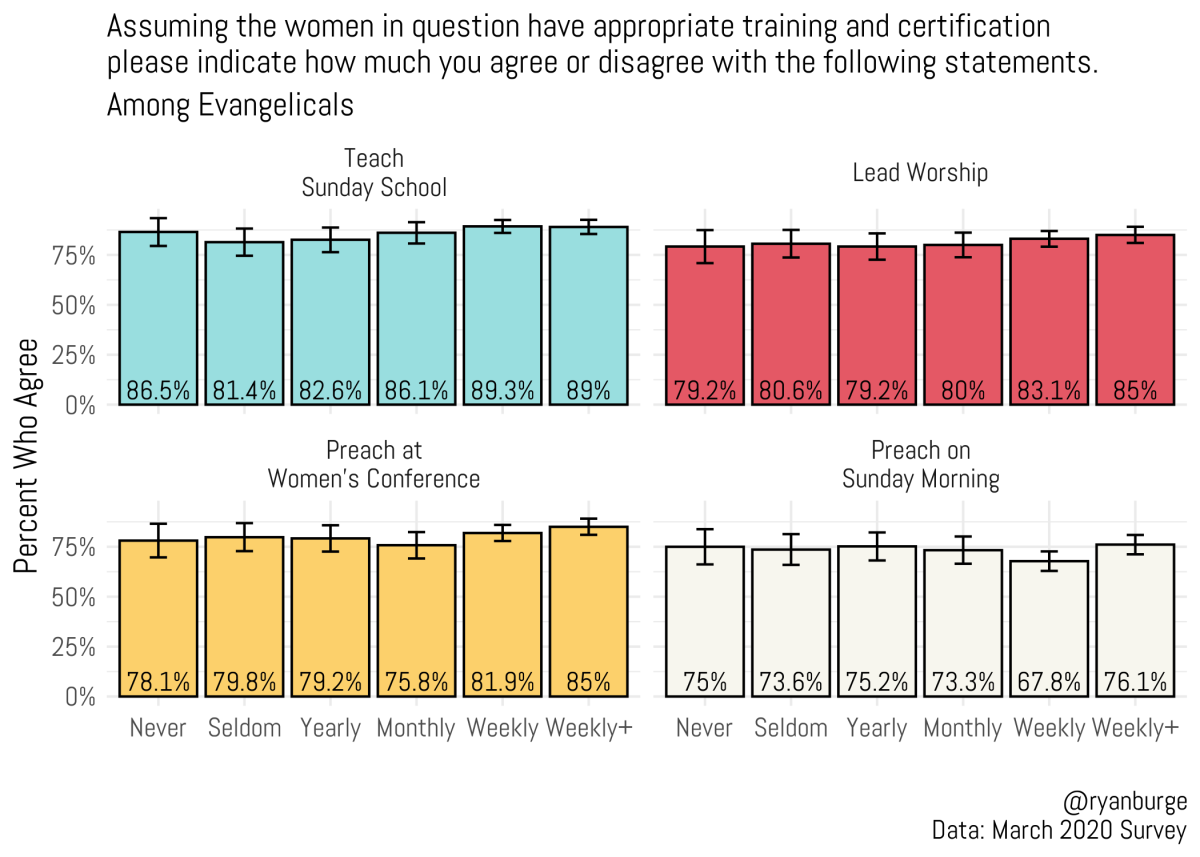
What is also surprising is how little this support for women in leadership is impacted by church attendance. A natural assumption is that more frequent attendance at an evangelical church that only permits male pastors is a sign of support for the doctrine of that faith tradition, but that’s not the case. In fact, in each of the four scenarios that were offered in the survey there was no statistical difference in support for women leaders between evangelicals who never attend services and those who indicate that they go to church multiple times a week. Three quarters of the most devout evangelicals believe that women should have a place behind the pulpit.

This finding continues to persist even when theology is taken into account. When the sample is restricted to just those who believe that the Bible is literally true, three-quarters of those who attend services multiple times a week agree with women preaching during weekend services.
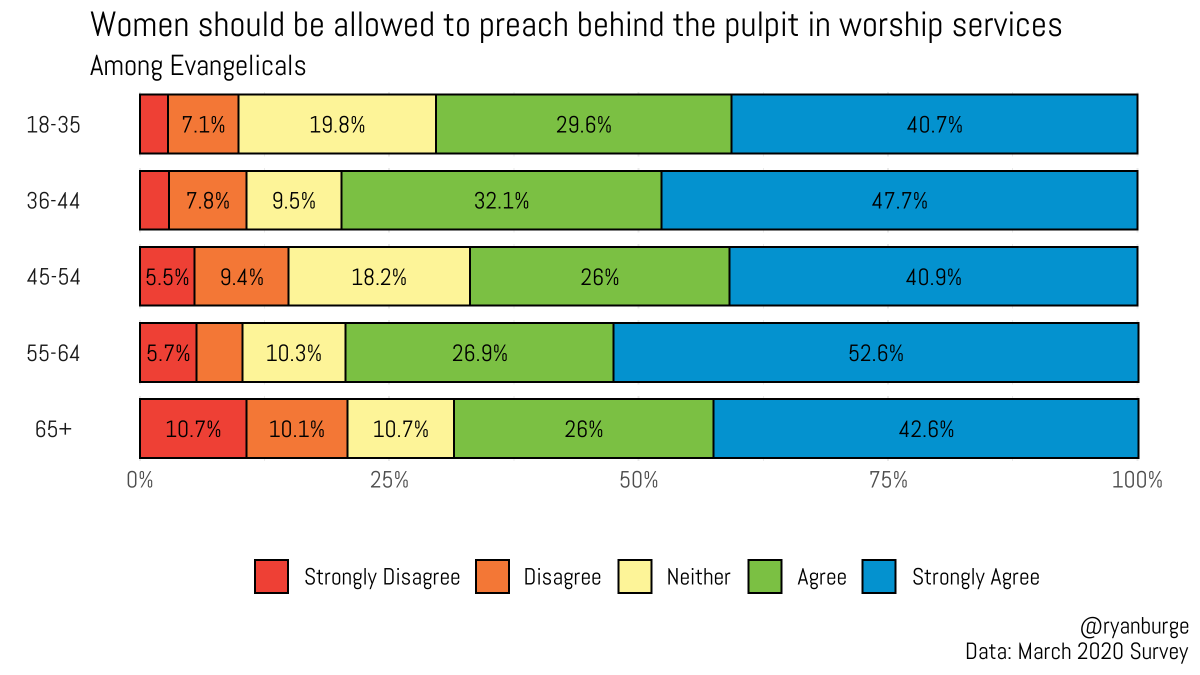
However, there is an interesting pattern when age is considered. There is not a clear relationship between older evangelicals and resistance to women preaching. For instance, while 20 percent of evangelicals who are 65 or older disagree with women preaching, that drops to just 10 percent among those between the ages of 55 and 64. Another notable result is that the youngest evangelicals (those between 18 and 35) are just as likely to oppose women preaching as those in the oldest age group.
State of Pastors report / Barna Research

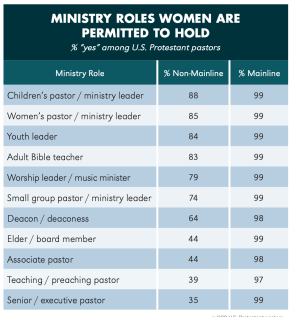
There has been evidence that support for women in leadership roles has led to some evangelical churches hiring female pastors. Barna Research found that the share of pastors that are women was 9 percent in 2017, up significantly from 3 percent in 1992. But, clearly the vast majority of evangelicals would be comfortable with this number increasing more rapidly.

The findings here are not out of step with results from the Faith Matters Survey from 2011 that found that 65 percent of Southern Baptists are supportive of women being allowed to serve as clergy. And a Barna survey of pastors found significant support among non-mainline traditions. Two-thirds of non-mainline pastors were in favor of women being deacons and nearly 40 percent supported women preaching.

Taken together, these results indicate that evangelical support for women preaching and leading is robust across gender, church attendance, theological position, and age.

Ryan P. Burge is an instructor of political science at Eastern Illinois University. His research appears on the site Religion in Public, and he tweets at @ryanburge.
News

Supreme Court Dismisses State Ban on Public Funding for Religious Schools

Update: Could a Montana school choice case be the end of Blaine amendments?

Jeri Anderson and Kendra Espinoza are parents of students at Stillwater Christian School in Montana.

Jeri Anderson and Kendra Espinoza are parents of students at Stillwater Christian School in Montana.

Christianity Today June 30, 2020
Casey Kreider / The Daily Inter Lake via AP

Update (June 30): Montana violated the First Amendment when it barred religious schools from a state scholarship program, the US Supreme Court ruled Tuesday, in a case school choice advocates hope will open the door for more education voucher programs.

The state’s “no aid provision,” categorically banning any type of aid to religious schools, represents an overly sweeping effort at church-state separation that results in religious discrimination against religious schools and adherents, wrote Chief Justice John Roberts in the 5–4 Espinoza vs. Montana Department of Revenue decision.

“The prohibition before us today burdens not only religious schools but also the families whose children attend or hope to attend them,” the opinion read. “They are ‘member[s] of the community too,’ and their exclusion from the scholarship program here is ‘odious to our Constitution’ and ‘cannot stand.’”

Roberts said that states do not need to subsidize private education, but if they do, they cannot disqualify some private schools just for being religious.

“For many families, Espinoza not only provides the potential for expanded opportunities for them to educate their children, including the choice of religious education, but also the right to decide what they believe is the most effective way to do so,” said Jeanne Allen, the founder of the Center for Education Reform.

—–

When a Montana tax credit program for private school scholarships was accused of being discriminatory because religious schools were not eligible, the state eliminated the program outright rather than fight the case.

But now, the state has ended up at the US Supreme Court anyway, with a legal dispute centering around whether the legal basis Montana (and dozens of other states) uses to bar public funding of religious education is constitutional.

The justices will hear arguments Wednesday in Espinoza vs. Montana Department of Revenue, a case over a scholarship program for private K-12 education that makes donors eligible for up to $150 in state tax credits. Advocates on both sides say the outcome could be momentous because it could lead to efforts in other states to funnel taxpayer money to religious schools.

Montana is among 37 states that have provisions in their state constitutions that prohibit religious schools from receiving state aid, also known as Blaine amendments.

Legal advocates and Christian schools opposed to the restrictions say they discriminate against religious families by blocking them from government benefits available to others, or by favoring secular education. They also note that such prohibitions were historically designed to not to keep the government from endorsing religion—since a Protestant ethos was generally part of public education—but to deny support to Catholic (“sectarian”) schools in particular.

Like many religious freedom cases, this one floats the balance between the establishment clause—the government cannot support a particular faith over others—and the free exercise clause—it cannot prohibit citizens from exercising their religious beliefs.

In a brief to the Supreme Court, the Montana Department of Revenue argued, “Different states, with different legislatures and different constitutions, will arrive at different policies,” which “is something to celebrate, not quash.”

Diana Verm, senior counsel with Becket Fund for Religious Liberty, which filed a friend-of-the-court brief in support of the plaintiffs, challenged whether Montana had gone too far with its “no aid” provision.

“It’s true you do want space for states to address things in their own way, but the free exercise clause is always the limit in this case,” she said in an interview with CT. “Does the free exercise clause allow a state to end a program because parents who receive funding from that program would use it at a religious school?”

The US Justice Department wrote that Montana’s stance “penalizes parents who choose a religion rather than a secular school for their children.” Jameson Coppola, legal director for the American Association of Christian Schools, similarly told CT “the unjust prohibitions in the Blaine amendments … restrict religious people from educating their children in ways that others in society are able to.”

Others fear that school choice programs, vouchers, individual tax credits or deductions and education savings accounts, ultimately siphon public money away from public schools and weaken the education system.

The Montana Tax Credit Scholarship Program was created in 2015 to allow Montanans a tax credit of up to $150 for individual and business contributions to a privately run scholarship program for private school tuition. Though most private schools in Montana are religiously affiliated, the Montana Department of Revenue issued a rule that barred families from using the scholarships at religious schools, citing the state’s Blaine Amendment, and the Montana Supreme Court ultimately struck down the tax credit as a violation of Blaine.

Kendra Espinoza of Kalispell, Montana, the lead plaintiff in the Supreme Court case, said the state court decision amounts to discrimination against her religious freedom. “They did away with the entire program so that no one could use this money to send their kids to a religious school,” Espinoza told the Associated Press. Her two daughters attend the Stillwater Christian School in Kalispell, near Glacier National Park. Espinoza said she could not afford to keep her daughters enrolled without financial aid from the school, where tuition this year is $7,735 for elementary and middle school and $8,620 for high school.

The state hoped the wholesale invalidation of the program would shield it from Supreme Court review. In urging the Supreme Court to reject the case, Montana said it can’t be compelled to offer a scholarship program for private education. The state told the justices that the Montana court decision did not single out students at religious schools because the state court ruling struck down the entire program.

In addition to support from Christian advocates and the Trump administration (whose Secretary of Education Betsy DeVos is known for her favorable stance on school choice), the Jewish Coalition for Religious Liberty filed a friend-of-the-court brief discussing the important of Jewish day schools in Jewish education.

Coppola, with the Christian schools association, points to the recent Supreme Court decisions regarding the Bladensburg Peace Cross and the Trinity Lutheran playground as evidence that this court sees a difference between establishing a religion and impeding the free exercise of religion. (In the Bladensburg case, the Supreme Court ruled 7-2 in favor of allowing a memorial cross to remain on a state-owned median in Bladensburg, Maryland, and declared that government efforts to maintain the landmark do not violate the religion clause of the Constitution. In Trinity Lutheran Church v. Comer the Court voted 7-2 in favor of a conservative Lutheran congregation seeking a state grant for improving its playground.)

If the Supreme Court rules in favor of Montana, Verm said it will be a missed opportunity to provide states with guidance on Blaine amendments. “If it doesn’t take this opportunity, we’ll see a lot more litigation and as we wait for guidance on when states can exclude religious groups from their programs.”

News

Will International Religious Freedom Survive the Trump Administration?

The president’s executive order elevates its priority in US foreign policy. Nine experts assess the strategy’s longevity.

Christianity Today June 30, 2020
Evan Vucci / AP Images

On June 2, as protests over the death of George Floyd raged across the United States, President Donald Trump elevated the stature of religious freedom within the State Department.

“Religious freedom for all people worldwide is a foreign policy priority,” read the executive order (EO) he signed, “and the United States will respect and vigorously promote this freedom.”

It received almost no media attention.

The provisions—long called for by many advocates of international religious freedom (IRF)—could overhaul a US foreign policy that has historically sidelined support for America’s “first freedom.”

That is, if the order survives a potential Joe Biden administration.

It is common for a new president to reverse EOs issued by their predecessor. In his eight years in office, President Obama issued 30 to amend or rescind Bush-era policies. In his first year in office, Trump issued 17 directed at Obama-era policies.

While IRF has typically enjoyed bipartisan support, current political polarization leaves few sacred cows.

Trump signed the EO after a visit to the Pope John Paul II National Shrine in Washington, DC. It was previously scheduled to coincide with the anniversary of the Polish-born pope’s 1979 return to his home nation, which set off a political and spiritual revolution that defied the Soviet Union and eventually ended the Cold War.

However, Washington’s Catholic archbishop called it “baffling and reprehensible” the facility would allow itself to be manipulated one day after Trump lifted a Bible in front of St. John’s Anglican Church across from the White House in the wake of the aggressive dispersal of protesters opposing police brutality and racial injustice.

The president’s gesture risked corroborating critics who argue that Trump’s religious freedom policies are a nod only to evangelical Christians concerned for fellow believers.

But while the Bible photo op divided evangelicals, should Trump’s IRF credentials definitively tilt the scale come elections in November?

“President Trump’s executive order will make the commitment to international religious freedom more robust,” said former congressman Frank Wolf, arguing the Trump administration has been markedly stronger on the issue than those of either party.

“If you care about religious freedom, this is an issue to vote on.”

Wolf, a Republican from Virginia who retired from the House in 2015 after 34 years of service, was a forceful advocate for the 1998 International Religious Freedom Act (IRFA). The bill, passed 98–0 by the Senate, provided for an ambassador-at-large position, responsible for producing an annual State Department Report on International Religious Freedom, and designating violators as “Countries of Particular Concern.”

It also created the independent and bipartisan US Commission on International Religious Freedom (USCIRF), to advise on foreign policy.

A third provision, for a special advisor on IRF to serve at the National Security Council, went unheeded until February this past year, when Trump appointed Sarah Makin to the position.

A 2016 amendment to IRFA, named in honor of Wolf, re-clarified that the ambassador-at-large must report directly to the secretary of state. Some did not respect this arrangement, following presidential delays even to fill the position. George W. Bush presented his candidate 16 months after assuming office; Barack Obama waited 28 months.

By contrast, Trump nominated current ambassador Sam Brownback, previously the Republican governor of Kansas, only six months into his term.

“The US government has slow-walked international religious freedom,” said Paul Marshall, professor of religious freedom at Baylor University’s Institute for Studies of Religion.

“It is a difficult and sensitive issue, raises tensions with other countries, and tends to get siloed within the State Department.”

Wolf stated that under Secretary of State Hillary Clinton, the department resisted declaring Nigeria’s Boko Haram a terrorist organization. It viewed this issue through an economic lens only.

Under current Secretary of State Mike Pompeo, however, Nigeria was listed for the first time as a Special Watch List nation.

Trump’s EO authorizes a minimum of $50 million for programs to advance IRF through the prevention of attacks on religious minority communities as well as the preservation of pluralistic cultural heritage.

It also stipulates there must be no discrimination against faith-based entities in funding awarded through the State Department’s US Agency for International Development (USAID).

Vice President Mike Pence’s 2017 pledge to directly assist beleaguered Christian communities in Iraq serves as a case-in-point why Trump’s EO will be helpful. Eight months later, no funds had been distributed.

“Many State Department officials have a religion deficit in knowing how to engage,” said Chris Seiple, who serves as a senior advisor for the Center for Faith Opportunities and Initiatives at USAID.

“They don’t have the skill set, and fear it could risk their career if they violate the religious establishment clause [of the First Amendment], so they back off.”

USAID likes to give big grants to large organizations with a proven track record, Seiple said, but this runs against current wisdom in development circles, which emphasizes local actors. And around the world, these are often people of faith.

Seiple, also president emeritus of the Institute for Global Engagement, said better development comes when communities work together across religious divides in a respectful, robust pluralism.

A new analysis of a 2018 survey by the Pew Research Center, released this month, found a 15-point increase in the favorability rating by Hindus toward Muslims in India, from 56 percent to 71 percent, if they reported frequent interaction together.

In the Philippines, Christian favorability towards Muslims increased from 50 percent to 61 percent. And in Lebanon, already favorable Sunni Muslim attitudes towards Christians improved from 81 percent to 87 percent.

“Harness self-interest,” said Seiple. “If there is a serious religious divide and yet officials bring peace and development, they will get a good job evaluation.”

Wolf wants to see this same attitude at the State Department. For years, he said, he pushed for greater IRF training and the creation of a career track.

The 2016 IRFA amendment made such training mandatory for all foreign service officers (which today number about 8,000) before deployment overseas. But it took time to develop the resources.

An Obama administration fact sheet on its efforts to promote and protect IRF stated it “dramatically increased” such training, to reach 330 diplomats and embassy staff.

In 2019, Trump’s administration developed and launched an IRF distance learning course, also made available as an elective (described in Appendix E of this year’s IRF report).

According to the State Department, since the Wolf Act’s implementation, more than 10,000 employees have completed IRF training.

Trump’s EO expanded the training to include an additional 2,000 State Department civil service personnel.

It also added a deadline.

Within 90 days of the order, all heads of agencies assigning overseas personnel must detail their plans to ensure IRF training is conducted before departure, as well as in three-year cycles.

“This executive order could massively expand the number of people taking training on international religious freedom,” said Judd Birdsall, director of the religion program at Cambridge University’s Centre for Geopolitics.

Birdsall, a former diplomat in the State Department’s Office of International Religious Freedom, worked under both Secretaries Condoleezza Rice and Clinton. In 2011, he helped to design the department’s first training course on religion and foreign policy.

Birdsall said that several Obama officials were initially “highly skeptical” of his office, viewing it as an “evangelical outpost.” This was unfair, he said, because the diverse staff promotes the rights of people of all beliefs.

Even so, the timing of Trump’s EO will reinforce the perception.

“This is a plank-in-your-own-eye moment for America,” Birdsall said. “Its release amid the unrest made the executive order look like a diversionary tactic.”

Kent Hill, senior fellow for Eurasia, Middle East, and Islam at the Religious Freedom Institute (RFI), believes similarly.

Though “tragic” in its timing, the EO “embraces universal values and ought to enjoy tremendous bipartisan support,” he said.

“It is imperative that Americans disentangle their feelings about this administration—pro or con—and recognize [the order’s] exceptional importance.”

His colleague Jeremy Barker, director of the Middle East Action Team at RFI, centered the importance on a second EO-stipulated deadline.

Within 180 days of the order, the Secretary of State must develop a plan, in consultation with USAID, to prioritize IRF in US foreign policy. The secretary will furthermore direct US embassies to write “comprehensive action plans” on how it will encourage local governments to eliminate religious freedom violations.

The deadline will expire in December, one month after the 2020 presidential election. Might foreign service bureaucrats drag their feet until they know the outcome?

Barker thought it would be unlikely for Biden—one of the 98 senators to endorse IRFA—to rescind Trump’s EO, given the issue’s long history of bipartisan support.

After all, IRFA was signed by President Bill Clinton, he noted; the 2016 amendment, by Obama. And Nancy Pelosi lent her aid to Trump’s second Ministerial to Advance Religious Freedom.

But scholar Elizabeth Prodromou, appointed by Pelosi as a commissioner on USCIRF from 2004–2012, thought it possible, “even likely,” that State Department officials might take a wait-and-see approach—not for political reasons, but simply because there is too much institutional inertia.

The government treats IRF as important, she said, but not always as a priority.

But a Biden administration, Prodromou anticipates, would not abrogate the EO, as she believes the presidential candidate appreciates the linkages between religious freedom and national and human security.

Having served as a member of the State Department’s Religion and Foreign Policy Working Group under Secretaries Clinton and John Kerry, she pushed back against the idea that Trump has been better on IRF than other presidents.

Across administrations, Prodromou said, there has been a growing realization that national security must incorporate a commitment to civil and political liberties—inclusive of religious freedom.

In recognition, the Obama fact sheet stated his administration allotted more personnel, resources, and funding to IRF than any president since IRFA was established.

In 2013, Obama created the Office of Religion and Global Affairs (RGA) in order to include an international religious perspective not only on traditional “security” concerns, but also on development, gender rights, and climate change. He additionally created a special envoy to represent the US at the Organization of Islamic Cooperation.

Trump’s first Secretary of State, Rex Tillerson, eliminated the position, and controversially condensed the RGA office into the IRF office.

But while Prodromou praises the EO and Trump’s IRF promotion in general, the problem lies in the conflation of message and messenger.

“This executive through his language disrespects human dignity, and unfortunately the perception of confessional bias undermines his impact,” she said, mentioning issues of immigration and the rhetoric employed against ethnic minorities.

“Paradoxically, the President’s statements weaken the possibility and great potential for these [IRF] measures to have lasting positive outcomes.”

Birdsall suspected that a Biden administration would look much like Obama’s inclusion of IRF within a broad human rights agenda. Operating from England, he said much of Europe is suspicious of Trump’s approach.

Birdsall highlighted one of Trump’s signature accomplishments—the creation of an International Religious Freedom Alliance launched with 27 nations. It includes Hungary and Poland, two nations cited for violations in the annual State Department report and whose reputation in Europe is souring.

But while Trump’s EO was praised by Christian leaders in Syria, Iraq, and Nigeria, the World Evangelical Alliance (WEA) voiced overall concern.

“We are grateful for US leadership in the defense of religious freedom, and recognize that the Trump administration has been vocal in an unprecedented manner, mobilizing governments worldwide in support,” said Wissam al-Saliby, WEA advocacy officer.

“The current US administration, however, more than those previous, has indicated repeatedly that human rights are far from a foreign policy priority.”

Saliby centered his critique on the US withdrawal from global leadership. He urged America to rejoin the UN Human Rights Council, the World Health Organization, and to stop its attacks on the International Criminal Court.

“US partnership in the multilateral system—prioritizing human rights, hosting refugees, fighting pandemics, illiteracy, and poverty—will give greater credibility and impact to its advocacy on religious freedom.”

But independent of these global bodies, the Trump administration is pushing ahead. A fourth provision of the EO calls for collaboration with the Secretary of the Treasury to advance the cause of IRF.

Tools include economic sanctions, the reallocation of foreign aid, and the restriction of US visas. Though these measures are not new, previous administrations have been reluctant to employ them, regularly exercising waivers for the sake of national security.

And therefore, all steps must be taken in consultation with the Assistant to the President for National Security Affairs, the position Trump filled for the first time since 1998.

Will this be enough for conflicted voters to check the Republican box in November? Or will the Democratic critique of Trump’s administration undermine bipartisan and lasting approval for his EO?

Perhaps the Ethics and Religious Liberty Commission (ERLC) of the Southern Baptist Convention offers the best approach. Supportive of US foreign policy on IRF while concerned about the timing of the EO amid Floyd protests, Travis Wussow leaves voters to their own conscience.

“We will continue to be missionaries for the gospel in the public square, and a voice on these issues regardless of the national political environment from election to election,” said the ERLC vice president for public policy.

“Whoever is in office, we will continue to advocate for these fundamental freedoms.”

News

Supreme Court Rejects Louisiana Abortion Regulations

John Roberts joins liberal justices, citing precedent.

Christianity Today June 29, 2020
Alex Wong / Getty Images

The Supreme Court has ruled that a Louisiana law regulating abortion puts an unacceptable obstacle in the path of women who want an abortion.

Pro-life advocates had hoped that the two new conservative justices would swing the court in a different direction than its 2016 ruling on a similar case. Instead, the 5–4 decision solidifies the court’s definition of “undue burden” on women seeking the procedure and further limits states’ abilities to regulate abortion.

“This decision is disappointing and wrong-headed,” said Russell Moore, president of the the Southern Baptist Convention’s Ethics and Religious Liberty Commission. “The Louisiana law was directed toward the simple goal of protecting women from danger by placing the most minimal restrictions possible on an abortion industry that insists on laissez-faire for itself and its profits.”

The Louisiana law required abortion providers to obtain admitting privileges at a local hospital. Legislators said the requirement would improve the level of care that clinics provide for women. The court struck down similar requirements in Texas in 2016, ruling that the regulation would have no positive effect on the level of treatment women received but would likely cause some clinics to close. The regulation was unconstitutional because it would place an “undue burden” on women’s access to abortion.

On Monday, four liberal justices—Stephen Breyer, Ruth Bader Ginsberg, Sonya Sotomayor, and Elena Kagan—decided in June Medical Services vs. Russo that the Louisiana law was unconstitutional for the same reasons.

“Enforcing the admitting-privileges requirement would drastically reduce the number and geographic distribution of abortion providers, making it impossible for many women to obtain a safe, legal abortion in the State and imposing substantial obstacles on those who could,” wrote Stephen Breyer, for the majority.

Chief Justice John Roberts joined the decision in a concurring opinion. Even though he said the Texas decision was wrong, he thinks the precedent is binding. Roberts appealed to the legal doctrine of stare decisis, a Latin phrase meaning “to stand by things decided.”

Stare decisis requires us, absent special circumstances, to treat like cases alike,” Roberts wrote. “The Louisiana law imposes a burden on access to abortion just as severe as that imposed by the Texas law, for the same reasons. Therefore Louisiana’s law cannot stand under our precedents.”

The legal argument did not please pro-life advocates.

“Chief Justice Roberts’ vote is a big disappointment,” said James Bopp Jr., general counsel for National Right to Life. “This decision demonstrates how difficult it is to drain the DC swamp and how important it is that President Trump gets re-elected so that he may be able to appoint more pro-life Justices.”

Louisiana—like many conservative states—has passed numerous laws regulating abortion in the last few years. Most abortions are banned after 22 weeks. Every woman seeking abortion is required to get an ultrasound and receive in-person counseling. And girls under 18 are required to get parental consent.

The state has seen a 2 percent drop in abortions since 2016, continuing a nation-wide trend. In the state’s four clinics, there is currently about currently about 1 abortion per 100 reproductive-age women every year.

The Louisiana clinics do not have a good record of caring for women’s health. A lower court—which sided with the abortion providers—described the clinics’ disregard for basic levels of medical care as “horrifying.”

In one case, a doctor did not sterilize the instruments used to perform an abortion. The same doctor used single-use instruments multiple times, court records show. In another case, a women started to hemorrhage during her abortion. The doctor didn’t try to stop the bleeding, according to disciplinary records, but instead told her to “get up and get out.”

June Medical Services, the clinic at the center of the Supreme Court case, was cited for failing to monitor breathing and heartbeats while women were under anesthesia. Its doctors also didn’t check medical histories and performed abortions without documenting anything about prior complications with anesthesia, or issues with menstruation, pregnancy, and childbirth, according to the lower court’s findings.

Pro-choice advocates argued that requiring doctors who perform abortions to maintain admitting privileges at local hospitals will not improve the level of care. Sometimes hospitals evaluate a doctor’s qualifications and record, but admitting privileges can also be denied for bureaucratic reasons that have nothing to do with the quality of care a patient receives. Functionally, they argue, the requirement will only prevent some abortion doctors from working in Louisiana.

Justice Samuel Alito, in his dissent to Monday’s ruling, argued that “there is ample evidence in the record showing that admitting privileges help to protect the health of women by ensuring that physicians who perform abortions meet a higher standard of competence than is shown by the mere possession of a license to practice.”

Alito also argued the ruling shifts the standard for regulations in favor of abortion providers, allowing them to say what counts as an undue burden.

There has been much debate about what regulations are “substantial obstacles” since the court established that standard in 1992 with Planned Parenthood vs. Casey. Many abortion rights advocates see all regulations as an undue burden. They argue the state laws are just back-door attempts to ban abortion.

During oral arguments, the attorney representing June Medical Services said that even if there was no evidence that the Louisiana law made it harder for a woman to get an abortion, the regulation should not be allowed unless it was shown it made a positive impact on women’s health.

Pro-life groups, on the other hand, have argued a state law should be allowed unless it prevents all or nearly all abortions from occurring. In a friend-of-the-court brief, Bopp argued that regulations are not substantial obstacles until they rise to the level of “absolute obstacles” and when a law incidentally increases the cost or decrease the availability of abortion that is not “undue as a matter of law.” He suggested the court clarify its standard, to say that a regulation is permissible unless it deprives women of abortion access “in a real sense” or is clearly “designed to strike at the right itself.”

Justice Clarence Thomas, in his dissent, said the debates about what regulations are acceptable do not go to the heart of the matter.

“Today’s decision is wrong for a far simpler reason,” he wrote. “The Constitution does not constrain the States’ ability to regulate or even prohibit abortion. This Court created the right to abortion based on an amorphous, unwritten right to privacy, which it grounded in the ‘legal fiction’ of substantive due process … the putative right to abortion is a creation that should be undone.”

The case has been seen by many as a proxy battle over abortion, despite the fact that the legal status of abortion wasn’t at issue and abortions would continue to happen, regardless of the court’s ruling.

The Billy Graham Evangelistic Association filed a brief with the court arguing the 14th Amendment’s guarantee of the right to legal due process should protect the unborn. “It is now well known that a unique human being, a person, begins life at conception,” the association’s lawyer wrote to the court. “That has been indisputably established scientifically since the early 1800s.”

On the other side, the representative for 28 pro-choice religious groups including the Methodist Federation for Social Action, Presbyterians Affirming Reproductive Choice, and the United Church of Christ, took the opportunity to argue for the importance of abortion access.

“Being forced to carry an unwanted pregnancy to term not only exposes a woman to greater health risks, but is also an affront to her right to decide whether to terminate a pregnancy, in accordance with her faith and values,” the lawyer wrote. “Religious commitments to the marginalized in our society, including poor women, women of color, rural women, young women, women in abusive relationships, and women unable to travel to obtain abortion care, add to these concerns.”

The court’s ruling does not address the personhood of the unborn, though. Nor did it challenge the question of a women’s right to access abortion.

At least one justice wonders whether any Supreme Court decision could get at the real issue dividing the nation and address the deep ideological conflict over abortion.

“I have read the briefs. I understand there are good arguments on both sides,” Breyer said during oral arguments in March. “Indeed, in the country people have very strong feelings and a lot of people morally think it’s wrong and a lot of people morally think the opposite is wrong. … I think personally the court is struggling with the problem of what kind of rule of law do you have in a country that contains both sorts of people.”

News

Can Hagia Sophia Become a Mosque? Turkish Court Will Soon Decide

Armenian patriarch surprisingly backs President Erdoğan’s position, asking also for Christian prayer at famous former church.

Christianity Today June 29, 2020
Carsten Koall / Stringer / Getty Images

Update (July 10): Turkey’s high court and president have approved the reconversion of Hagia Sophia into a mosque.

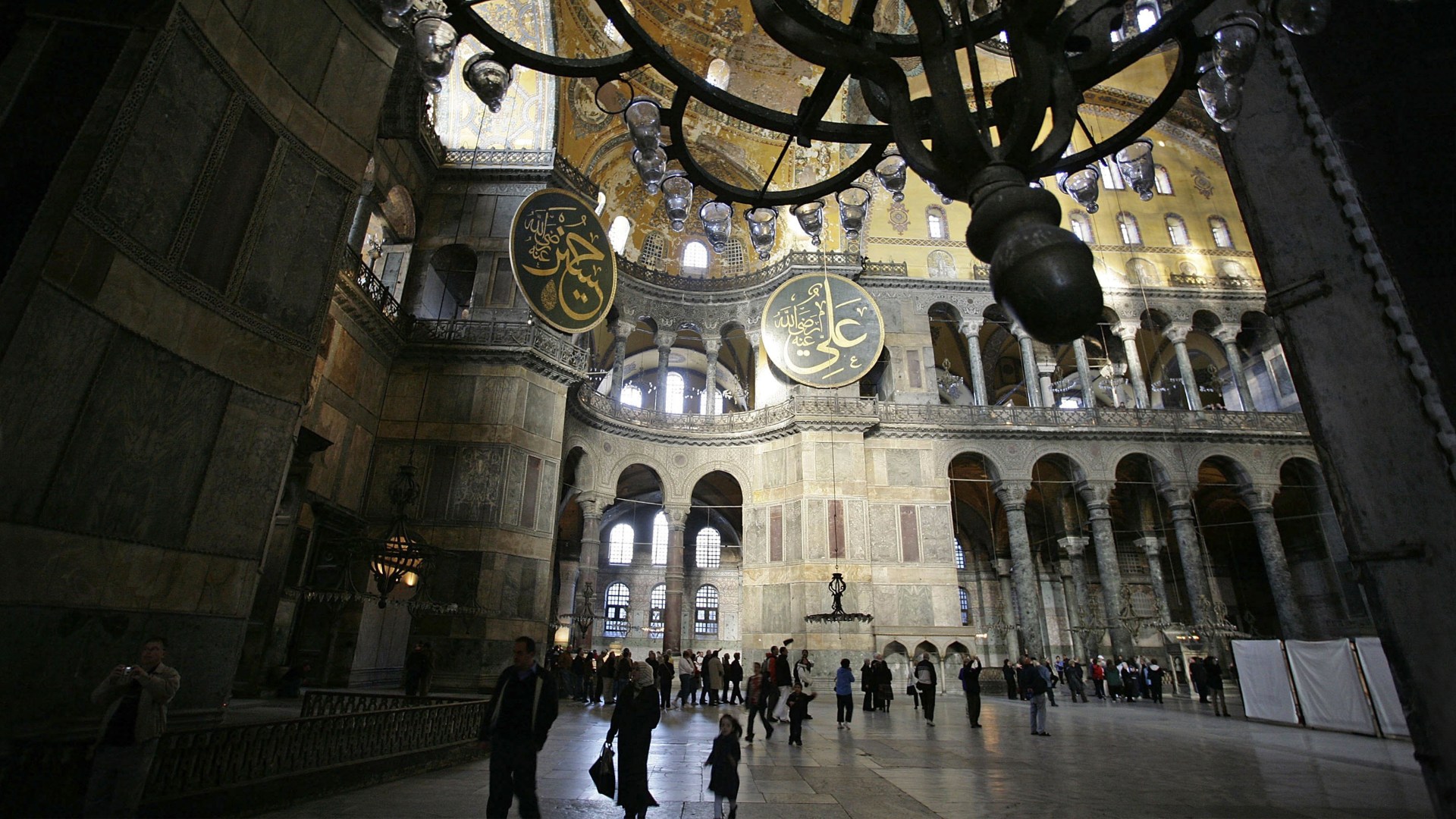
After 85 years as a museum, the Hagia Sophia is poised to once again become a mosque. Might it also again become a church?

A Turkish court is scheduled to rule on July 2 if the iconic Byzantine basilica can be opened for Muslim worship.

Built in 537 by Emperor Justinian, in 1453 the Ottoman sultan Mehmet II converted the Hagia Sophia into a mosque. Five centuries later, the secularizing founder of modern Turkey, Kamal Ataturk, turned it into a museum.

UNESCO designated the Hagia Sophia as a World Heritage Site in 1985.

President Recep Erdoğan has long stated his desire that the building would welcome prayer. In March, he led guests in silent Quranic recitation on the 567th anniversary of the conquest of Constantinople, dedicating the prayer to Mehmet II.

Last week, Erdoğan found an unlikely supporter.

“I believe that believers’ praying suits better the spirit of the temple than curious tourists running around to take pictures,” tweeted Armenian Patriarch Sahak II, resident in Istanbul.

“The site is large enough to allocate a space for Christians, [so that] the world can applaud our religious peace and maturity.”

The Armenian Apostolic Orthodox Church represents the largest Christian community remaining in Turkey, with an estimated 90,000 members. The Hagia Sophia used to serve as the cathedral for the Greek Orthodox Church, whose members have dwindled to an estimated 2,500.

Ecumenical Patriarch Bartholomew I, also resident in Istanbul, expressed his concern over the possible conversion.

“Instead of uniting, a 1,500-year-old heritage is dividing us,” said the Greek patriarch, who leads 300 million Orthodox worldwide.

“I am saddened and shaken.”

Condemnation also came from UNESCO, Greece, and the US ambassador-at-large for religious freedom.

“The Hagia Sophia holds enormous spiritual and cultural significance to billions of believers of different faiths around the world,” tweeted Sam Brownback.

“We call on the government of Turkey to maintain it as a UNESCO World Heritage site … in its current status as a museum.”

Turkey rebutted the criticism, stating the decision is a domestic issue with Turkish jurisdiction alone. A recent poll found 73 percent of Turks favor transforming the museum into a mosque.

Sahak II, whose election was covered by CT last December, wondered if his proposal to open the Hagia Sophia also as a church was “too utopian.”

But perhaps it would reduce the rancor.

“Enter the temple, breathe silence and learn from it,” tweeted the 85th Armenian patriarch of Constantinople.

“Hagia Sophia will advise you that there was nothing more valuable than peace.”

Turkish courts have also returned repurposed museums to their original status as churches, including the St. Paul’s Church in Tarsus in 2010. And in 2015, the 16,000 member Jewish community in Turkey was permitted to hold Hanukkah services for the first time.

“The salvation of the world is the covenant of the cross and the crescent,” Sahak II tweeted.

“And the honor of manifesting such peace to the world is worthy of the Republic of Turkey.”

Other churches-turned-museums, however, have been transformed into mosques. In 2013, CT reported on the similarly named Church of Hagia Sophia, on the Black Sea coastal city of Trabzon.

And in 2019, perhaps as a prelude, the historic Chora church was converted into a mosque.

The head of Turkey’s estimated 7,000-member Protestant community does not believe the government has recently treated Christian citizens with equality.

“The Hagia Sophia is just another attack on us as Christians, and very sad for the Armenians, the Orthodox, and the Catholics,” said Soner Tufan, stating his opinion is less important than that of the traditional churches.

“The government doesn’t look after us, or give us our rights.”

A chief complaint of Protestants in Turkey has been the surge in denials for residency permit renewals of expatriate Christian workers, and the deportation of others.

Though Donald Trump intervened to free pastor Andrew Brunson in 2018, last week a stay-at-home mother-of-three—married to a Turkish pastor—was told she could not return to her home of 10 years.

Social tensions are also increasing.

Fears that Christians are “responsible” for COVID-19 led one Turk to try and burn down a church in Istanbul. At another church in the city, protesters tore down its cross.

And while Turkish believers employed the coronavirus quarantine to participate in a global singalong initiative to bless their nation, Erdoğan advanced the reopening order to coincide with the 567th anniversary of Mehmet II’s conquest—hosted outside the Hagia Sophia.

Tufan believes that Sahak II realizes the cathedral is lost, so the patriarch is trying to negotiate and change the message to one of unity.

Tufan also thinks that despite the beautiful words, it is not the Armenian leader’s true opinion.

“Maybe he thinks this is a win-win position, but I don’t think others will agree.”

Nishan Bakalian, coordinator of church relations for the diaspora Union of Armenian Evangelical Churches in the Near East, thinks it serves Turkish propaganda.

“I don't think you will find anybody in the community debating as if this was a rational proposal,” he said.

“It sounds like a statement made by someone who is subject to the overt and covert pressures of a minority community, under the current Turkish regime.”

And for Paul Haidostian, president of the Armenian evangelical Haigazian University in Beirut, it is at best a theoretical discussion.

Sahak II’s call for cooperation might have been welcome, if Erdoğan’s purpose wasn’t purely political.

“Records must be set straight, and past wrongs acknowledged,” Haidostian said, in reference to the Armenian genocide.

“Interreligious dialogue is better served when peoples of faith humble their hearts to seek justice and repentance, rather than illustrious and politicized spaces.”

Ideas

White, Black, and Blue: Christians Disagree Over Policing

Staff Editor

Black Christians overwhelmingly say police treatment is biased against them. Why don’t white evangelicals believe them?

Christianity Today June 29, 2020
Hill Street Studios / Getty Images

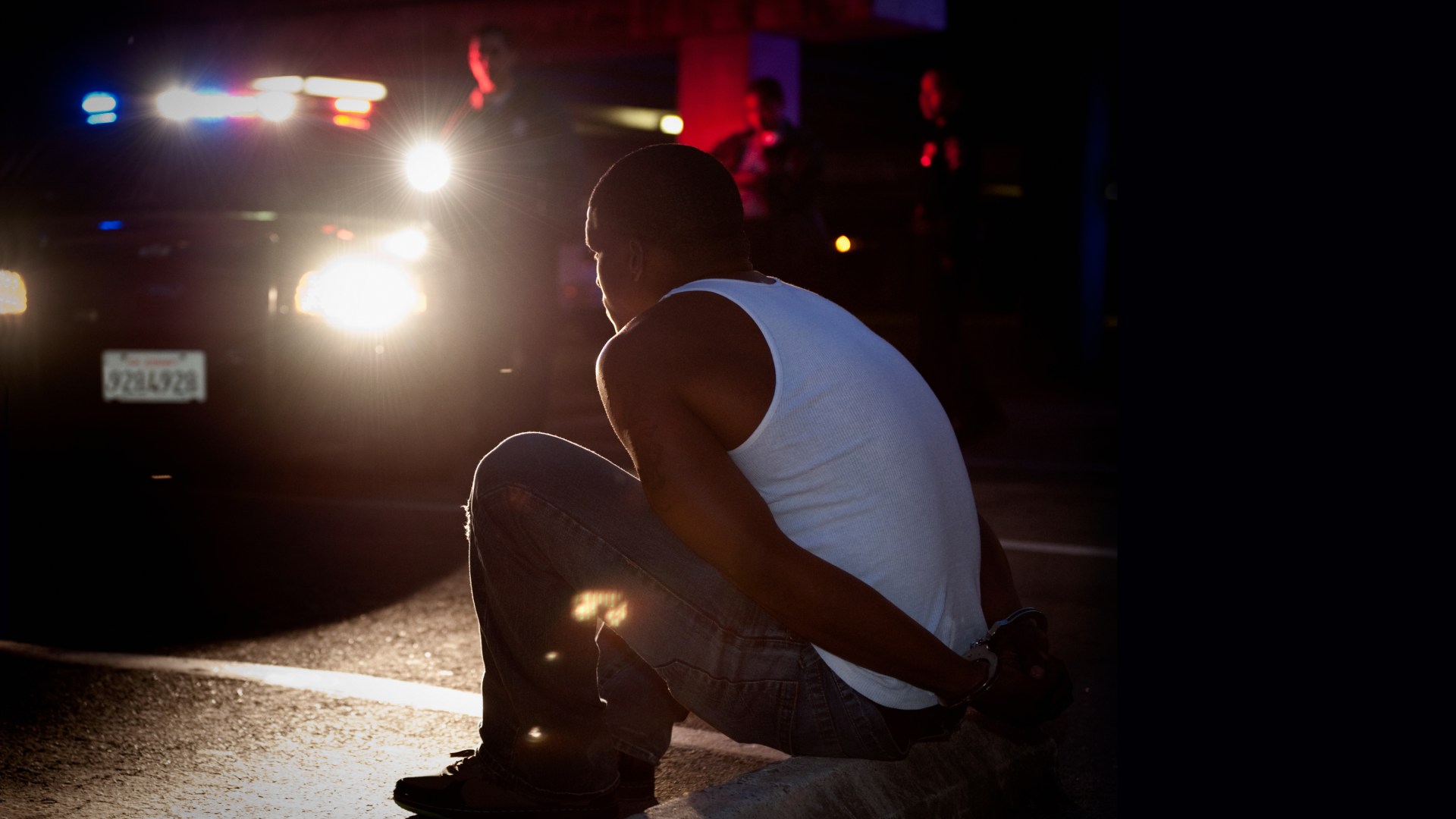
Do police officers generally treat black and white Americans alike?

White evangelicals are more likely to say “yes” than any other major religious demographic in the United States. Black Protestants are most likely to disagree.

This rift has appeared repeatedly in surveys on American policing over the past five years, as have disparities in how these two groups understand high-profile police killings of black men and in how police make them feel. The numbers are striking:

  • A 2015 poll from the Public Religion Research Institute (PRRI) found white evangelical Protestants were the only major religious group in which a majority (62%) said police generally treat white and black people equally. Only 20 percent of minority Protestants agreed.
  • Survey data from Pew Research Center and the Baylor Religion Survey in 2017 showed that gap between white evangelicals and black Protestants was intact two years later.
  • The same 2015 PRRI poll found 6 in 10 white evangelicals called high-profile police killings of black men isolated incidents; 7 in 10 minority Protestants said they see a broader pattern.
  • In a 2018 poll by PRRI, the isolated incident vs. broader pattern contrast was starker: Now 7 in 10 white evangelicals said the deaths were isolated incidents, while 84 percent of black Protestants said there’s a pattern.
  • And the 2018 Cooperative Congressional Election Survey showed white evangelicals and black Protestants were, of 16 religious demographics, furthest apart on whether the police make them feel safe or unsafe.

The latest of these polls (the most recent I’ve found) is two years old, and it’s possible opinions have shifted some, especially over the past few weeks, as the police killing of George Floyd in Minneapolis has drawn fresh attention to official violence and racial inequality.

But that fourth bullet point troubles me. Walter Scott, Alton Sterling, Philando Castile, and Botham Jean were all killed by police between 2015 and 2018. White evangelicals witnessed these stories and yet came away more convinced there is no broader pattern of how police treat black Americans with which we need concern ourselves. In those same years, our black Protestant brothers and sisters became more insistent that exactly the opposite was true.

Black Christians overwhelmingly say they are treated unequally by the police. Why do so many white evangelicals disbelieve them? There are four explanations.

If black Christians overwhelmingly say they are treated unequally by the police—and they do—why do so many white evangelicals disbelieve them? There are four explanations I’d like to explore, one historical, one informational, one cultural, and one spiritual.

The historical explanation, as a recent episode of CT’s Quick to Listen podcast detailed, concerns evangelical attitudes about policing from over a century ago (and how they’ve developed since). Around the turn of the 20th century, white American Christians across the theological spectrum believed “crime was a secular evil, that crime was something that America was going to descend into if it turned away from God,” explained historian Aaron L. Griffith, author of the forthcoming God’s Law and Order: The Politics of Punishment in Evangelical America. This produced extremely positive views of police, Griffith said, with even progressive or pacifist Christians speaking of officers as “missionaries” and “just as essential to a neighborhood's wellbeing as social workers or ministers.” Unwittingly, white evangelicals may filter what black Christians tell us through lingering, unexamined pieces of that historical lens.

The informational explanation, predictably, is about information. Before 2014, comprehensive data on police brutality and racial disparities in our justice system was inaccessible if not outright unavailable. Now we have a wealth of data and a wealth of disagreement about what it means. Those arguing racial disparities in policing are a statistical illusion tend to focus on fatal police shootings, and with that narrow dataset (perhaps narrowed again to consider only unarmed victims), they can make a plausible case. Examine other aspects of policing and criminal justice, however, and a clear racial pattern emerges in who is stopped, searched, and subjected to use of force; who is arrested, charged, and convicted for comparable crimes; who is sentenced to prison time and for how long; and who is offered pre-trial release, pardon, or commutation. Many white evangelicals may never have read these studies; many black Christians didn’t need to read them to know policing works differently for them.

The cultural explanation is much too weighty to fairly consider here, but consider that a Pew survey in 2009 found white evangelicals were an outlier on another violent topic: torture. As CT reported at the time, white evangelicals were the group most likely to say torture could be justified, and, even more damningly, enthusiasm for it was higher among those who attended church more often. Why these polling distinctions? Do they point to something gone wrong in white evangelical culture? Is there a cruelty among us? An indifference? Another poll found this support for torture plummeted if the question were tied to what could be done to captured American soldiers. That this Golden Rule framing made a difference is hopeful—but why did we need it to remember that those suffering our government’s violence are as human as us?

My last explanation is spiritual: Perhaps this disparity is the result of pride. I don’t mean the simple, blatant pride of self-aggrandizement, but rather the subtler, self-deceiving pride of hubris, the false confidence of believing we understand what we do not. Are we unjustifiably certain we know how black Americans experience our country’s criminal justice system? Do we let our hubris tell us we don’t need to re-examine our history, information sources, or culture? Do we let it convince us we don’t need to listen to accounts that unsettle our assumptions? Though “fools despise wisdom and instruction,” Proverbs 1:7 says, those who fear the Lord seek to learn “righteousness, justice, and equity” (Prov. 1:3–4, NRSV).

Our black family in Christ here in America overwhelmingly say they are treated unequally by the police. Can we, “with all humility and gentleness” (Eph. 4:2, NRSV), accept that instruction? Can we learn to believe them?

Bonnie Kristian is a columnist at Christianity Today, a contributing editor at The Week, a fellow at Defense Priorities, and the author of A Flexible Faith: Rethinking What It Means to Follow Jesus Today (Hachette).

Books
Review

I’m a Professional Evangelist. This Book Reawakened My First Love.

After reading Rebecca Manley Pippert’s follow-up to “Out of the Saltshaker,” I’ve never been more excited to talk about Jesus.

Christianity Today June 29, 2020
SDI Productions / Getty Images

As a preacher and evangelist, I like to say that the application for any sermon—no matter the Bible passage—should be: “Tell your friends about Jesus.” It’s a joke, of course. Because that’s a lazy application—one guaranteed to get guilty looks from the congregation.

Stay Salt

Stay Salt

Good Book Co

256 pages

$10.19

But why are we so bad at telling our friends about Jesus? In part, because in today’s post-Christian Western world, we’re told to keep our beliefs to ourselves. Our faith is supposed to be private, not public. In this environment, talking about Jesus is seen as judgmental, intolerant, and oppressive.

Last year, an article in Christianity Today carried a revealing headline: “Half of Millennial Christians Say It’s Wrong to Evangelize.” Evidently, evangelism is hated by significant numbers of both Christians and non-Christians! Who would have thought that a mutual dislike for evangelism would unite us all?

And yet, a desire to share the gospel with friends runs—or at least should run—through the DNA of every Christian. So how can we start talking about Jesus again?

This is the question at the heart of Rebecca Manley Pippert’s latest book , Stay Salt. Pippert, of course, is best known for her classic book on evangelism, Out of the Saltshaker and Into the World: Evangelism as a Way of Life. First published in 1979, Out of the Saltshaker was written to equip believers for evangelism in a culture that was drifting in post-Christian directions. Four decades later, those forces have only accelerated, but Pippert hasn’t lost any confidence that the gospel message can break through walls of hostility and indifference, even in the context of everyday conversations. As the subtitle of Stay Salt puts it, “The World Has Changed: Our Message Must Not.”

A Multi-Pronged Approach

There are three sections in Stay Salt. In the first, Pippert looks at what she calls the means of evangelism—in other words, you and me, the “evangelists.” None of us feels adequate when confronted with the juggernaut of hostile Western secularism. But Pippert reassures us that this is precisely how God works our circumstances. God uses us not despite but because of our smallness, weaknesses, and inadequacies. We are supposed to depend upon God for the courage and strength to evangelize.

In the second section, Pippert takes us through the message of evangelism—the gospel. Here we might roll our eyes. Don’t we already know this stuff? But Pippert got me excited about the gospel with the fresh language she uses. She skillfully presents the gospel as both a rebuttal to the accepted doctrines of secularism and a positive message our friends will want to hear.

In the final section, Pippert outlines the method of evangelism. This might seem like another occasion for eye-rolling. Surely not another formulaic technique! But Pippert instead motivates us to love our friends and to “proclaim” the message through questions and conversations rather than a pre-rehearsed monologue.

Stay Salt got me genuinely excited to tell my friends about the gospel and its many glories. There are three main reasons for this. First, the book preached the gospel at me so that I rediscovered my first love. It’s worth reading Stay Salt just to enjoy the wonder and beauty of the gospel message. This is exactly what will get us talking about Jesus again.

Second, I appreciated hearing stories from Pippert’s life of evangelism. These stories are both instructional and inspirational. But more importantly, Pippert has stories of conversations with strangers on a plane and family members alike. As a public evangelist myself, I know it’s far easier to have conversations with strangers I’ll never see again than with family members I’ll encounter every Thanksgiving!

Third, the book takes a helpful, multi-pronged approach. There are instructions on one-to-one conversations, group Bible readings, and proclamation evangelism. This shows we all have a part to play. Just like a football team needs both a running and a passing game to move down the field with any success, evangelism works best when it draws on a variety of methods.

If I could push this book to go further, I would offer just a few observations. First, I think Pippert is somewhat mistaken in how she categorizes contemporary culture. The book’s guiding assumption is that the West, having lurched toward a post-Christian extreme, is functionally pre-Christian. I too used to believe this. But the Australian writer Mark Sayers had a brilliant response on his podcast, This Cultural Moment. In pre-Christendom, he says, people converted into Christianity. But in post-Christendom, Christians are the “bad guys.” People are de-converting from Christianity. And they don’t think they need Christians to save them from famines or plagues. In fact, even amid the COVID-19 pandemic, the Christian humanitarian group Samaritan’s Purse faced pressure to disband its Central Park field hospital because medical staffers were required to sign a faith statement opposing same-sex marriage.

Second, and relatedly, the book underestimates just how “post-Christian” we really are. When Billy Graham preached the gospel message in the 20th century, he liked to invite non-believers to come up front for the altar call. He reassured them with his famous saying, “The buses will wait.” What does that mean? It means that these non-believers were, in some sense, churched non-believers. After all, they had come to hear Graham preach on a church bus, as part of a community of believers . He was only asking them to believe what their friends believed .

But most of today’s non-believers have minimal connections, if any, to the church. They are not just agnostic about the God of the Bible but about any god. Many have no Christian friends at all. In certain ways, this is an unprecedented situation.

To evangelize effectively in such a context, we need to acknowledge how the presence of Christian community can make all the difference. Until we can connect non-believers with a community of believers, our efforts at one-to-one evangelism will only go so far. It was Nathan Campbell, the Australian pastor and blogger, who told me that evangelism is a team game . He pointed out that in 1 Thessalonians 1:5, Paul says, “Our gospel came to you not simply with words but also with power. …You know how we lived among you for your sake” [emphasis added].

Getting Excited

Even if Pippert sometimes fails to grasp the full extent of post-Christian drift in the Western world, she deserves credit for welcoming it as an opportunity for the church. Rather than seeing the secular climate as a threat to the gospel, she embraces it as a spur toward new and better ways of evangelizing. Why? Because people will be even hungrier for purpose, hope, identity, and someone who loves them. This is what I love most about Pippert’s approach. Instead of treating secularists as culture-war opponents, she welcomes them as neighbors to love afresh with the news of Jesus.

Stay Salt made me fall in love with the gospel all over again. I am a professional evangelist. I tell people about Jesus for a living. But this book renewed my commitment to pray for my family members, friends, and neighbors who don’t know Jesus yet. And it made me look for more opportunities to tell them about Jesus. It got me more excited about evangelism than I’ve ever been before.

Please read this book, and pray that God would use you—not despite but because of your smallness, weaknesses, and inadequacies—to tell your friends about Jesus.

Sam Chan is a public evangelist for City Bible Forum in Australia. He is the author of Evangelism in a Skeptical World: How to Make the Unbelievable News About Jesus More Believable (Zondervan Academic) as well as a forthcoming book, How To Talk About Jesus (Without Being That Guy): Personal Evangelism in a Skeptical World (Zondervan), which releases in October.

News

Cedarville President Reinstated Despite ‘Clouding’ Former Employee’s Past Abuse

Trustees release a summary of findings from an internal investigation, while a pastor who oversaw the restoration process resigns.

Christianity Today June 26, 2020
Jeremy Mikkola / Flickr

Cedarville University president Thomas White has been reinstated despite an internal investigation concluding that he kept the university from knowing the “specific nature” of a former professor’s abusive past.

Two members of the board of trustees have resigned in protest, saying the investigation’s findings were “extreme troubling.” Some of the Cedarville faculty say they have lost trust in the school’s leader.

White was put on leave May 1, a week after he fired Anthony Moore. Moore was three years into a five-year “restoration plan” as an employee at the Baptist school when White said he learned “additional information related to [his] past” and ended his employment at the university, where he had taught theology, helped coach basketball, and served as a special advisor on diversity.

While White knew about the behavior that cost Moore his previous job as pastor at The Village Church in Fort Worth, White said he didn’t realize the extent of the misconduct, that Moore had reportedly filmed a subordinate in the shower multiple times over months, not just one or two times. CT reported that Moore’s Cedarville colleagues, fellow professors and basketball coaches, said they were not informed that his sinful past involved abuse.

According to a statement released by Cedarville trustees Friday afternoon, an internal investigation by the legal firm Husch Blackwell LLP found no evidence of sexual misconduct by Moore while he was employed at Cedarville.

The report acknowledged White’s “benevolent motivation” in hiring Moore under a plan to counsel and restore him, but said “it is reasonable to infer… President White took steps that he knew, or should have known, clouded the specific nature of Dr. Moore’s misconduct” and “President White subsequently failed to notify the Board of the specific nature of Dr. Moore’s misconduct.”

Cedarville board member Daniel Akin, also the president of Southeastern Baptist Theological Seminary, resigned over the report and the board’s decision to reinstate White. He said the restoration plan for Moore was “seriously flawed from the beginning and poorly implemented.”

“I believe the outside, independent investigation by the law firm of Husch Blackwell confirmed this. Their report was extremely troubling to me,” he wrote. “Nevertheless, the Board of Trustees voted on Tuesday, June 23, to reinstate Dr. White as president. Regretfully, this is a decision I could not support.”

Mark Vroegop, pastor of College Park Church in Indianapolis and a Cedarville alumnus, also resigned from the board.

“I’m thankful the Trustees took the appropriate steps of conducting a third-party investigation to examine the impact on students and the hiring process. I rejoice that no students were affected,” he wrote. “Today the Board of Trustees issued a statement outlining a summary of the findings and steps related to the reinstatement of Dr. Thomas White. Unfortunately, I could not support this direction. I do not believe these steps are sufficient in light of what the report revealed.”

Some Cedarville employees share the former trustees’ concerns.

White “clearly lied and misled and withheld information that was damaging to our reputation, and he put our students at risk,” one faculty member told CT, under the condition of anonymity. “He has continued to deflect and try to put a positive spin on it, instead of owning that he had sufficient information about Moore and shouldn’t have be so coy and misleading about Moore’s sins.”

The local pastor who oversaw Moore’s restoration resigned from his position last week. According to White, Moore became a member of the Grace Baptist Church in Cedarville and met weekly with pastor Craig Miller for accountability as a condition of his restoration plan at the university.

An inquiry by the church elders concluded Miller “was apprised of and had access to the relevant information sufficient to understand the gravity of the situation” and “did not communicate specifics of the situation or discuss his plan of action with any staff or elders,” according to an email sent to the congregation.

“We found that Craig’s actions reflected some errors in judgment, demonstrating a disproportionate focus on care for one member over shepherding and protecting the entire flock,” the elders wrote. “Craig’s decisions and his working independently diminished confidence in Craig’s ability to lead a unified congregation at this time.”

Two months ago, White detailed the process for hiring Moore on his blog and said, “I sincerely regret that this attempt at restoration will now result in personal pain for many.”White took a six-week break from social media ending in mid-June. Since then, he has been tweeting reflections on the book of Philippians, Cedarville updates, and some posts from family vacation. He will be required to complete victim prevention and victim advocacy training.He has yet to post on social media about the news of his return.

Theology

Black Lives Matter in the Bible

From Genesis to Revelation, racism runs counter to everything Scripture teaches.

Christianity Today June 26, 2020
Illustration by Mallory Rentsch / Portrait: Courtesy of Jarvis Williams / Background Images: WikiMedia / Unsplash / New York Public Library

Racial discourse is again part of the national and global conversation due to the recent killings of black people. White Christians especially find themselves trying to wrestle with how to understand, respond to, and engage what many black Christians see as clear examples of racial injustice.

Some Christians are asking whether they should affirm the dignity of black lives with the words “black lives matter” since this phrase is associated with the Black Lives Matter (BLM) organization and the BLM organization affirms things that are clearly contrary to Scripture.

As a black Christian man who believes the Bible gives us everything we need for eternal life and godliness, I think Christians must begin our opposition to racism with a biblical and theological analysis of the problem and with a biblical and theological presentation of the solution to the problem. Christians must also be rigorous exegetes of both the Bible and of our own social locations, as we use common-grace resources and common sense under the authority of Scripture to eradicate the evil of racism in the power of the Spirit.

We must carefully and critically evaluate every idea in any organization in light of Scripture and under the authority of Scripture. We must reject teachings in any organization that are contrary to Scripture. My own theological tradition has an article in our confession of faith stating this very fact (Article XV, Baptist Faith and Message).

However, the recent criticisms against Christians who affirm the scriptural truth of black dignity using the words “black lives matter” seem odd to me as a black Christian man in America. After all, the Bible affirms black lives are created in the image of God (Gen. 1:26–27), and our country has a history of dehumanizing black people. The words “black lives matter” affirm a scriptural truth about black people.

God created humans in his image. From Genesis (3:15) to Matthew’s gospel (28:16–20) to Revelation (5:9), the Bible speaks clearly about God’s vision to restore everything Adam and Eve lost in the Garden of Eden and his vision to redeem ethnically diverse individuals from different tongues, tribes, peoples, and nations.

Through Christ’s death and resurrection, God makes sinners right with himself (Rom. 5:6–10), reconciles sinners to each other (Eph. 2:11–22), and restores and reconciles the entire universe (Col. 1:19–20). Paul calls this cosmic redemption the disarming of earthly and demonic powers (Col. 2:14–15) and the unification of all things and all people in Christ.

Racism is opposed to the gospel of Jesus Christ and against God’s vision to redeem and unify creation through Christ.

Racism is opposed to the gospel of Jesus Christ and against God’s vision to redeem and unify creation through Christ. God recreates through Christ a diversity of different tongues, tribes, peoples, and nations into one new (but diverse) people. God commands us to live in pursuit of reconciled community with one another and with our neighbors in anticipation of the age to come (Is. 65:17–25; Rom. 8:19–22). God’s kingdom is an already-and-not-yet kingdom, whose king is a brown-skinned Jewish Messiah. The kingdom is filled with diverse people and diverse stories of beautiful image-bearers who’ve tasted the salvation of the one God, the one Lord, and the one Spirit by faith in Christ (Eph. 4:4–6).

As Christians, we must intentionally oppose racism because God through Christ both empowers us and commands us to walk in love with the power of the Spirit. One way Christians walk in the Spirit is when we love our neighbors as ourselves (Gal. 5:13–14). We should not use our freedom in Christ to pursue our sinful passions in accordance with the flesh. Those who live to gratify their flesh will not inherit eternal life (vv. 16–21). One’s complicity in racism may prove one is enslaved to the flesh and to its seductive powers of evil. We must oppose racism whenever and wherever it appears because we are new creatures in Christ (2 Cor 5:17-21).

As a black Christian pastor of Asian, black, brown, and white people, I thank God that Genesis 1:26–27 clearly states God created all humans in his image and bestows upon us God-given dignity, and that he promises to redeem us, to reconcile us, and to restore the entire creation through Christ. When black lives are dehumanized and treated as though they don’t matter simply because they’re black, Christians everywhere should be able to stand up and assert without hesitation and with their Bibles open that black lives certainly matter, have dignity, worth, and value, just as non-black lives certainly matter, have worth, dignity, and value.

God created black people in his image. God redeems black lives in Christ. Black lives matter to God because the Bible teaches they matter.

Jarvis J. Williams is an associate professor of New Testament interpretation at the Southern Baptist Theological Seminary in Louisville. This article is based on his chapter in For God So Loved the World: A Blueprint for Kingdom Diversity (B&H, 2020), as well as a lecture he gave at the 2019 Just Gospel Conference in Atlanta.

Church Life

American Bible Society’s New President Sees a Bible Revolution

Robert Briggs will oversee the launch of a Philadelphia-based Bible history center and continue to foster partnerships to accelerate global translations.

Christianity Today June 26, 2020
American Bible Society

As the new president of the American Bible Society (ABS), Robert Briggs will balance the work of spurring Scriptural engagement in his own country with the ongoing efforts to complete Bible translations around the world.

A 20-year veteran of the ABS and a founding member of the steering committee of Every Tribe Every Nation, Briggs—who was announced as president this week—knows these causes well. He succeeds Bible translation veteran Roy Peterson, who came to ABS in 2014 after leading The Seed Company and Wycliffe USA.

Under his leadership, the society will launch a landmark historical center in Philadelphia designed to showcase the Bible’s role in the lives of the Founding Fathers and early American history. ABS itself exemplifies these connections, with John Jay, Francis Scott Key, and Elias Boudinot among its early leaders.

But its work is not only American. The society partners with national societies in other countries to collaborate toward global goals around speeding up Bible translation and access.

“This is deeply embedded in my heart, to be a part of, really unprecedented translation movement that is bringing God’s word in the entire globe,” he said in an interview this week with CT. “We’re watching a revolution happen right before our eyes.”

The ministry is also looking at digital packaging, social media, and new platforms to bring a revival of Bible engagement in its own country.

After President Donald Trump posed with the book in front of St. John’s Church in Washington D.C., ABS shared a statement about seeing the Bible as more than a symbol and launched a Bible giveaway

“Some of those people were getting Bibles for the first time. That’s really our emphasis—to provide the first Bible that people will actually engage with,” said Briggs. “Somebody might’ve received a Bible as a gift back when they got confirmed or had some events in their lives, but we want to provide the first Bible that people will receive at a moment in their life when they’re motivated to engage with it, consider its content, consider its message and, and live and choose to live in accordance to what they hear.”

What would you say has changed the most with how Americans understand and view the Bible over the past 50 years?

Fifty years ago, the proposition of truth, the declaration of objective truth, was recognized as a foundational lens through which we could understand God’s perspective and God’s view that could inform our lives.

Today, the confidence that there is a singular objective understanding of truth has lessened. Currently, the culture would view perspectives about the Bible is more subjective and more linked to your experience and not linked to definitive, objective truth.

What about with American Christians’ view of the Bible in the same time span?

For American Christians, there is a fresh recognition that this is a book that needs to be lived, not just known. Not that there wasn’t some sort of recognition of that in previous generations, but there was an emphasis on knowing and memorizing and expressing the content of the Bible and believing in so doing this would automatically bleed into the way your life was lived, which to some extent is true.

The emphasis now among the emerging generations is that it’s all well and good to know what the Bible says, but it’s way more important to demonstrate that you are living in a way that aligns and is consistent, at home, in church, at work, across the spans of your life.

Our country is still in the midst of a pandemic. How does this affect the time table of the opening of the Faith and Liberty Discovery Center?

The pandemic has caused us to delay the opening. We were aiming for November. We had to shut down construction for several weeks. In light of that it didn’t make sense to open in the middle of winter. Our new target date is the end of April 2021.

We don’t exactly know what to expect, but we’ll be ready to open and facilitate the experience of leveraging the history of the nation, the story of the changemakers of the nation, and examining the ways that their lives have been influenced by the Bible. We’re eager to introduce that narrative here at Independence Hall, in Philadelphia, the heart of the history of the nation.

Frankly, we need to turn the volume up on that narrative. It’s not being adequately communicated and not adequately heard. We want to be able to tell the story of where the nation got it right, where the nation didn’t get it right, and how we need to correct the course on some fronts now in order to move to a more perfect union, which is the path that the founders set out on.

How does the center compare to the Museum of the Bible?

We are so enthusiastic about the Museum of the Bible. It’s so good for the cause. Their vision and their expression is way more comprehensive, and we love what the Museum of the Bible represents. It tells the whole story of the Bible’s history and its impact around the world.

The Faith and Liberty Discovery Center is designed to tell a much more targeted and specific story about the influence of the Bible on the development of this nation, the influence that the Bible brought to the changemakers, who established the direction of a nation, and who altered the course of the nation as they exerted their influence. People come to Philadelphia to primarily explore history, so we’re leveraging the historical backdrop of Independence Mall and the Liberty Bell and the Constitution Center.

What prompted American Bible society to respond to President Trump’s recent Bible photo op?

We’re always watching for opportunities to promote engagement with the Bible. We weren’t really responding to President Trump as much as we were responding to the conversation going on about the Bible.

Our message was designed signal that while the Bible can certainly be a symbol and that’s not a bad thing, the Bible is way more than a symbol. We wanted to emphasize the fact that the Bible is a message. The Bible is an expression of the heart of God and a way that we can understand God’s character and God’s plan and God’s nature. We want to just continually invite people to not only see the Bible as a symbol, but in addition to that, see the Bible as carrying the content that can change lives and can bring hope and can bring healing, healing into the very kinds of historical times that we are living in and times that require attention to issues of justice and, and addressing issues of racial injustice in particular.

Was there any backlash that you guys received after putting out that statement?

Yes, here was some. There were some people that felt like we were not adequately celebrating a positive image of the Bible as a symbol.

We wanted to clarify that we weren’t trying to challenge the featuring of the Bible as a symbol but simply wanting to say it’s far more than that. We didn’t intend it the way some people took it as a negative statement about a leader. We intended it as a positive statement about the Bible as more than a symbol. But yes, there were a few people that wrote to us and said, “We think you could have mentioned it more fully.”

What is the role of the printed, tangible Bible in 2020?

Our mission is to provide the Bible in a language and a format that people can understand and afford. The format in which we present that changes in every generation. The Bible Society’s job is to discern what the preferred formats are or how people are wanting to engage. We’re leaning hard into digital delivery systems. We’re amazed at what we’re able to get done in terms of Bible provision distribution through digital means.

However, the predominant community of Bible readers still wants to have the option of a printed Bible in a format that they can hold in their hands and open and flip through the pages, so the days of the printed Bible are still very much alive. but supplemented by the added speed and accessibility and flexibility of digital delivery also.

We strive to be format neutral. We’re not the American Print Bible Society. We’re the American Bible Content Society, delivered through whatever format is the preference of the culture of the day. If we ever go back to scrolls, handwritten on manuscripts, then we’ll do that again.

I recently reported a story about local churches around the world seizing the initiative to translate the Bible. Have you observed this phenomenon as well?

Through Every Tribe Every Nation, we’re seeing this is an amazing thing happen where an alliance of Bible translation organizations is coming together with, with strategists and resource partners to take on this task of ensuring that every language group, every people group on the planet, will access to at least some part of God’s word by the year 2033.

We’re also recognizing that if we don’t adjust some of our methodologies, we’re going to miss the target date. We’re watching diligently for ways to leverage technology, including artificial intelligence and other methodologies, to increase the speed without compromising any of the quality of the translation. We have to maintain the quality of the translation, but if we can increase the speed, then that’s a win.

One of those methodologies to increase the speed is clearly mobilizing the native language speakers and equipping them enough for them to take on some of the translation burden themselves. Some of that is taking shape in church planting movements and among church communities. It’s a powerful accelerator. We’re enthusiastic about it and wanting to come alongside and make sure that we are providing the equipment and the tools and the training and helping ensure quality.

How does ABS understand its role and responsibility with respect to the global church?

ABS was founded by church leaders, commissioned by the church to serve the church and one really, really specific area: Bible provision and Bible engagement. We’ve got a really specific swim lane. We certainly do that work in the US context and serve the church.

The church is our primary partner in all the work that we do. That’s true in the US and in the global context, where we have sister Bible societies. Importantly, it’s the church across all her expressions and traditions. From Catholic to Orthodox, to mainline Protestant to evangelical communities, we want to serve the entire church, ensuring that the Bible is available and being engaged and informing the work of the church on all those fronts.

Our strategy in the global context since 1946 has been to has been to work through the United Bible Societies, which is a fellowship of some 150 Bible societies all led by indigenous leaders nationally, which gives it a powerful global footprint. Through this incredible fellowship and network we can collaborate with all designed to serve the church, but serving the church in their context. It’s not ABS independently dropping into Malawi and trying to figure out how to serve the church in Malawi. It’s ABS coming alongside the Bible Society of Malawi and helping to provide resources, strategies, and tools that that Bible society can bring to the church and their concepts.

What’s a new piece of technology that you imagine will have a major impact on how people use the Bible in the next decade?

Artificial intelligence will be the driver of increasing the speed of Bible translation and helping us ensure that we can get to the year 2033 and achieve what we refer to as the all access goals, where everyone will have access to at least some portion of the scripture in their own heart language.

In terms of Bible engagement, the digital storage and packaging and distribution of content which has made possible by way of the platforms that are available today, and social media related applications, will be the driver of what we pray will be a fresh revival of Bible engagement. Having content available as the preferred time and the preferred format on the preferred topic that aligns with people’s choices and preferences and walks along with them in their life, that’s the path that’s going to lead to increased engagement, particularly in the generations that are emerging.

Apple PodcastsDown ArrowDown ArrowDown Arrowarrow_left_altLeft ArrowLeft ArrowRight ArrowRight ArrowRight Arrowarrow_up_altUp ArrowUp ArrowAvailable at Amazoncaret-downCloseCloseEmailEmailExpandExpandExternalExternalFacebookfacebook-squareGiftGiftGooglegoogleGoogle KeephamburgerInstagraminstagram-squareLinkLinklinkedin-squareListenListenListenChristianity TodayCT Creative Studio Logologo_orgMegaphoneMenuMenupausePinterestPlayPlayPocketPodcastRSSRSSSaveSaveSaveSearchSearchsearchSpotifyStitcherTelegramTable of ContentsTable of Contentstwitter-squareWhatsAppXYouTubeYouTube