How a Jewish Evangelical Won Trust with Arab Muslim Leaders

Apocalyptic fiction writer Joel Rosenberg’s new book describes his behind-the-scenes interactions with crown princes and presidents in search of peace and religious freedom.

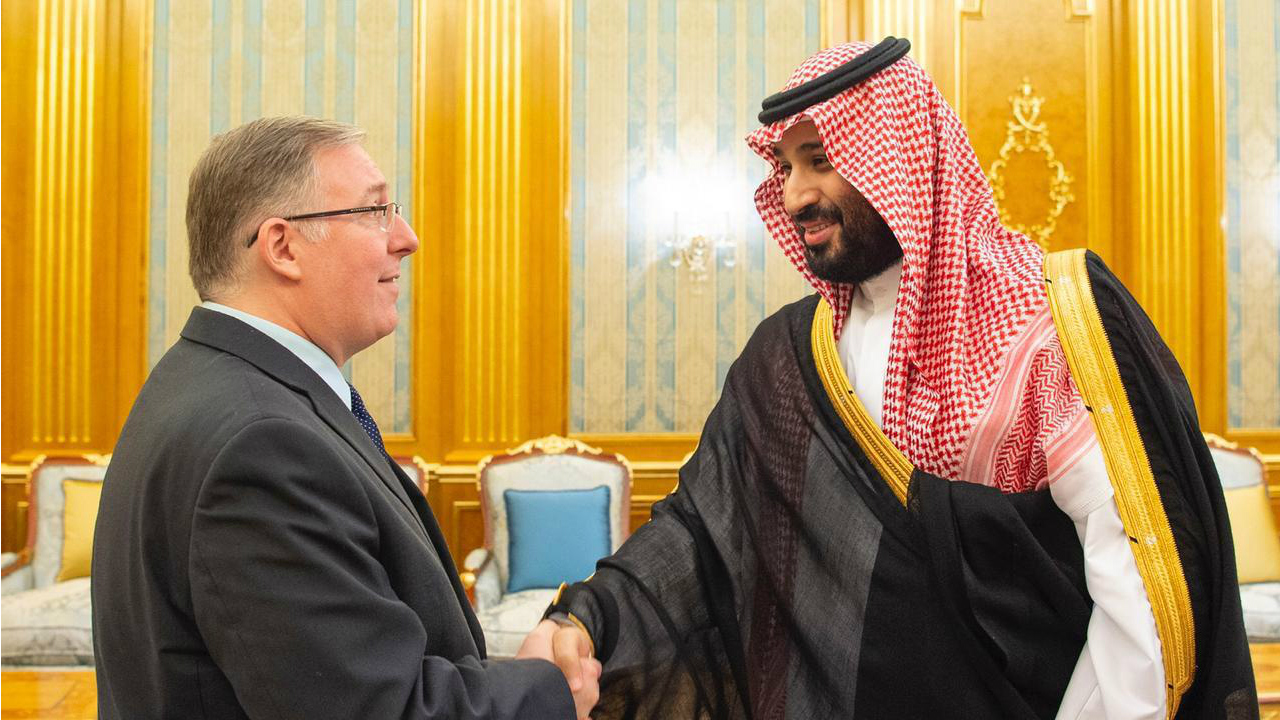
Crown Prince Mohamed bin Salman (right) greets Joel C. Rosenberg at the Royal Court in Jeddah on September 10, 2019.

Crown Prince Mohamed bin Salman (right) greets Joel C. Rosenberg at the Royal Court in Jeddah on September 10, 2019.

Christianity Today October 1, 2021
Courtesy of Joel Rosenberg

Fans of Joel Rosenberg’s Middle East apocalyptic fiction can now read his real-time account of real-world peace.

Through behind-the-scenes meetings with kings, princes, and presidents, the Jewish evangelical and New York Times bestselling author had an inside scoop on the Abraham Accords.

For two years, he sat on it.

His new nonfiction book, Enemies and Allies: An Unforgettable Journey inside the Fast-Moving & Immensely Turbulent Modern Middle East, released one year after the signing of the normalization agreement between Israel and the United Arab Emirates (UAE), finally tells the story.

During an evangelical delegation of dialogue to the Gulf nation in 2018, the Crown Prince of Abu Dhabi, Mohammed bin Zayed (MBZ), told Rosenberg of his groundbreaking and controversial plans—and trusted the author to keep the secret.

Named after the biblical patriarch, the accords were Israel’s first peace deal in 20 years. In the five months that followed, similar agreements were signed with Bahrain, Sudan, Kosovo, and Morocco.

Might Saudi Arabia be next? Mohammed bin Salman’s (MBS) comments to Rosenberg remain off the record. But asked if his reforms might include building the kingdom’s first church, the crown prince described where religious freedom falls in his order of priorities.

Enemies and Allies provides never-before-published accounts of Rosenberg’s interactions with these leaders, in addition to Egypt’s President Abdel Fattah al-Sisi and Jordan’s King Abdullah. Included also are exchanges with former president Donald Trump and vice president Mike Pence.

CT interviewed Rosenberg about navigating politics and praying in palaces and about whether he would be willing to lead similar evangelical delegations to Turkey or Iran:
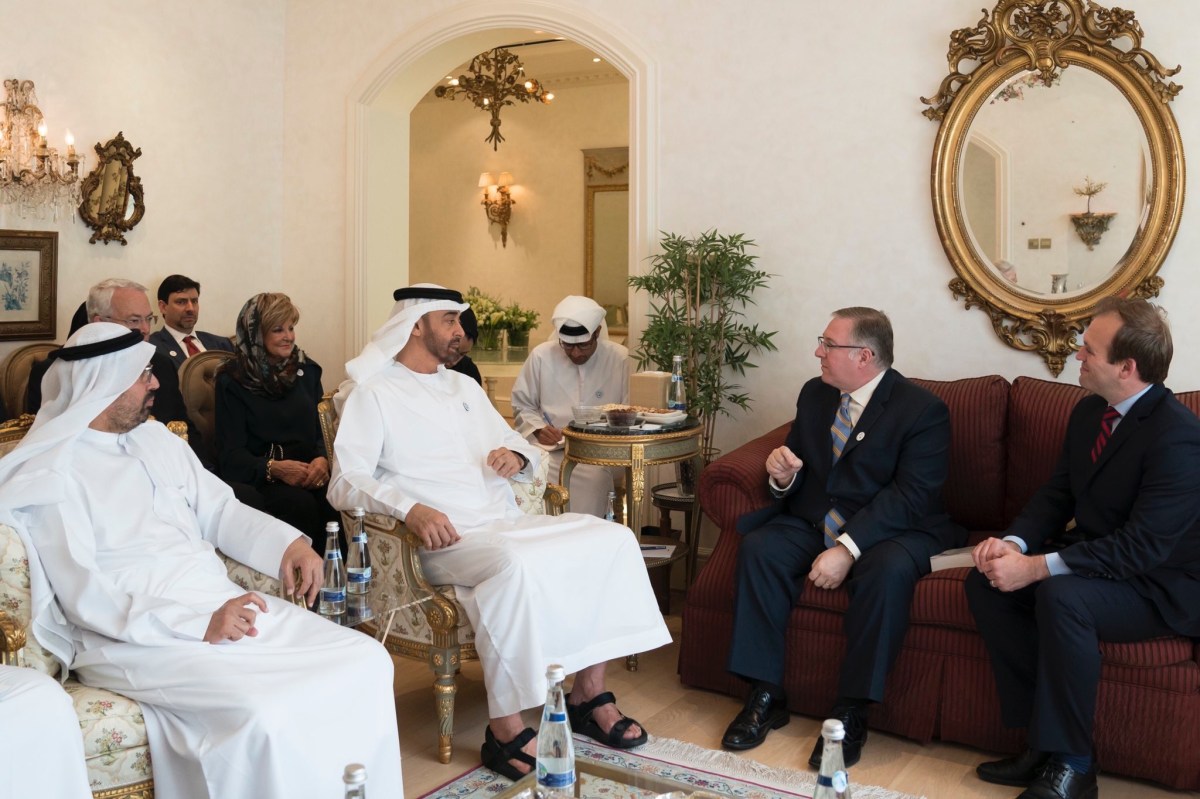
Sheikh Mohamed bin Zayed, Crown Prince of Abu Dhabi (center), welcomes a delegation of American evangelicals including Joel C. Rosenberg (left) and Johnnie Moore (right) into his home.Courtesy of Joel Rosenberg
Sheikh Mohamed bin Zayed, Crown Prince of Abu Dhabi (center), welcomes a delegation of American evangelicals including Joel C. Rosenberg (left) and Johnnie Moore (right) into his home.

You describe your relationships, especially with the UAE’s MBZ, as ones of “trust.” How did you nurture that? Did you sense it was different than their official diplomatic connections?

I’m not sure I have a good answer for that. Why would Arab Muslim leaders trust a Jewish evangelical US-Israeli citizen?

In the case of King Abdullah, he had read my novel and decided to invite me to his palace rather than ban me from his kingdom forever. The book was about ISIS trying to kill him and blow up his palace. In our first meeting, we spent five days together, and it was not on the record. We were building trust.

I didn’t have that with any of the others. In every case, we were invited rather than us going and knocking on the door. With the case of [MBZ], his ambassador Yousef Al Oteiba had seen the coverage of our Egypt and Jordan trips. He has very good relations with these countries and was able to get the backstory, asking, “Who is this guy Rosenberg? How did it go? Should we do the same?”

I think it has much more to do with being a follower of Jesus Christ. They didn’t know me, but they seemed to trust that followers of Christ who call themselves evangelicals would be trustworthy. That we are genuinely interested in peace, in security in the region, and in a US alliance with the Arab world. And in terms of the expansion of religious freedom, all of them wanted to talk about these things.

They were making a bet that the evangelical community in the United States, while being deeply—though not uniformly—pro-Israel, still has a deep interest in peace and assessing their countries and their reforms fairly. It was the sincerity of our faith that led to trust.

But you still had to nurture trust. How?

I’m sure they vetted me, and in reading my work, they saw I have a deep respect for Muslims. I’m not infected with Islamophobia. I’ve traveled from Morocco to Afghanistan. And I’ve done what I can to strengthen Christian communities in the Arab and Muslim worlds.

I’m not your classic high-profile Christian Zionist who tends to speak of Israel almost exclusively. But in the end, it is sitting there and the type of questions we ask and the tone of our conversation. In John 12:49, Jesus says that the Father commands him what to say and how to say it. Substance is important, but so is style.

You speak of opportunities to pray with different Muslim leaders and even how your delegation explained the gospel to MBS of Saudi Arabia. How do you measure the spiritual impact your efforts had in their lives and nations?

I don’t think it is possible to assess this. We were there to be witnesses for Christ.

In the case of the crown prince of Saudi Arabia, if you were accused of proselytizing the future king, it might be a capital offense. But in asking him if the term evangelical is used much in the kingdom, he laughed. We told him we had an ordained pastor in our delegation and asked if we could take a moment to explain what we believe. This was having a respectful conversation, not proselytizing. But it was beautiful.

You could argue there’s not a church built yet in Saudi Arabia, so it wasn’t a huge success. But the fact that he invited us back for a second, longer trip, completely off the record, suggested that we were building trust and that he wanted to go deeper.

Each of these leaders, including MBS, told us some very sensitive things about what they think about peacemaking with Israel. And in the case of MBZ, the biggest fruit is nothing that we take credit for, but the decision of the UAE to make peace with Israel is an answer to decades of people praying for the peace of Jerusalem.

He told us he would do it, and we didn’t leak that. He took a big risk. Why? I think he was trying to build trust with us.

But trust goes both ways. By not leaking it, it created a sense of safety. He could judge that these people are sitting on a massive headline but they have self-restraint to care more about the relationship.
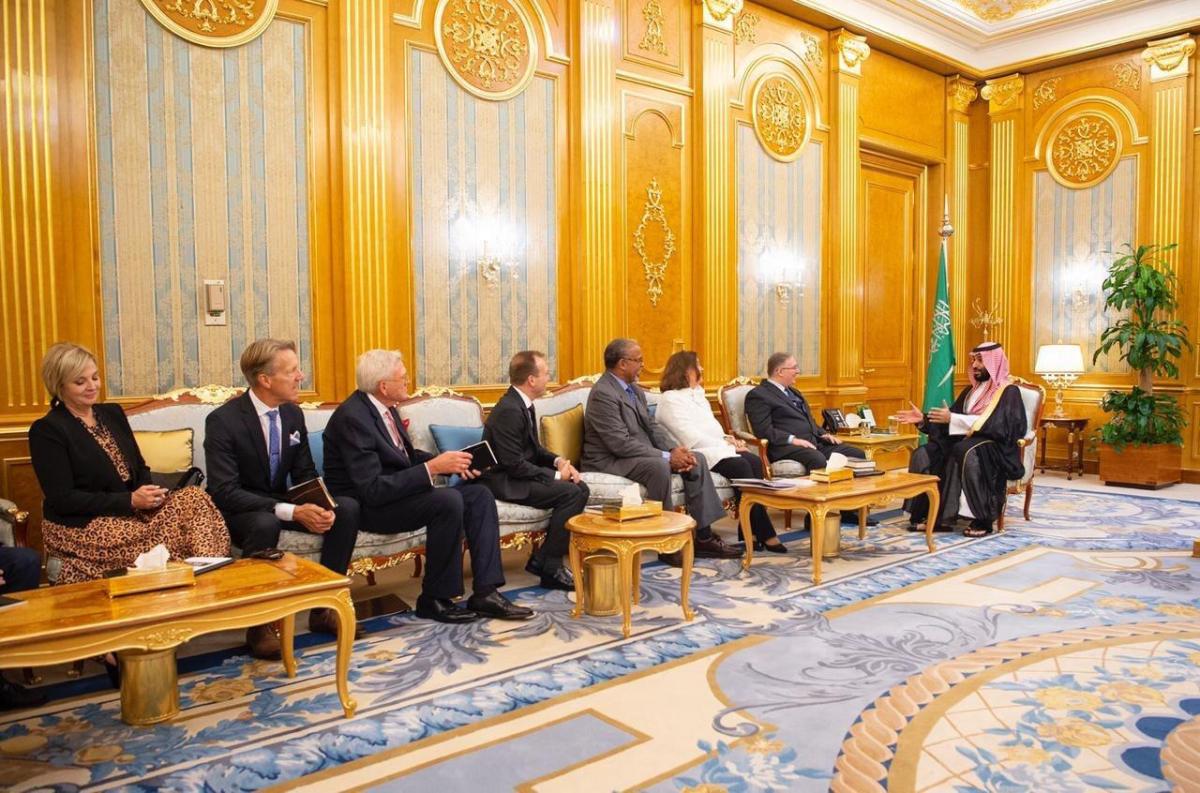
Crown Prince Mohamed bin Salman (right) hosts a delegation of American evangelicals in the Royal Court in Jeddah in September 2019.Courtesy of Joel Rosenberg
Crown Prince Mohamed bin Salman (right) hosts a delegation of American evangelicals in the Royal Court in Jeddah in September 2019.

In Egypt and Jordan, you involved the local Coptic and evangelical communities in your meetings. Have your visits resulted in any tangible gains?

I would defer this to their local leadership. The Christian leaders in some of these countries were rather anxious when they learned this evangelical delegation would be led by a Jewish Israeli American. I was not the poster child for whom they might expect to help them expand relations with their governments. Ironically, the Muslim leaders of their countries were far more secure in reaching out to me than they were—understandably, as they are in charge.

In Egypt, President Sisi, a devout Muslim, met with me five times and invited us to a second visit. This may have provided more confidence for Coptic and evangelical leadership to say this is okay. And in the protocol photo, it was Andrea Zaki who was next to Sisi, while I was out on the edge.

Later, Zaki told me that this was the first meeting he had with Sisi and evangelicals only. This was Sisi honoring them.

I don’t want to overstate this, but it was part of our core values to ask how we could strengthen the local Christian community rather than work around them.

So there may not have been tangible gains, but there were intangible.

To have a photo on the front page of every newspaper in Cairo with the president next to the head of the Protestant community—in his distinctive purple shirt—sent a positive message that our voice is being listened to.

Egypt has a lot of systemic and institutional problems in its relations with Christians. The fact that Sisi honors them and sees them as part of the Egyptian family is important—but it is not sufficient. The question is: How deep will it go? Will every judge, mayor, and policeman also treat Christians respectfully? This is going to take time. Our meetings are not going to solve 1,400 years of troubles.

Your book contains many references to foreign intelligence. A retired CIA station chief helped set up your first meetings with MBZ. How did you navigate such waters? Did you ever feel you were being used for political purposes?

We navigate by being willing to speak with whoever wants to talk to us. Let’s be crystal clear: These Arab leaders have objectives. Their prime objective with us was for their leadership and reforms to be seen positively by the American people—not just in the White House, the National Security Council, the State Department, or the Pentagon.

They realize that Israel has a deep cultural connection to America, such that even amid disagreements the relationship will not break. I think these Arab leaders are concerned—20 years after 9/11—that they have built strong relationships with Washington on the executive level but sometimes not so strong with Congress and almost not at all with the culture or the people.

So how would they do this? [They reasoned:] If there are 60 million evangelicals in the US, maybe we should start meeting some of their leaders. They seem to be peacefully minded and fair. If we get to know them, maybe they will be impressed by our reforms and start thinking about us differently.

I don’t mind this objective. I don’t feel like we’re being used, because we have our own objectives, and they are being mutually achieved. Our objective is to sit in the room with the people who make decisions that affect Christians on the ground in their countries.

And in every case, we were told we were coming off the record, very quietly, just to build a relationship. We said, “That’s good; that’s what we want. We’re not here to get on the front page of your newspapers.” And in every case, at the last moment, they changed that.

Had they always intended that? Maybe, but our motive was to have the relationship and be able to talk not just once but over time.

Were you also a backchannel, expected to take off-the-record comments to American officials?

I don’t think there was any expectation; they have direct channels already. No one asked me to bring a specific type of leader in these delegations. I chose a range, some of whom had close ties with Trump and some who did not—myself included. Some who had good relationships with Congress and some who stayed clear of politics at every level.

I would say we briefed US leaders (and I briefed Israeli leaders) at very senior levels, even about things that were off the record—just so they were aware. I figured in terms of the American and Israeli intelligence services, they probably already knew anyway, but I never got the sense that what I told them they hadn’t heard before.

I did get the sense that they were intrigued how things they knew had been told to us. It suggested not only a level of trust but also a desire to have a more public posture. They weren’t aware the Emiratis or Saudis were willing to do this.

I don’t think they needed a backchannel. They needed a channel to the American evangelical community—to make their case that they are working very hard on sweeping social, economic, and even religious freedom reforms.

Your goal was to build “long-term friendships.” Since the election of President Joe Biden, have Arab leaders continued to reach out to you even as evangelicals are no longer central to the administration?

Yes. Bahrain’s king has invited me to bring a delegation early next year. We will probably also go to the UAE on this trip. I am keeping very close relations with these leaders and their inner circles.

You make a sympathetic case for why we should support these regional leaders, but you also deal with criticisms of their human rights records. How do you keep the balance or decide what to speak about privately as opposed to reporting about on your websites?

The baseline for religious freedom in most of these countries is miserable. I think Jordan is the best; Bahrain is probably second best. The UAE is actually pretty good. If you go back 1,400 years, it’s bad for Christians, and in the last 100 years, it’s been very challenging. But there has been a lot of positive movement. In the UAE, there are 700 freely operating churches, compared to none in Saudi Arabia.

But let’s go to Egypt. They have had a terrible human rights record for centuries, and during [the presidency of former President Hosni] Mubarak, it was terrible. Is it getting better at all? But my baseline is not Mubarak; it is [former President] Mohamed Morsi.

The question is not whether Sisi is doing better than King Abdullah or MBZ. It is: Has Sisi liberated 100 million Muslims from the reign of terror of the Muslim Brotherhood? Yes. Has he rebuilt all the churches burned down or damaged during their era? Yes. Did he build the largest church in the Middle East and give it to Christians on Christmas Eve as a gift? Yes.

He is encouraging religious pluralism and moderation. These are human rights issues, all of them. I think he gets very high marks compared to Morsi and Mubarak.

That being said, is it enough? No. Is he jailing human rights activists and journalists unfairly? Yes, and I say that in the book. There is an overreaction in the Sisi government to ever letting the Muslim Brotherhood emerge again. They have to dial it back.

But I would compare it to Abraham Lincoln during the Civil War. If you don’t have a state, there are no human rights. And the very existence of the state of Egypt was very much in doubt over the last decade. Lincoln arrested journalists and suspended habeas corpus. But we have to understand the context in which he did it. And a lot of my Coptic Orthodox friends are not giving the Egyptian government enough credit.

You spoke to leaders of your theological commitment to the state of Israel that goes beyond politics. Is there a distinction between your efforts of seeking peace with Israel specifically and regional peace in general?

Religious freedom was far and away our No. 1 objective. Certainly, advancing Arab-Israeli peacemaking was a high objective for us all. Whether a reader of Christianity Today sees current Israel as the beginning of the fulfillment of Bible prophecies or not, I think every reader would want to see it as a secure country living in peace with the other countries of the region, just as they would for Brazil or Ghana.

In a post-Holocaust, post multiple Arab-Israeli war era, advancing peace is a good thing, biblical, and certainly one of our important objectives. Helping advance it is a very important human rights objective—and a Christian virtue.

What about peace with Iran? Several evangelicals took hope in the nuclear deal, but in your book you are critical and clear about the threat. You also mention frequently the challenges posed by Turkey’s President Erdogan. Would you make yourself available to these leaders also to bring an evangelical delegation?

I picture a ticket to Tehran as one-way. I see no scenario where I can picture me personally sitting down with the supreme leader of Iran. If there are other Christian leaders who get an invitation and get to go and be a witness for Christ and talk about these issues, I would strongly support it. But as an Israeli Jewish evangelical, there are certain roles in the body of Christ that I can play and certain ones I can’t.

In terms of Erdogan, I probably would go and meet with him, and I am encouraged that leaders in the Jewish community have met with him. But you’re right; I am very critical and am very concerned. I love the nation of Turkey, and I think he is leading it to the dark side. When I look at Andrew Brunson, basically I see Erdogan as someone who took a hostage. It took two years of the president of the United States imposing sanctions to get him out. This is telling us something diabolical about Erdogan.

I’m grateful for the doors that have opened, but I don’t believe I’m the one to lead every delegation to every country. There are real risks. But the apostle Paul believed he was supposed to go to Rome and meet with Nero. He was in chains, and he knew he probably wasn’t going to get out. And he was right. But he wanted to do it, the Holy Spirit wanted him to do it, and it happened.

We need to be willing as followers of Christ to meet with any leader God tells us to and be a witness for him regardless of the consequence—because we serve a King higher than these leaders.

Your conclusion states, “I cannot fully explain why doors to such intriguing leaders have opened for me.” From your first invitation by King Abdullah through the signing of the Abraham Accords, how do you interpret the role God has given you in the Middle East?

Psalm 119:46 says that we will be God’s witness to kings. Most of Christianity is about day-to-day life, ministering to ordinary people in their struggles. And so much of the Scriptures is about showing particular concern for the poor, vulnerable, and powerless. But sometimes we forget that kings and governors also have to have a friend who knows Jesus and speaks of him with love and respect. Paul was given a mission to speak to leaders, not just to the lost.

A lot of it is checking your own motive. Am I there for a photo op or to be a witness? Or did God open a door, and now it would be sinful not to go through it? I’m not saying it is easy, but these leaders need to be engaged. We’ve met with senior Muslim clerics and spoken about our faith. These are very rare moments.

Yes, people will ask how we could sit down with MBS, a man accused of such a heinous murder [of journalist Jamal Khashoggi]. I’ll say: How could Paul meet with Nero? Even if MBS isn’t Nero—but especially if he is—why shouldn’t I meet with him? Interacting with the government is not verboten in the Christian world.

Justice [Louis] Brandeis used to say that sunlight is the best disinfectant. This book will allow people to look at what we’re doing, why we’re doing it, and maybe some people will have constructive criticism. And maybe God will raise up someone to learn from it and speak with the supreme leader of Iran. Or Turkey. Or China. There are a lot of countries that are not going in the right direction.

[But] I find in some Christian circles a resistance, sometimes even a revulsion, to spend time with high officials out of a feeling that it is courting power and ingratiating yourself for your own ambition or vanity. That we should avoid such contact and remain devoutly nonpolitical. But this runs the risk of missing the mission: Everybody in the world needs a friend who loves Jesus. And God changes the hearts of leaders.

CT Then and Now

You can help CT pursue the next decade of kingdom ministry.

The Holy Spirit inspired Billy Graham’s vision for CT. And, for decades, CT has pursued that vision—advancing the stories and ideas of the global church. Today, with your help, CT will inform, transform, and inspire new audiences and new generations with these stories of the kingdom of God.

Give Today.

News

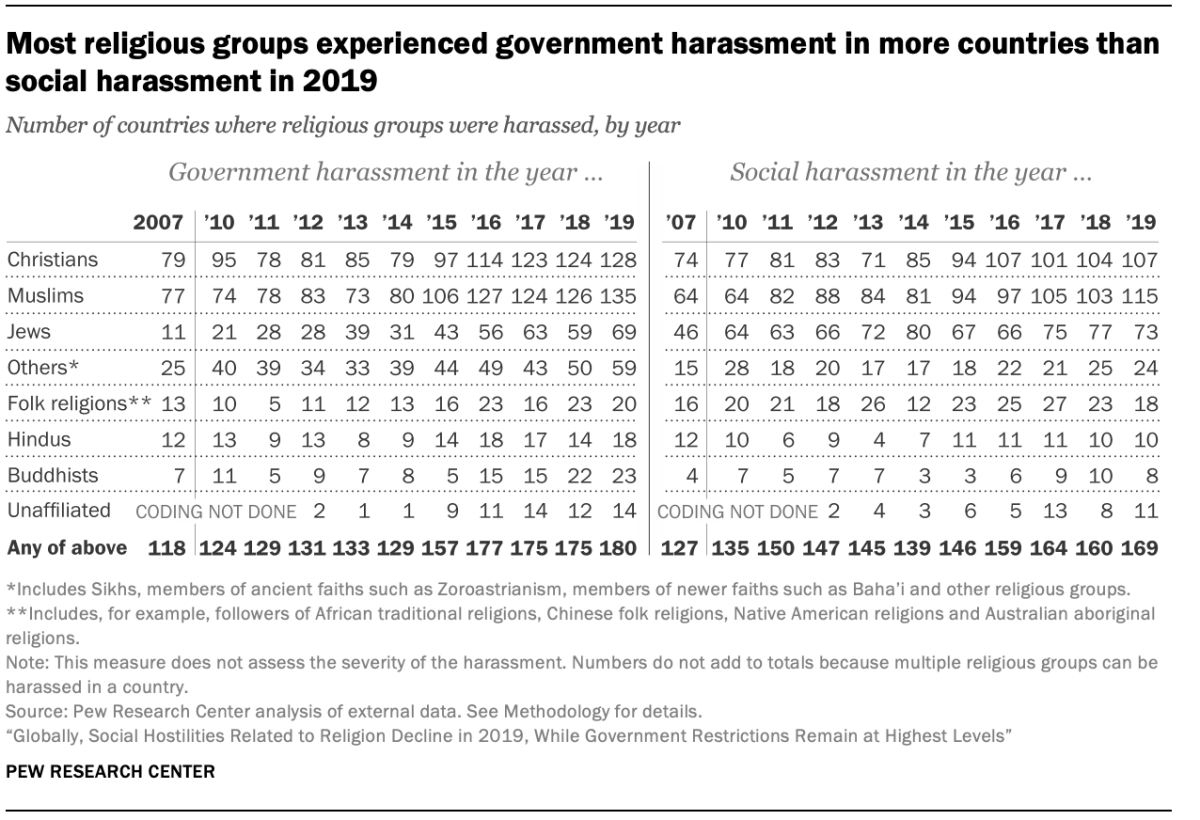
Pew: Religious Terrorism at Record Low, Government Persecution at Record High

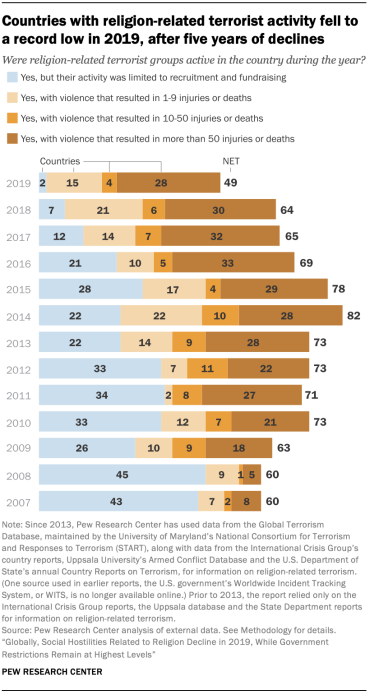
Countries with religion-related terrorist activity at a record low of 49 after five consecutive years of decline. Yet 28 nations still suffered more than 50 people injured or killed.

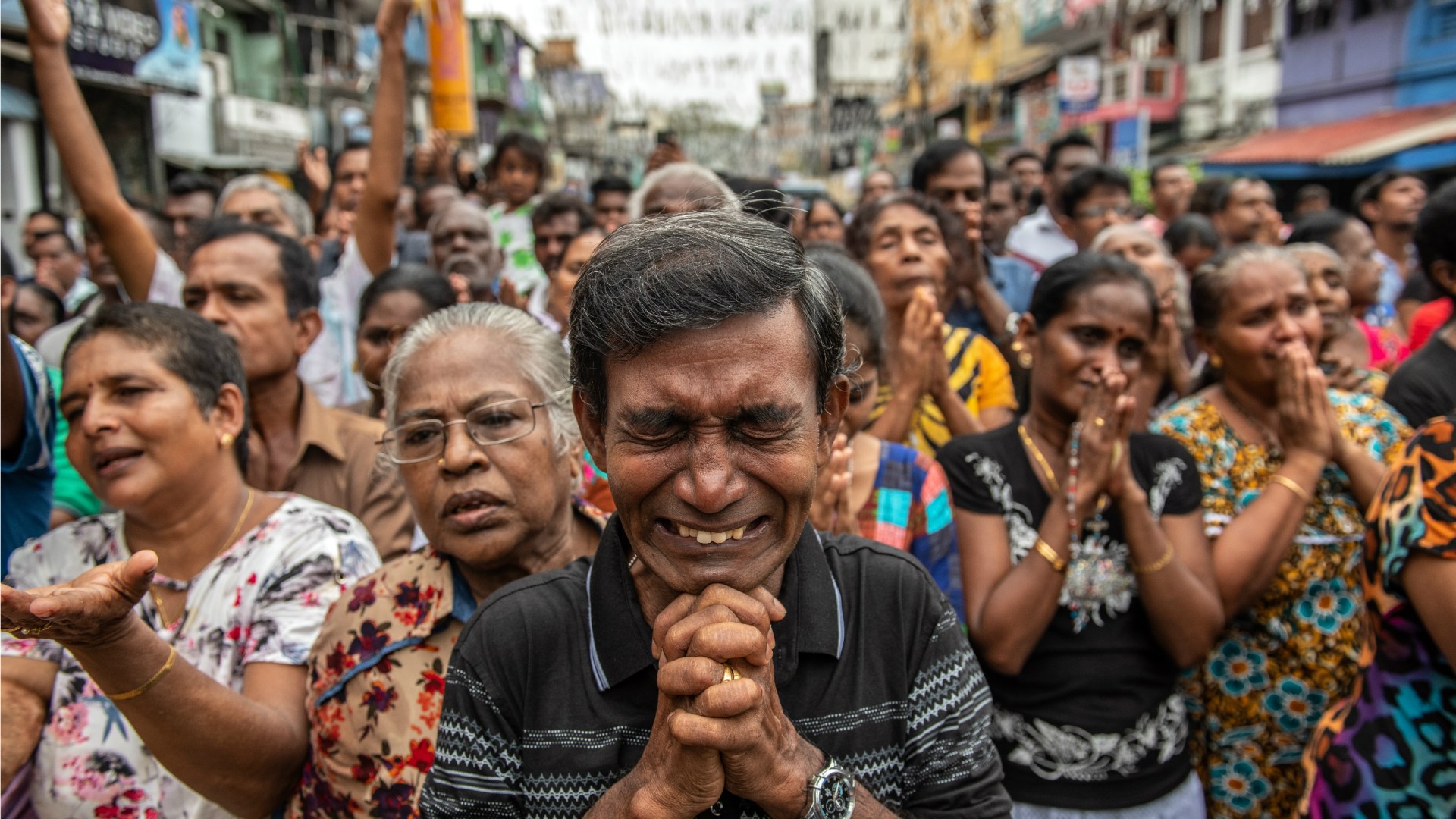
A man cries as he prays in the street near St. Anthony's Shrine one week on from Easter terrorism attacks that killed more than 250 people, on April 28, 2019 in Colombo, Sri Lanka.

A man cries as he prays in the street near St. Anthony's Shrine one week on from Easter terrorism attacks that killed more than 250 people, on April 28, 2019 in Colombo, Sri Lanka.

Christianity Today September 30, 2021
Carl Court / Getty Images

In this series

Government restrictions on religion are at a global high.

Social hostility toward religion, however, is at its lowest level worldwide since ISIS.

So says data analyzed by the Pew Research Center in its 12th annual measurement of the extent to which 198 nations and territories—and their citizens—impinge on religious belief and practice.

The 2021 report, released today, draws primarily from more than a dozen UN, US, European, and civil society sources, and reflects pre-pandemic conditions from 2019, the latest year with available data.

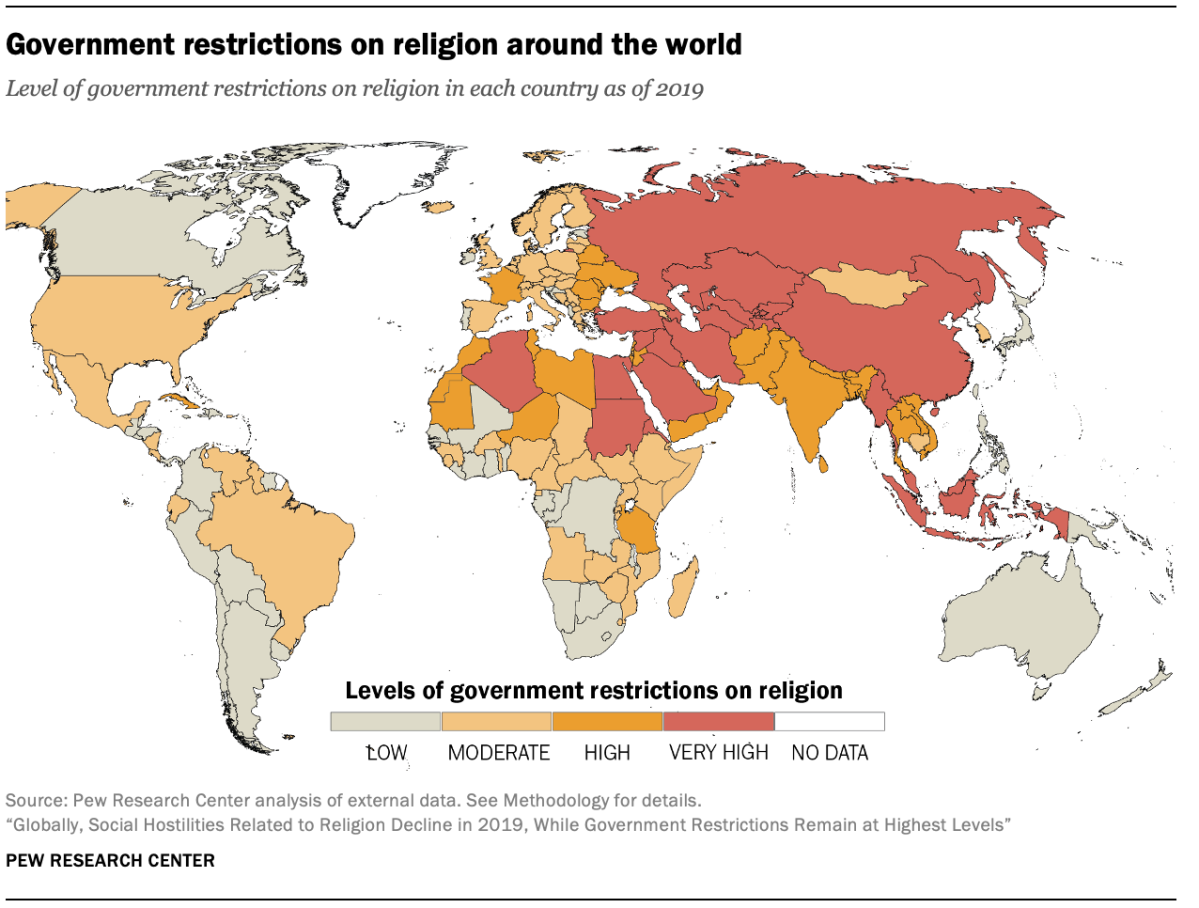
Matching a peak from 2012, 57 nations (29%) record “very high” or “high” levels of government restrictions—an uptick of one nation from 2018. The global median on Pew’s 10-point scale held steady at 2.9, after a steady rise since the baseline of 1.8 in 2007, the report’s first year measured.

Regional differences are apparent: The Middle East and North Africa scored 6.0; Asia-Pacific scored 4.1; Europe scored 2.9; Sub-Saharan Africa scored 2.6; and the Americas scored 2.0.

But across the globe, restrictions are present.

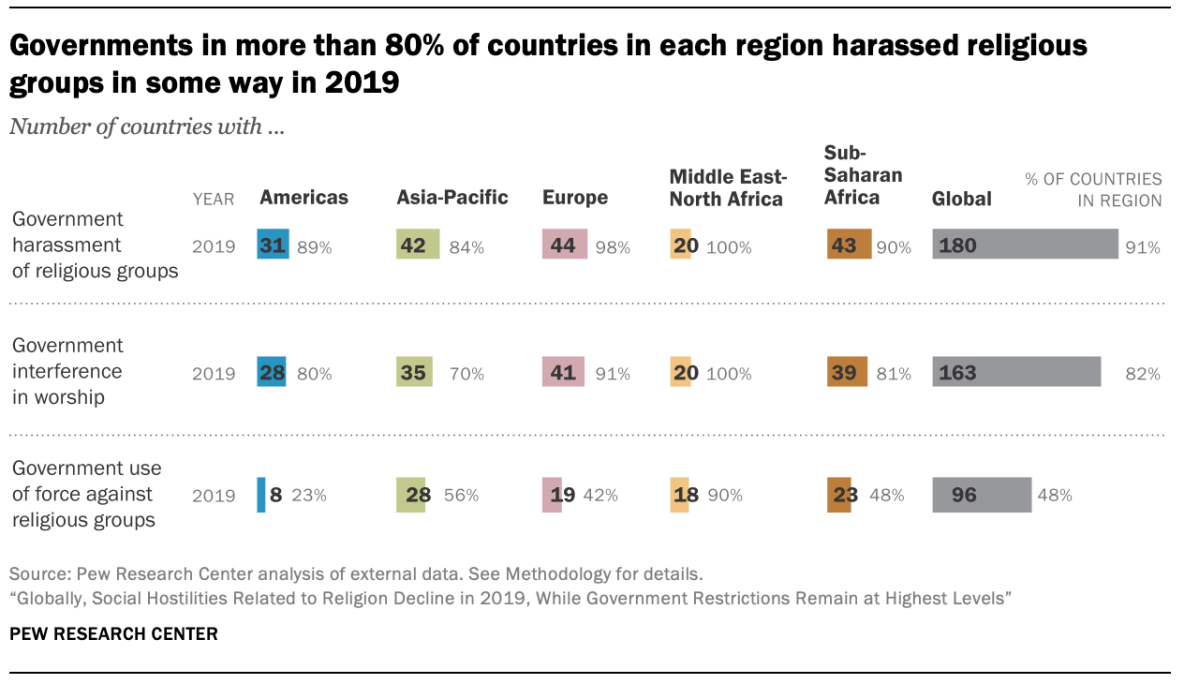
Most common, according to Pew, is “government harassment of religious groups.” More than 9 in 10 nations (180 total) tallied at least one incident. Also common is “government interference in worship.” More than 8 in 10 nations (163 total) recorded incidents.

And nearly half (48%) of all nations used force against religious groups. China, Myanmar (formerly known as Burma), Sudan, and Syria tallied over 10,000 incidents each.

For example, Pew noted: “Renewed fighting between the military and armed ethnic organizations in the [Myanmar] states of Kachin and northern Shan ‘deeply impacted’ Christians, according to USCIRF. In 2019, thousands were displaced—including many Christians—in addition to more than 120,000 Rohingya who already had been internally displaced, and the military damaged over 300 churches.”

While increases were noted in the above categories, the overall median score stayed level due to decreases in two categories. Fewer countries had limits on proselytizing and on foreign missionaries (on both metrics, 77 nations in 2019, down from 81 in 2018). And there were fewer reports of countries denouncing religious groups as “cults” or “sects” (26 nations in 2019, down from 30 in 2018).

The number of nations recording “very high” scores also decreased, from 26 to 23, matching the lowest total since 2015. Kyrgyzstan and Sudan were added to the ranks of the “very high,” while Mauritania, Morocco, Vietnam, Western Sahara, and Yemen scored lower this year.

Overall, all but 14 nations scored about the same as the prior year. “Modest” increases of 1.0 or more were recorded in six countries, while eight declined similarly. No nations registered a “large” variance of 2.0 or more in their score.

If you really love Jesus, don’t honk!I thought for a while that there was something wrong with me. A part of me was pleased with what I shall term the “divine détente” that appeared to be developing quite rapidly in Christian community.However, an uncomfortable question mark tended to hover over what seemed to be not so much détente as impropriety in the expression of our relationship with the diety. God is our personal God; Jesus did say that we are his friends; the Savior used the familiar “Abba” when speaking of the heavenly Father.Yet the model prayer opens the gates of heavenly communion by stating that the name of the One upon whom we call is “hallowed”: holy, consecrated, sacred, revered.In an attempt to break from errors embraced by some traditionalists, is it possible that many in today’s church have also unwittingly tossed aside basic tenets of our faith? In an honest desire to take the church into the streets—and rightly so—are we dangerously close to bringing the streets into the church? The language of today’s liturgy often gives indication that holiness is passé, and we must be careful that we not season our speech with terms that might sound sacred.The old cliché “is nothing sacred anymore?” becomes all too real.In a recent editorial, a Catholic leader, John Catoir, expressed something of the same concern. “Worship cannot be reduced to a coffee klatch where people can smile at one another and feel chummy. We should realize that we are participants in a mystery to which we adhere by faith.… Speech has much to do with language. After all, speech is the language of communication. To convey a sense of mystery one can hardly use the same language spoken at a cocktail party.“Today, unfortunately, the language of worship has become dull, prosaic, without fire of life.… A return to old language is not the answer, a return to poetry is.”I was greatly encouraged to find a kinship in my own thoughts expressed so beautifully by a fellow traveler. For months my spirit had been reiterating the same idea: Bring back the poetry!At a mass youth conference where my late husband and I were scheduled to speak, a popular young minister chided the gathering, “You aren’t enthusiastic! Look at you, sitting there so calmly. You don’t act like this at the ball game!” (No, they don’t, and they were not at a ball game.) The well-meaning minister proceeded to lead some 2,000 youth in a loud, rousing “yell for Jesus.”“Gimme a J! Gimme an E!”As the multitudes moved the stadium into the sanctuary, I cried silently, “Bring back the poetry.”In a small Bible study group, a 60-year-old woman who is gaining increased popularity as a leader in the Christian community told a group of mature women, “We are kids of the King, and isn’t that neat?”I cringed inwardly. As a child of the Creator-God and joint-heir in his kingdom, I am immensely grateful. Being called a “kid of the King” is not a “neat” concept of my faith at all. Bring back the poetry!One senses that society today is grown weary with plastic people trying to sell to a passive public a holy God with unholy speech. No wonder honest seekers become confused. How easily can the Divine be defined when his person and his message are parroted in the language of the coffee klatch or a stadium cheer or in the current vernacular offered by Nielsen’s number one?When well-meaning believers are purporting that we address “Daddy God”; when the Christian community calls upon others to “honk” if they know Jesus; when that redemptive faith that cost the very life of the Son of God is labeled as “really neat,” I continue to struggle with mixed emotions.I sincerely rejoice in the fact that Christians have moved from a lethargic silence into ministry and service. Yet, I do believe that I join multitudes of the faith who applaud outwardly yet plead inwardly for the church to return to a language that defines the Divine.Bring back the poetry.Elaine Herrin is assistant director of public relations with the Georgia Baptist Convention. She is a former missionary and high school English teacher, and author of Two for the Show (Convention Press, 1979).

Pew noted that due to the inability of independent observers to have regular access, North Korea has not been included in the report. Also not included are two new measures among the 20 in Pew’s Government Restrictions Index, in order to maintain continuity with previous reports.

But adapting their methodology in step with a changing world, Pew will hereafter track online restrictions on religion as well as the use of new technologies for surveillance of religion.

For online restrictions, researchers identified 28 nations, including 50 percent of the Middle East and North Africa (10 nations), and 30 percent of Asia-Pacific (15 nations). Two European nations and one from the Americas complete the list.

For surveillance, six of the 10 nations are concentrated in Asia-Pacific, with two in the Middle East and North Africa and two in Europe.

For example, the United Arab Emirates blocked online testimonies from Muslim converts to Christianity. And in China, authorities used facial recognition technology to monitor and collect biometric data on Uyghur Muslims and other groups deemed to be potential threats.

But while governments around the world increasingly restrict religious freedom, the people of the world appear to be growing in their respect for it.

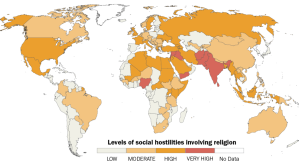
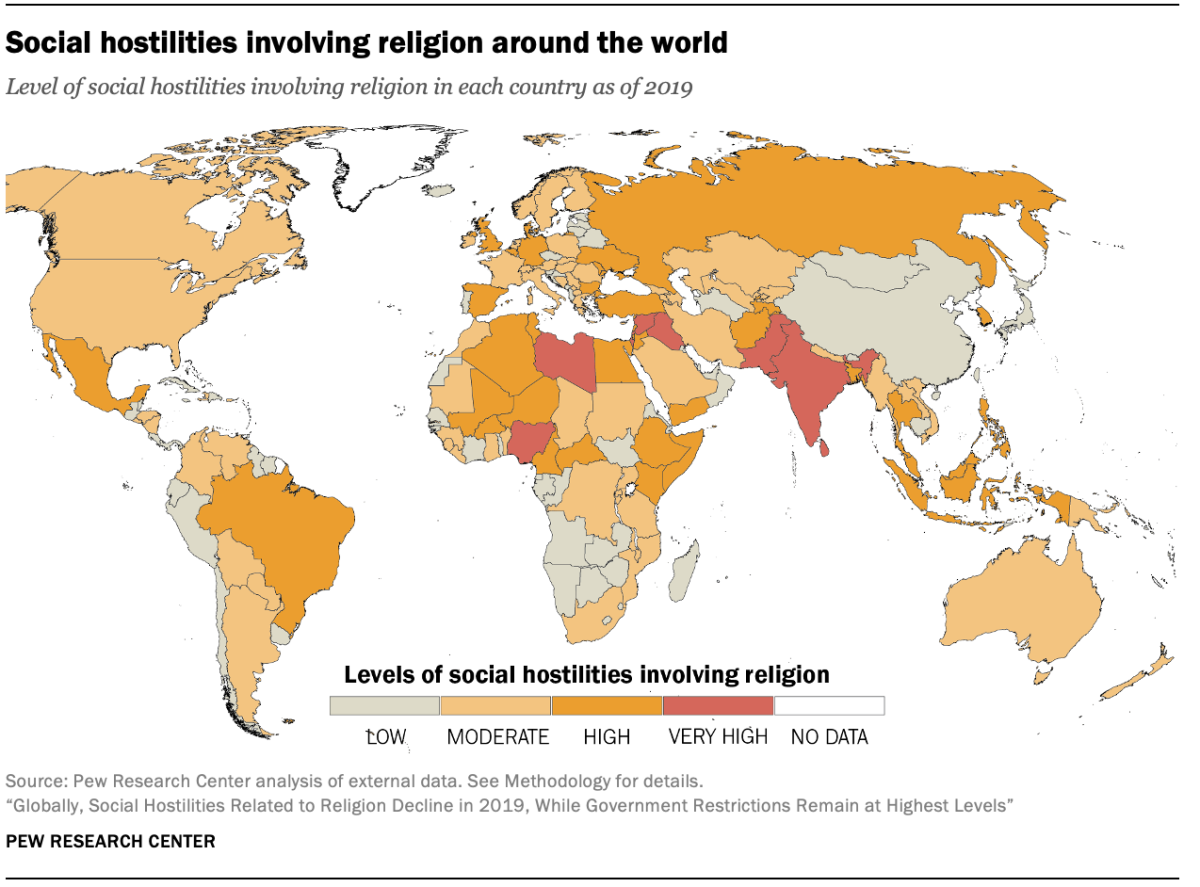
Social hostilities toward religion are present at “very high” or “high” levels in 43 nations (22%). This is down from 53 nations the prior year, and a peak of 65 nations in 2012. Meanwhile Pew’s global median score declined from 2.0 to 1.7, its lowest level since 2014.

“Social hostilities declined in 2019 partly due to a decrease in reports of terrorism, mob violence, and hostilities against proselytizing,” Samirah Majumdar, the report’s lead researcher, told CT.

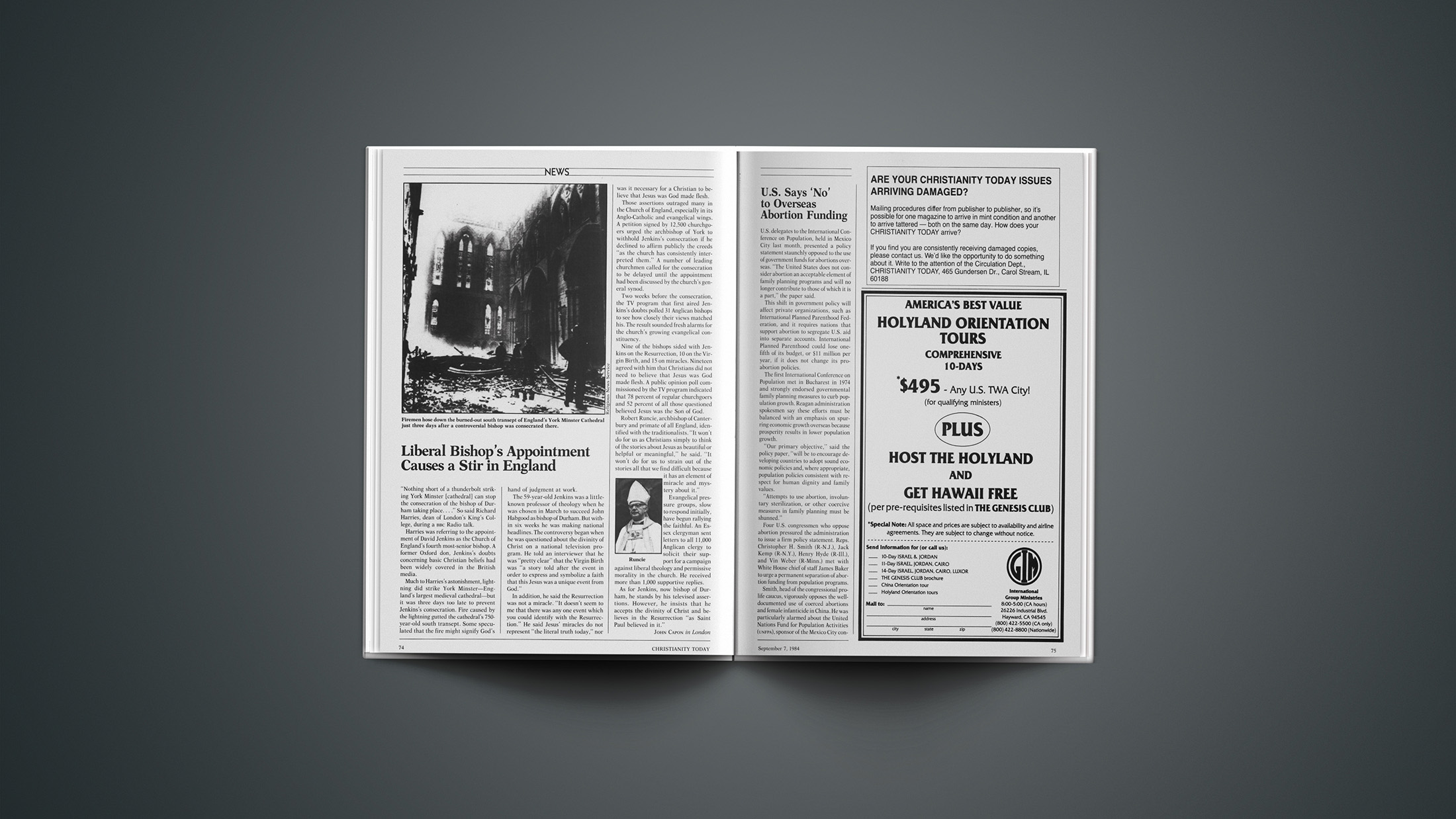
“Nothing short of a thunderbolt striking York Minster [cathedral] can stop the consecration of the bishop of Durham taking place.…” So said Richard Harries, dean of London’s King’s College, during a BBC Radio talk.Harries was referring to the appointment of David Jenkins as the Church of England’s fourth most-senior bishop. A former Oxford don, Jenkins’s doubts concerning basic Christian beliefs had been widely covered in the British media.Much to Harries’s astonishment, lightning did strike York Minster—England’s largest medieval cathedral—but it was three days too late to prevent Jenkins’s consecration. Fire caused by the lightning gutted the cathedral’s 750-year-old south transept. Some speculated that the fire might signify God’s hand of judgment at work.The 59-year-old Jenkins was a little-known professor of theology when he was chosen in March to succeed John Habgood as bishop of Durham. But within six weeks he was making national headlines. The controversy began when he was questioned about the divinity of Christ on a national television program. He told an interviewer that he was “pretty clear” that the Virgin Birth was “a story told after the event in order to express and symbolize a faith that this Jesus was a unique event from God.”In addition, he said the Resurrection was not a miracle. “It doesn’t seem to me that there was any one event which you could identify with the Resurrection.” He said Jesus’ miracles do not represent “the literal truth today,” nor was it necessary for a Christian to believe that Jesus was God made flesh.Those assertions outraged many in the Church of England, especially in its Anglo-Catholic and evangelical wings. A petition signed by 12,500 churchgoers urged the archbishop of York to withhold Jenkins’s consecration if he declined to affirm publicly the creeds “as the church has consistently interpreted them.” A number of leading churchmen called for the consecration to be delayed until the appointment had been discussed by the church’s general synod.Two weeks before the consecration, the TV program that first aired Jenkins’s doubts polled 31 Anglican bishops to see how closely their views matched his. The result sounded fresh alarms for the church’s growing evangelical constituency.Nine of the bishops sided with Jenkins on the Resurrection, 10 on the Virgin Birth, and 15 on miracles. Nineteen agreed with him that Christians did not need to believe that Jesus was God made flesh. A public opinion poll commissioned by the TV program indicated that 78 percent of regular churchgoers and 52 percent of all those questioned believed Jesus was the Son of God.Robert Runcie, archbishop of Canterbury and primate of all England, identified with the traditionalists. “It won’t do for us as Christians simply to think of the stories about Jesus as beautiful or helpful or meaningful,” he said. “It won’t do for us to strain out of the stories all that we find difficult because it has an element of miracle and mystery about it.”Evangelical pressure groups, slow to respond initially, have begun rallying the faithful. An Essex clergyman sent letters to all 11,000 Anglican clergy to solicit their support for a campaign against liberal theology and permissive morality in the church. He received more than 1,000 supportive replies.As for Jenkins, now bishop of Durham, he stands by his televised assertions. However, he insists that he accepts the divinity of Christ and believes in the Resurrection “as Saint Paul believed in it.”JOHN CAPONin LondonU.S. Says ‘No’ To Overseas Abortion FundingU.S. delegates to the International Conference on Population, held in Mexico City last month, presented a policy statement staunchly opposed to the use of government funds for abortions overseas. “The United States does not consider abortion an acceptable element of family planning programs and will no longer contribute to those of which it is a part,” the paper said.This shift in government policy will affect private organizations, such as International Planned Parenthood Federation, and it requires nations that support abortion to segregate U.S. aid into separate accounts. International Planned Parenthood could lose one-fifth of its budget, or million per year, if it does not change its proabortion policies.The first International Conference on Population met in Bucharest in 1974 and strongly endorsed governmental family planning measures to curb population growth. Reagan administration spokesmen say these efforts must be balanced with an emphasis on spurring economic growth overseas because prosperity results in lower population growth.“Our primary objective,” said the policy paper, “will be to encourage developing countries to adopt sound economic policies and, where appropriate, population policies consistent with respect for human dignity and family values.“Attempts to use abortion, involuntary sterilization, or other coercive measures in family planning must be shunned.”Four U.S. congressmen who oppose abortion pressured the administration to issue a firm policy statement. Reps. Christopher H. Smith (R-N.J.), Jack Kemp (R-N.Y.), Henry Hyde (R-Ill.), and Vin Weber (R-Minn.) met with While House chief of staff James Baker to urge a permanent separation of abortion funding from population programs.Smith, head of the congressional prolife caucus, vigorously opposes the well-documented use of coerced abortions and female infanticide in China. He was particularly alarmed about the United Nations Fund for Population Activities (UNFPA), sponsor of the Mexico City conference,because of its four-year, million grant to the Chinese government’s population control program. UNFPA receives millions of American aid dollars.Organizations that promote abortion as a family-planning alternative call the new administration policy “a significant setback.” They may challenge it in Congress by encouraging prochoice representatives to try to legislate a repeal of the strictures on funding.North American SceneThe U.S. Supreme Court has ruled unconstitutional a Maryland law that limited the fund-raising costs of charities. The law sought to forbid fund raisers from charging charities a fee totaling more than 25 percent of contributions raised. The court’s majority opinion said the law operated on the “mistaken premise that high solicitation costs are an accurate measure of fraud.”A federal judge has ruled against municipal sponsorship of a Michigan nativity scene because it promoted only one set of beliefs. The U.S. Supreme Court earlier upheld a nativity display on public property in Pawtucket, Rhode Island. However, U.S. District Judge Anna Diggs Taylor noted that the Pawtucket display included secular holiday symbols. She ruled that the Birmingham, Michigan, nativity scene was strictly religious.A number of proabortion and feminist organizations are urging President Reagan to denounce violence against abortion clinics. The National Abortion Federation, whose Washington, D.C., headquarters were damaged by a bomb blast in July, reports that 10 clinics have been bombed or damaged by arson this year.A group of Methodist clergymen and the American Jewish Congress are challenging a federal program designed to discourage adolescent sexual activity. Filed through the American Civil Liberties Union, the suit argues that the Adolescent Family Life Program promotes religious teachings in violation of the First Amendment. Under the law, the government has distributed more than million to hospitals, universities, social service agencies, and religious organizations.The U.S. Army is using a version of theFocus on the Familyfilm series to help provide positive role models for soldiers and their spouses. Christian author James Dobson, whose organization produced the film series, is a member of the army’s Task Force on Soldiers and Families.An association of 51 Southern Baptist churches in North Carolina has taken its denomination to task for adopting an antitobacco resolution. Southern Baptist Convention messengers (delegates) in June urged Congress to terminate subsidies to tobacco farmers and encouraged Southern Baptists who grow tobacco to switch to another crop. A recent resolution adopted by the Johnson Baptist Association in North Carolina calls the crop “the lifeline for many of our people and the majority of the churches” in the association.The science education program at Liberty Baptist College has gained the approval of Virginia’s state board of education.Last year the program won conditional approval after a battle over whether Liberty graduates would teach creationism. College chancellor Jerry Falwell had sparked the dispute by saying Liberty graduates would teach evolution only to show that it is “foolish.” Recently, a committee appointed by the state board of education found the college’s biology curriculum to be scientifically sound.A Washington, D.C., newspaper owned by Sun Myung Moon’s Unification Church has fired its editor and publisher. Officials at the Washington Times said James Whelan had made outrageous contract demands, including a salary increase from ,000 to 5,000 by 1989, a rent-free 0,000 house, and a new luxury car every two years. Whelan charged that Moon’s church had assumed direct control of the newspaper. The Unification Church has pumped 0 million into the two-year-old operation to keep it alive.A group of religious radio stations and a music licensing agency have resolved more than seven years of litigation. U.S. District Judge Whitman Knapp approved a settlement between some 75 radio stations and the American Society of Composers, Authors and Publishers (ASCAP). The stations had challenged the method ASCAP uses to charge fees to radio stations that broadcast music licensed by ASCAP. The settlement provides for a judge to determine reasonable fees when religious radio stations and ASCAP fail to agree on terms for licenses.

Pew highlighted declines in five of the 13 measures of its Social Hostilities Index.

Religion-related terrorism (including “deaths, physical abuse, displacement, detentions, destruction of property, and fundraising and recruitment by terrorist groups”) was recorded in 49 nations—a record low, down from 64 the prior year and from a high of 82 in 2014 (which led the US State Department to declare terrorism as the persecuted church’s biggest threat). In sub-Saharan Africa the number of countries experiencing religious terrorism stayed stable, in all other regions the tally dropped.

However, 28 nations did experience terrorist violence resulting in more than 50 injuries or deaths—a grim tally that has stayed relatively stable since 2013. When the report began in 2007, fewer than 10 nations suffered the same.

Pew highlighted Sri Lanka as the worst example in 2019. Over 250 people were killed and 500 injured during an ISIS-affiliated series of bombings at churches and hotels on Easter Sunday. But Afghanistan was also noted, for attacks carried out by the Taliban.

Mob violence was recorded in 34 nations, down from 41. And social hostilities stemming from proselytism were recorded in 28 nations, down from 35.

Efforts to enforce a dominant religion or religious norms also declined. Group hostility was recorded in 94 nations, down from 104, and individual hostility in 74 nations, down from 85.

Bolivia was highlighted, as unlike the year before there were no reports of Protestant missionaries expelled from rural areas by practitioners of indigenous belief. And in Egypt, while violence toward Christians continued, there were fewer abductions and displacements reported, leading to a reduction of social hostilities from “very high” to “high.”

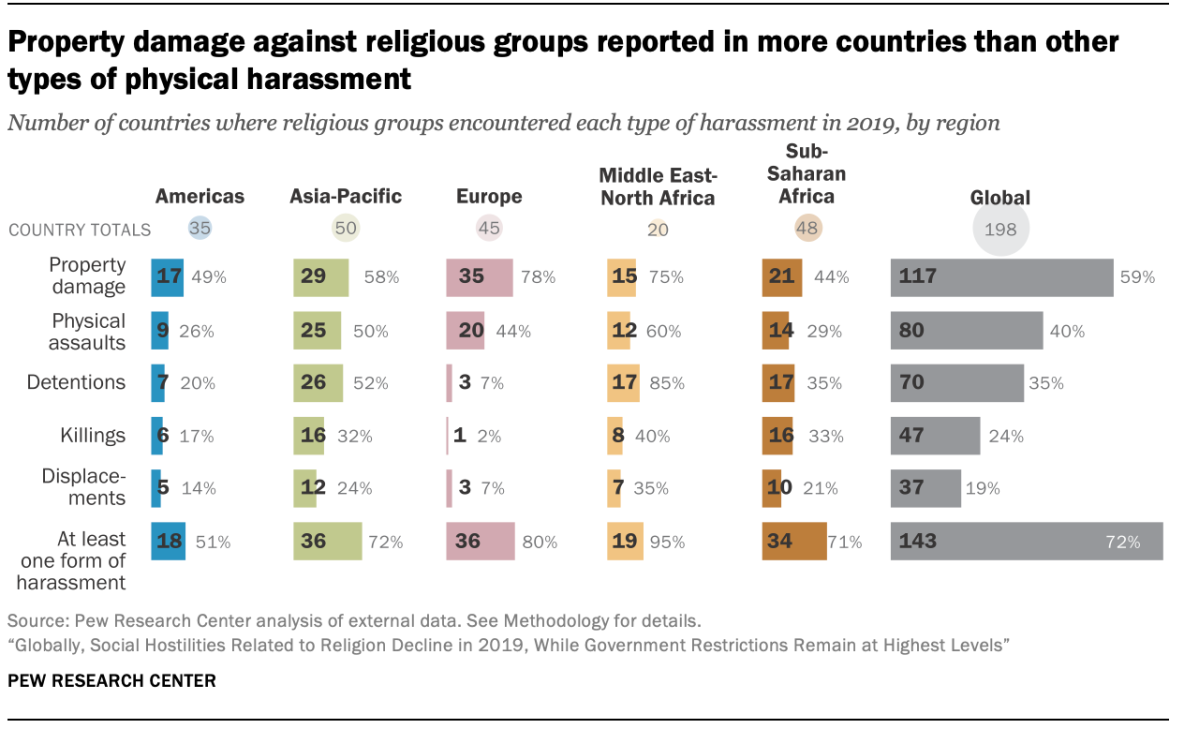
Pew also tallied the type of force or violence inflicted around the world. Property damage (occurring in 59% of nations), physical assaults (in 40%), detentions (in 35%), killings (in 24%), and displacement (in 19%) were ranked from most to least common.

Again, regional differences were apparent: the Middle East and North Africa scored 3.8; Europe scored 2.1; Asia-Pacific scored 1.9; Sub-Saharan Africa scored 1.7; and the Americas scored 0.7. Only Europe ticked upward. In Denmark, Pew noted, vandals destroyed over 80 tombstones in a Jewish cemetery on the anniversary of a 1938 pogrom.

However, a federal appeals court bars a Bible club from meeting in a Pennsylvania school.Equal-access legislation, ardently supported by almost all evangelical and mainline church organizations, has become federal law. It prevents public secondary schools from disbanding student religious groups that want to meet for prayer, Bible study, or discussions of religion (see related editorial on p. 12).Heartfelt, sometimes rancorous, congressional debate about the measure hinged on a question that ordinarily lies dormant beneath the surface of national consciousness: May individual rights of free speech and assembly cross over the boundary between church and state?In response, the U.S. Senate voiced a resounding yes, voting 88 to 11 in favor of the bill. The U.S. House of Representatives followed suit in July with a 337 to 77 vote. But on the same afternoon the House took its decisive vote, a U.S. Circuit Court of Appeals in Pennsylvania said no. The court overturned an earlier ruling in favor of Williamsport high school students who organized a Bible club called Petros.To protect groups like Petros, the Equal Access Act makes it unlawful for any public secondary school to discriminate against student groups based on the subject matter they are discussing. It protects “religious, political, philosophical, or other” types of speech rather than singling out only religious speech. The law does not allow nonstudents to “direct, conduct, control, or regularly attend” such meetings.The act does not authorize the government to withold federal financial assistance to schools that do not comply, a provision earlier drafts included. It defines “noninstructional time”—during which extracurricular groups may meet—as occurring before or after the school day begins. It does not specifically prohibit religious meetings during free periods throughout the school day, but court decisions around the country, including the recent Williamsport ruling, have done so.Conservative members of Congress, discontent over compromises in the wording of the act, pushed ahead with proposals for vocal and silent prayer during class time. A measure endorsing silent prayer passed in the House, while a more sweeping proposal failed. The silent-prayer amendment that passed the House stood slim chance of coming up in the Senate, which would have to debate and pass it before it became law.An earlier version of the Equal Access Act failed to pass the House in June after it was blocked by the American Civil Liberties Union (ACLU), National Education Association (NEA), and several Jewish lobby groups (CT, June 15, 1984, p. 58). In the wake of that narrow defeat, Senate sponsor Mark O. Hatfield (R-Oreg.) redoubled his efforts to work out an acceptable compromise.Drafting the bill and nudging it through Congress proved to be a grueling decathlon of unusual procedures, power plays, and negotiation. Hatfield’s staff lawyer Randy Sterns met with strategists from the Christian Legal Society (CLS), National Association of Evangelicals, and Baptist Joint Committee on Public Affairs. They painstakingly weighed and measured the nuances of each phrase troubling the bill’s opponents. Finally, the ACLU declared itself neutral toward the measure, and Hatfield attached it to a bill providing federal funds to upgrade math and science teaching—a program dear to the heart of the NEA. Once the ACLU declared a truce, “that broke the logjam and changed a lot of votes,” Sterns said.Hatfield’s involvement with the issue began in 1981 after a court decision in Lubbock, Texas, prevented a student religious group from meeting at school. In response, Hatfield shaped a coalition of 24 senators who filed an unprecedented friend-of-the-court brief on behalf of the Lubbock students. “We built a strong basis of support from which to introduce this bill,” Sterns said, including 50 cosponsors by the end.After achieving Senate passage, the bill went to the House. It was promptly shelved by House Speaker Thomas P. O’Neill, who sent it to two committees from which he never expected it to emerge. But Democrats who supported the measure threatened to use an obscure confrontational tactic to upstage committee chairmen who tried to block the bill.O’Neill backed down and agreed to suspend the usual rules of debate. That move was necessary to prevent opponents from choking off debate by offering hundreds of meaningless amendments.Opponents voiced fears of cults infiltrating student meetings; of “student-initiated catechism or baptism or other religious services”; and of school districts “inundated by demands from students for religious meetings of various types of cults, fringe groups, and allegedly religious movements.”Throughout the congressional wrangling, equal-access supporters drew attention to the Williamsport case, a classic illustration of the type of discrimination they wanted to remedy. To their relief, the appeals court decision opposing the students came down after Congress approved the Equal Access Act.The appeals court ruling acknowledges the students’ right to free speech and the school’s prerogative to allow clubs to meet in its classrooms. But the court applied a traditional three-part test of whether a religious activity is constitutional, and it gave the Petros club a failing grade because it would have the effect of “advancing” religion under the auspices of the state.The majority said high school students are apt to be immature and impressionable, thus “less able to appreciate the fact that permission for Petros to meet would be granted out of a spirit of neutrality toward religion and not advancement.” Some students may come to believe that the school endorses and encourages religious practice, the decision says, because “involuntary contact between nonparticipating students and religious groups is inevitable.” The club is unconstitutional, according to the court, because “public schools have never been a forum for religious expression.”A strong dissent by one circuit court judge pointed out that Petros is the only club in the school’s history to be denied the right to meet. This “selective exclusion,” he said, raises a more pertinent question: Is the school officially hostile to religion?Sam Ericsson of CLS, lead counsel for the Williamsport students, said he will appeal the case to the U.S. Supreme Court. Because a number of similar lower-court rulings conflict with a two-year-old U.S. Supreme Court decision permitting college students to meet on campus for religious purposes, it is likely that the high court will agree to rule on the Williamsport case.Court decisions have made school officials increasingly wary of allowing student religious groups to meet. But passage of the Equal Access Act trumpets a clear signal that these clubs are legitimate and acceptable. Even so, future court challenges are expected.“We have no sense of smugness about resolving every issue that’s going to come up,” Sterns said. “The particulars will have to be worked out in case-by-case litigation.” Meanwhile, it is up to students, parents, and schools to work out ways to exercise their equal-access rights.U.S. Churches Debate Wide Array Of Issues During Summer MeetingsThe General Board of American Baptist Churches (ABC) has affirmed the competence of Christians to make decisions regarding “covenantal, intentional family arrangements,” an apparent reference to homosexual unions. The board also asked the 1.6-million-member ABC to help strengthen family units of all kinds, including “covenantal family-like groups.”The action came as part of a policy statement on family life approved by the general board at its summer meeting. The statement was adopted by a vote of 140 to 24, with 4 abstentions.One denominational official stressed that the statement upholds an individual’s right to choose, and does not address the morality of all choices. Some board members asked if the reference to “covenantal, intentional family arrangements” could be construed as approving homosexual unions. Robert Chew, a member of the task force that prepared the statement, said it does not condone all family lifestyles. Instead, the statement is a “mandate to ABC churches to minister to every kind of lifestyle that exists,” he said.The statement also says remarriage for divorced Christians is “appropriate where the issues which ended an earlier marriage have been addressed.” However, it affirmed that God intends marriage to be monogamous and lifelong.The general board also urged the U.S. government to reject a military approach to problems in Central America and instead stress assistance in economic development. In addition, the board spent four hours debating American Baptist involvement in ecumenical organizations. At its December meeting, the board will vote on a statement that reaffirms the denomination’s commitment to the National Council of Churches and World Council of Churches.Other major American denominations met during the summer, debating issues from abortion to ordaining women as deacons. Actions taken include the following:• The all-male general synod of the 300,000-member Christian Reformed Church voted 82 to 75 to allow women to be ordained as deacons. The synod gave local congregations the right to decide whether to implement the decision. Women continue to be excluded from the offices of minister, elder, and evangelist.The 160-member synod also declared that theological support for apartheid—South Africa’s ideology of racial segregation—is heresy.• Delegates to the Lutheran Church in America (LCA) convention adopted a statement that says nuclear weapons must not be seen as a permanent deterrent to war. The statement deplored the sale of military arms and expressed alarm at the “proliferation of nuclear weapons.” The delegates, representing three million Lutherans, also condemned foreign military intervention in Central America and asked that U.S. economic aid be withheld from regimes that violate basic human rights.• Delegates representing the Church of the Brethren’s 164,000 members adopted a statement that reiterates its opposition to abortion. In other action, delegates appointed a committee to study and make recommendations on how the historic peace church should respond to the dilemma of paying for war through taxes.• Commissioners to the Presbyterian Church in America (PCA) general assembly voted not to call the mainline Presbyterian Church (USA) “apostate.” The assembly said it did not want to put itself in the position of labeling more liberal church bodies. Commissioners also rejected a proposed study to explore a possible role for women as deacons in the 135,000-member denomination.As the world’s attention was fixed on Olympic athletes striving for the gold, another quieter yet massive effort was taking place. Some 11,000 Christian volunteers from 77 countries were sharing their faith with foreign visitors and Los Angeles-area residents.The evangelistic outreach—sprawling over an 80-mile radius surrounding the Olympic competition—was assisted by 1,800 area churches. Campus Crusade for Christ, Messengers International, the International Church of the Foursquare Gospel, Youth With a Mission, and 10 other major organizations recruited volunteers. Participants served without pay, and were responsible to cover their living expenses during the effort. Some were housed by Christians in the area, while others lived in churches, schools, or missions.Several methods of evangelism were used, from one-on-one conversations to dramatic and musical presentations. Drama and music were employed in more than a thousand outreach sites, including stages set up near Olympic athletes’ villages. Singers such as Debby Boone, Andraé Crouch, and Donna Summer, and 150 groups, performed 700 hours of gospel music.Much of the Christian witness was focused on the athletes’ villages. The U.S. Track and Field Team contained 60 professing Christians among its 120 members. Some of these, including gold medalist Carl Lewis, gave public testimonies of their faith at an event organized by Laywitnesses for Christ International. Several Christian athletes sacrificed thousands of dollars in promotional fees from athletic clothing manufacturers by choosing to wear Christian T-shirts at public events.Volunteers witnessed to international visitors on the streets. The mayor of Paris expressed surprise at the numbers of Christians he saw engaged in evangelism. Egyptians involved in the outreach focused on Arabs, giving Bibles to athletes from Muslim countries that are difficult to penetrate with missionary activity.On Hollywood Boulevard, Christian groups performed on a stage set up near massage parlors and pornographic movie theaters. Other groups witnessed in Los Angeles’s many ethnic neighborhoods.A Fijian group called Island Review was warmly received in black and Hispanic areas. At one performance in an inner-city park, 20 gang members stepped forward to acknowledge Christ as their Savior.Olympics outreach chairman John Dawson estimates that during the Summer Games, at least 1,000 persons a day made decisions to follow Christ.JANICE ROGERS




The number of nations scoring “very high” levels of social hostilities also decreased, from 10 to 8, the lowest tally in over a decade. The Central African Republic and Egypt were removed from the list.

Overall, there was more variance in social hostilities year-over-year than in government restrictions. “Modest” increases in score of 1.0 or more were recorded in 10 countries, while 32 declined similarly. One nation—Burkina Faso—scored a “large” increase of 2.0 or more, while Armenia, Greece, Kyrgyzstan, Malaysia, and Romania declined by the same amount.

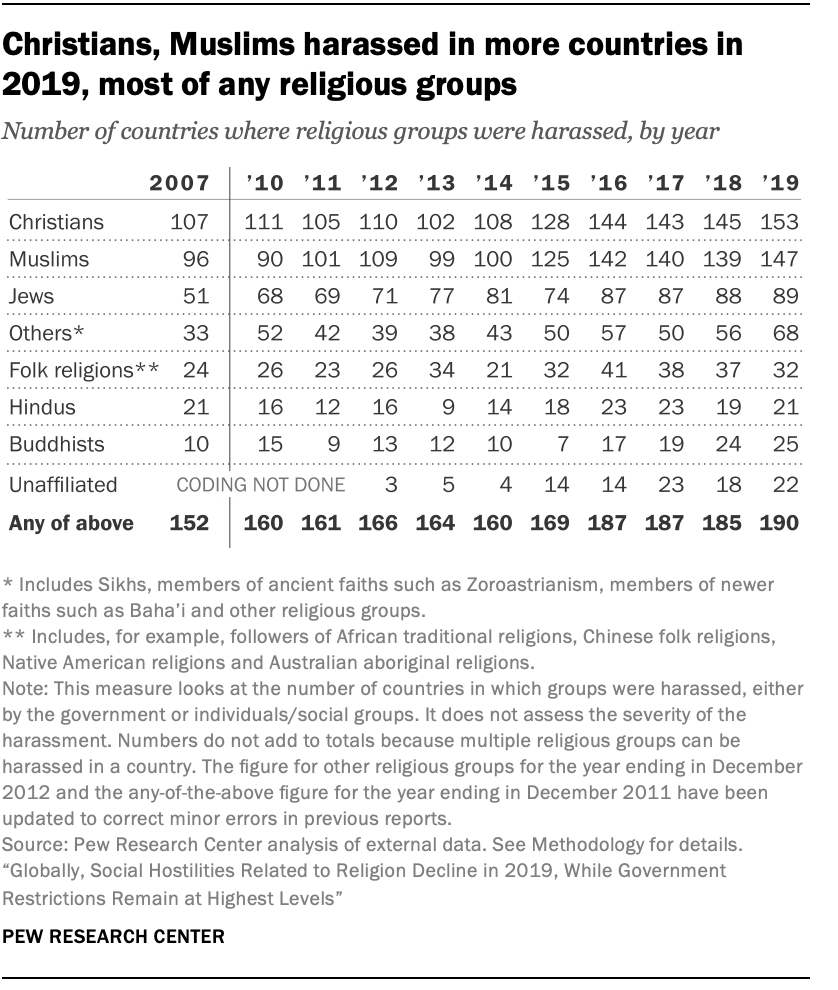
Christians and Muslims remain the religious groups receiving harassment most widely. The number of nations harassing Christians increased from 145 to 153, while the nations harassing Muslims increased from 139 to 147. Jews, harassed in 89 nations (up from 88), were the only group to receive more pressure from society than from government.

An “other” category of Baha'is, Sikhs, and Zoroastrians followed, harassed in 68 nations, followed by folk religions in 32. Violations against Buddhists (in 25), Hindus (in 21), and an “unaffiliated” category of atheists, agnostics, and humanists (in 22) were less widespread.

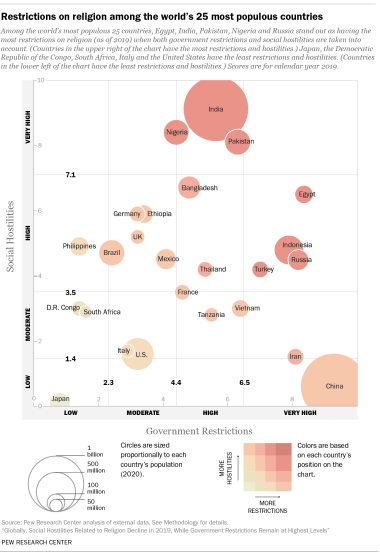
In addition to a tally of nations, Pew also organized data to measure the impact of restrictions and hostilities on a wide scope of humanity. Among the 25 largest nations—representing 75 percent of the world population—Egypt, India, Pakistan, Nigeria, and Russia recorded the highest overall levels. Japan, the Democratic Republic of Congo, South Africa, Italy, and the United States ranked lowest.

Porn opponents call for a boycott of 7-Eleven, a leading retailer of sexually explicit magazines.Pornography was put on center stage when former Miss America Vanessa Williams was dethroned after Penthouse magazine published sexually explicit photos of her. The National Federation for Decency (NFD) is working hard to keep the porn issue in the spotlight.Last month the group organized a nationwide, one-day picket of 7-Eleven, the convenience store leader. Demonstrators showed up at more than 400 7-Eleven stores in some 150 cities. The NFD says 7-Eleven leads the nation in retailing pornographic magazines. A 7-Eleven spokesman says the charge can neither be conclusively confirmed nor disproved.The NFD also has urged a boycott of the convenience-store chain until it changes its policies on porn retailing. The organization says its efforts already are netting results. A number of retail chains, other than 7-Eleven, have discontinued the objectionable magazines, says NFD associate director Steve Hallman. Handy Marts Corporation, which owns 78 7-Eleven stores, has pulled the magazines on a two-month test basis.There are almost 7,400 7-Eleven stores in the United States. Most are owned and operated by the multi-billion dollar Southland Corporation, based in Dallas. Doug Reed, Southland’s media relations coordinator, says there will be no changes in his company’s policy on porn retailing. That policy allows for the sale of just three “men’s” magazines—Playboy, Penthouse, and Forum. These are covered with blinders that allow only the titles to show, and they are not advertised.However, independent franchisees own 35 percent of the nation’s 7-Eleven stores. Some openly display as many as 60 pornographic magazines. Reed says Southland urges compliance with corporation policy on the sale of such magazines, but has no legal control over independent owners.“We consider ourselves a public-minded corporation,” he says. “We don’t want to offend anyone, but we recognize that [the magazines] are products some people request. We are not in the position to make moral judgments for our customers.”The antipornography movement has embraced a boycott strategy partly because of perceived lax enforcement of laws regulating the pornography industry. Most states have enacted some form of antiobscenity laws. In addition, federal laws prohibit the shipping, mailing, and importation of obscene material.However, it can be difficult to determine what is obscene. The U.S. Supreme Court in Miller v. California (1973) defined obscenity in terms of what an “average person” would find “patently offensive” by applying “contemporary adult community standards.” For guilt to be established, someone must initiate legal proceedings against each violation.When a case does go to court, defense lawyers—heavily subsidized by the pornography industry—are often able to outmanuever prosecutors. Paul McCommon, legal counsel for Citizens for Decency through Law, says the current system, with its heavy emphasis on civil rights, favors pornographers. He adds that most authorities have not taken the initiative to prosecute and punish violators.Meanwhile, the pornography industry burgeons. Some analysts say it does billion worth of business annually. Accurate figures are hard to come by since some segments operate underground. “The pervasiveness of the problem increases every day,” McCommon says. “This is easily observable based on what’s available on cable TV, at video stores, corner stores, and gas stations.”The conviction that pornography degrades women has drawn feminists into the fray. City councils in Minneapolis and Indianapolis have passed bills that would outlaw pornography as a violation of women’s rights. (The Minneapolis measure was vetoed by the city’s mayor. The Indianapolis ordinance is being challenged in court.)The chairman of the Playboy Foundation, Burt Joseph, claims there is no connection between reading sexually explicit material and criminal behavior, such as rape. “The studies show that it’s the violence, not the sex, that causes antisocial conduct,” he says. Playboy does not publish photographs dealing with violence and refuses to accept advertising for guns, he says.Joseph, who does not consider Playboy to be pornographic, theorizes that censors and pornographers need each other to keep their trades alive. “Only when pornography is suppressed,” he says, “does it continue to have a market interest. If people wanted to stamp out pornography, they should let it proliferate, and it would lead to boredom.” Critics call Joseph’s solution naïve and his evaluation of Playboy inaccurate. Both those who agree and disagree with him cite studies to support their views.Not only has the pornography industry expanded, but its tone has changed markedly in recent years. Thirty years ago, when Playboy was alone in the field, pornography consisted of pictures of nude women. But Playboy, now considered relatively tame, has lost a large segment of the market. It now has 4.1 million subscribers, down from 7.2 million in its peak year of 1972. In many magazines, today’s pornography includes depictions of sadomasochism, rape, bestiality, and urination. In addition, some porn monitors estimate that more than 200 pornographic magazines exploit children. Some are published for profit; others serve a subculture of pedophiles.Pornography’s turn toward the violent, bizarre, and grotesque has given rise to sociological and psychological analyses of the problem. Robert Moore, a professor of psychology and religion at Chicago Theological Seminary, says people who have been deprived of loving relationships early in life are prime candidates for psychological addiction to pornography.Jean Bethke Elshtain, a University of Massachusetts professor of political science, writes in The New Republic that the porn plague mirrors “a world in which human beings … see themselves as objects of social forces over which they have no control.” She says pornography offers the viewer the illusion of “unlimited power to bend others to his will.”

If measuring just government restrictions, China, Iran, and Indonesia join Egypt and Russia with the highest scores. If measuring just social hostilities, then Bangladesh replaces Russia in the grouping.

Only China and Japan score “low” levels of social hostility, however. The United States, while lowest overall among the 25 most populous nations, is ranked along with Iran and Italy as “moderate.”

Grading took place on a scale. The top 5 percent of nations in each index are categorized as “very high,” while the next 15 percent are “high.” The following 20 percent are categorized as “moderate,” while the remaining 60 percent are “low.”

“Terrorism and war can have huge direct and indirect effects on religious groups, including destroying religious sites, displacing whole communities and inflaming sectarian passions,” Pew researchers noted. “Accordingly, [Pew] tallied the number, location and consequences of religion-related terrorism and armed conflict around the world, as reported in the same primary and secondary sources used to document other forms of intimidation and violence. However, war and terrorism are sufficiently complex that it is not always possible to determine the degree to which they are religiously motivated or state sponsored.”

“Nothing short of a thunderbolt striking York Minster [cathedral] can stop the consecration of the bishop of Durham taking place.…” So said Richard Harries, dean of London’s King’s College, during a BBC Radio talk.Harries was referring to the appointment of David Jenkins as the Church of England’s fourth most-senior bishop. A former Oxford don, Jenkins’s doubts concerning basic Christian beliefs had been widely covered in the British media.Much to Harries’s astonishment, lightning did strike York Minster—England’s largest medieval cathedral—but it was three days too late to prevent Jenkins’s consecration. Fire caused by the lightning gutted the cathedral’s 750-year-old south transept. Some speculated that the fire might signify God’s hand of judgment at work.The 59-year-old Jenkins was a little-known professor of theology when he was chosen in March to succeed John Habgood as bishop of Durham. But within six weeks he was making national headlines. The controversy began when he was questioned about the divinity of Christ on a national television program. He told an interviewer that he was “pretty clear” that the Virgin Birth was “a story told after the event in order to express and symbolize a faith that this Jesus was a unique event from God.”In addition, he said the Resurrection was not a miracle. “It doesn’t seem to me that there was any one event which you could identify with the Resurrection.” He said Jesus’ miracles do not represent “the literal truth today,” nor was it necessary for a Christian to believe that Jesus was God made flesh.Those assertions outraged many in the Church of England, especially in its Anglo-Catholic and evangelical wings. A petition signed by 12,500 churchgoers urged the archbishop of York to withhold Jenkins’s consecration if he declined to affirm publicly the creeds “as the church has consistently interpreted them.” A number of leading churchmen called for the consecration to be delayed until the appointment had been discussed by the church’s general synod.Two weeks before the consecration, the TV program that first aired Jenkins’s doubts polled 31 Anglican bishops to see how closely their views matched his. The result sounded fresh alarms for the church’s growing evangelical constituency.Nine of the bishops sided with Jenkins on the Resurrection, 10 on the Virgin Birth, and 15 on miracles. Nineteen agreed with him that Christians did not need to believe that Jesus was God made flesh. A public opinion poll commissioned by the TV program indicated that 78 percent of regular churchgoers and 52 percent of all those questioned believed Jesus was the Son of God.Robert Runcie, archbishop of Canterbury and primate of all England, identified with the traditionalists. “It won’t do for us as Christians simply to think of the stories about Jesus as beautiful or helpful or meaningful,” he said. “It won’t do for us to strain out of the stories all that we find difficult because it has an element of miracle and mystery about it.”Evangelical pressure groups, slow to respond initially, have begun rallying the faithful. An Essex clergyman sent letters to all 11,000 Anglican clergy to solicit their support for a campaign against liberal theology and permissive morality in the church. He received more than 1,000 supportive replies.As for Jenkins, now bishop of Durham, he stands by his televised assertions. However, he insists that he accepts the divinity of Christ and believes in the Resurrection “as Saint Paul believed in it.”JOHN CAPONin LondonU.S. Says ‘No’ To Overseas Abortion FundingU.S. delegates to the International Conference on Population, held in Mexico City last month, presented a policy statement staunchly opposed to the use of government funds for abortions overseas. “The United States does not consider abortion an acceptable element of family planning programs and will no longer contribute to those of which it is a part,” the paper said.This shift in government policy will affect private organizations, such as International Planned Parenthood Federation, and it requires nations that support abortion to segregate U.S. aid into separate accounts. International Planned Parenthood could lose one-fifth of its budget, or million per year, if it does not change its proabortion policies.The first International Conference on Population met in Bucharest in 1974 and strongly endorsed governmental family planning measures to curb population growth. Reagan administration spokesmen say these efforts must be balanced with an emphasis on spurring economic growth overseas because prosperity results in lower population growth.“Our primary objective,” said the policy paper, “will be to encourage developing countries to adopt sound economic policies and, where appropriate, population policies consistent with respect for human dignity and family values.“Attempts to use abortion, involuntary sterilization, or other coercive measures in family planning must be shunned.”Four U.S. congressmen who oppose abortion pressured the administration to issue a firm policy statement. Reps. Christopher H. Smith (R-N.J.), Jack Kemp (R-N.Y.), Henry Hyde (R-Ill.), and Vin Weber (R-Minn.) met with While House chief of staff James Baker to urge a permanent separation of abortion funding from population programs.Smith, head of the congressional prolife caucus, vigorously opposes the well-documented use of coerced abortions and female infanticide in China. He was particularly alarmed about the United Nations Fund for Population Activities (UNFPA), sponsor of the Mexico City conference,because of its four-year, million grant to the Chinese government’s population control program. UNFPA receives millions of American aid dollars.Organizations that promote abortion as a family-planning alternative call the new administration policy “a significant setback.” They may challenge it in Congress by encouraging prochoice representatives to try to legislate a repeal of the strictures on funding.North American SceneThe U.S. Supreme Court has ruled unconstitutional a Maryland law that limited the fund-raising costs of charities. The law sought to forbid fund raisers from charging charities a fee totaling more than 25 percent of contributions raised. The court’s majority opinion said the law operated on the “mistaken premise that high solicitation costs are an accurate measure of fraud.”A federal judge has ruled against municipal sponsorship of a Michigan nativity scene because it promoted only one set of beliefs. The U.S. Supreme Court earlier upheld a nativity display on public property in Pawtucket, Rhode Island. However, U.S. District Judge Anna Diggs Taylor noted that the Pawtucket display included secular holiday symbols. She ruled that the Birmingham, Michigan, nativity scene was strictly religious.A number of proabortion and feminist organizations are urging President Reagan to denounce violence against abortion clinics. The National Abortion Federation, whose Washington, D.C., headquarters were damaged by a bomb blast in July, reports that 10 clinics have been bombed or damaged by arson this year.A group of Methodist clergymen and the American Jewish Congress are challenging a federal program designed to discourage adolescent sexual activity. Filed through the American Civil Liberties Union, the suit argues that the Adolescent Family Life Program promotes religious teachings in violation of the First Amendment. Under the law, the government has distributed more than million to hospitals, universities, social service agencies, and religious organizations.The U.S. Army is using a version of theFocus on the Familyfilm series to help provide positive role models for soldiers and their spouses. Christian author James Dobson, whose organization produced the film series, is a member of the army’s Task Force on Soldiers and Families.An association of 51 Southern Baptist churches in North Carolina has taken its denomination to task for adopting an antitobacco resolution. Southern Baptist Convention messengers (delegates) in June urged Congress to terminate subsidies to tobacco farmers and encouraged Southern Baptists who grow tobacco to switch to another crop. A recent resolution adopted by the Johnson Baptist Association in North Carolina calls the crop “the lifeline for many of our people and the majority of the churches” in the association.The science education program at Liberty Baptist College has gained the approval of Virginia’s state board of education.Last year the program won conditional approval after a battle over whether Liberty graduates would teach creationism. College chancellor Jerry Falwell had sparked the dispute by saying Liberty graduates would teach evolution only to show that it is “foolish.” Recently, a committee appointed by the state board of education found the college’s biology curriculum to be scientifically sound.A Washington, D.C., newspaper owned by Sun Myung Moon’s Unification Church has fired its editor and publisher. Officials at the Washington Times said James Whelan had made outrageous contract demands, including a salary increase from ,000 to 5,000 by 1989, a rent-free 0,000 house, and a new luxury car every two years. Whelan charged that Moon’s church had assumed direct control of the newspaper. The Unification Church has pumped 0 million into the two-year-old operation to keep it alive.A group of religious radio stations and a music licensing agency have resolved more than seven years of litigation. U.S. District Judge Whitman Knapp approved a settlement between some 75 radio stations and the American Society of Composers, Authors and Publishers (ASCAP). The stations had challenged the method ASCAP uses to charge fees to radio stations that broadcast music licensed by ASCAP. The settlement provides for a judge to determine reasonable fees when religious radio stations and ASCAP fail to agree on terms for licenses.
Theology

Why Don’t We Sing Justice Songs in Worship?

Let’s swap “sloppy wet kiss” for “break the arm of the wicked man.”

Christianity Today September 30, 2021
Illustration by Mallory Rentsch

In 2018, an unusual Bible made national news. Published in 1807, the so-called “Slave Bible” offered Caribbean slaves a highly edited edition of the KJV. The editors presumably cut out parts of Scripture that could undermine slavery or incite rebellion.

If you want a pro-slavery Bible, it’s unsurprising you’d get rid of the exodus story or drop Paul’s declaration that in Christ “there is … neither slave nor free” (Gal. 3:28). But why did the creators of the “Slave Bible” cut out the Book of Psalms? After all, the portions that tend to be well known and well-loved draw our minds toward well-tended sheep sitting by quiet waters.

Yet upon closer inspection, Psalms is obsessed with the Lord’s liberating justice for the oppressed. And because the book offers us prayers and songs, it doesn’t just tell us how to think about justice—it offers us scripts to practice shouting and singing about it.

But when I recently took a quick look at the lyrics of the first 25 songs listed in the “CCLI Top 100” worship songs reportedly sung by churches and compared them to the way the Psalms sing about justice, I realized that we don’t necessarily follow that script. Here’s what stood out:

There is only one passing mention of the word justice in the Top 25. By contrast, just one of the Old Testament’s words for justice (mishpat) shows up 65 times in 33 different psalms. The oldest title for the Book of Psalms is simply “Praises.” When you ask what the Psalter says we should be praising God for, though, the Lord’s justice stands at the top of the list. The Psalms shout for joy to the “Mighty King, lover of justice,” who has “established equity” and enacted “justice and righteousness in Jacob” (Ps. 99:4, NRSV).

There are zero references to the poor or poverty in the Top 25. But Psalms uses varied language to describe the poor on nearly every page. Psalm 146 declares that the Lord deserves praise because he is the one “who executes justice for the oppressed; who gives food to the hungry” (v. 7, NRSV).

The widow, refugee, and oppressed are completely absent from the Top 25. By contrast, these victims of injustice are everywhere in the Psalms.

References to enemies are rare in the Top 25. When they are mentioned, they appear to be enemies only in a spiritual sense. By contrast, the psalmists constantly pray to God about the way the wicked prosper by exploiting or betraying their neighbors (Ps. 73).

Maybe most devastatingly, in the Top 25, not a single question is ever posed to God. When we sing the Top 25, we don’t ask God anything. By contrast, prick the Psalter and it bleeds with the cries of the oppressed, pleading for God to act.

Why, O Lord, do you stand far off? Why do you hide yourself in times of trouble? In arrogance the wicked persecute the poor. (10:1–2, NRSV)

Protesting to and even raging at God about injustice is central to the hymnal God himself gives his people (Ps. 44:23–24). The Book of Psalms recognizes that suppressing feelings of anger and rage in situations of extreme violence does more harm than good. Humans need spaces to process the full range of our emotions, especially when we or our loved ones have been victimized. For the Psalter, worship is that safe place. But such language is completely lacking in the Top 25.

We need those who write worship music to help us sing the psalms, and to write new songs that echo the psalms’ outcry against injustice. Many are already doing so, including groups like Porter’s Gate, Poor Bishop Hooper, Sons of Korah, Urban Doxology, and others. But we can’t put all the responsibility on songwriters.

After all, the Top 25 isn’t a list of what our worship leaders write—it’s a list of what, broadly speaking, we like to sing. Even if the psalms were our only songbook, our desire for Top 25-like worship suggests that we might still only sing the “restore my soul” lines of Psalm 23. Likewise, if we rely exclusively on the Top 25, our worshiping lives will be fundamentally impoverished.

Our hymnals aren’t much better. Soong-Chan Rah shows that the major hymnals of mainline and evangelical churches downplay or outright refuse to lament. Even the lectionary doesn’t solve the problem. According to Brent Strawn, more than a third of the psalms get cut out of the Revised Common Lectionary’s weekly readings, and nearly half of those that are included get excerpted.

And what is it that gets edited out of our Psalter? Often, it’s the psalms that plead with God over injustice and demand that he do something about it. For white evangelicals at least, maybe that’s because we often place the affluent, middle-class American experience at the center of the choir, while the book of Psalms frequently centers the economically poor.

Worship that doesn’t sing like Scripture fails to relate to God the way God himself demands we relate to him. And because worship has a unique power to transform hearts and minds, when we refuse to sing Scripture’s justice songs, we reject one of God’s strategies for discipling us to become just ourselves.

Worse yet, we deny the poor and oppressed what Ellen Davis calls the “First Amendment for the faithful” that Psalms offers them. Meanwhile, by refusing to sing like the psalms do, those of us who are not poor and oppressed refuse to learn how to mourn and protest alongside them. We complain that our suffering neighbors sound too angry, rather than discovering the angry rage of the poor in the face of extreme injustice on nearly every page of Holy Scripture’s hymnbook.

Addressing our failure to sing justice the way the psalms do requires a long-term, significant investment by contemporary congregations. At the very least, our best first step is to reclaim the psalms themselves as scripts we use in prayer and song and then to evaluate other hymns and songs against the measuring stick of the Psalter itself.

White evangelicals like myself have tended to be particularly guilty of rejecting Scripture’s justice songs, but we can look for help on this journey from others. We can learn from traditions that continue to chant the psalms regularly and fully in worship and from traditions whose worship songs echo the language of the psalms. For instance, if we listen to the way the “Sorrow Songs” of the Black church tell “of death and suffering and unvoiced longing,” as W.E.B. Du Bois put it, perhaps we can learn what it might sound like to sing Scripture’s cry for justice in a new key.

Because we’re out of the habit of singing for justice, because many congregations are ill-equipped to understand the psalmists’ rage at injustice, and because the angry psalms can be dangerous if misused, we also need extensive teaching and preaching on the Book of Psalms.

We’re talking about a revolution in the way we sing and pray, a revolution driven neither by smoke machines nor by the theological flavor of the week but by the very scripts God has given us to use in our life with him. Sounds like a lot of work. But if we embrace it, we might find ourselves singing our way toward the justice that our God loves and our world longs for.

Michael J. Rhodes is an Old Testament lecturer at Carey Baptist College and an assistant pastor at Downtown Church. He is the co-author of Practicing the King’s Economy, and is currently writing a book on justice-oriented discipleship (IVP Academic).

Speaking Out is Christianity Today’s guest opinion column and (unlike an editorial) does not necessarily represent the opinion of the publication.

News

CT Premiere: ‘See How Good It Is (Psalm 133)’

An already/not yet psalm of unity.

Christianity Today September 30, 2021
Image: Caroline Combs

Update: “See How Good It Is (Psalm 133)” premiered on CT’s website Thursday. It is now widely available.

When Sandra McCracken and I sat down to write this song at The Porter’s Gate gathering in January 2019, I had no idea what it would mean to me in 2021.

That gathering was a glorious pre-COVID-19 event, the kind I look back on now and wonder if we’ll ever do again. I sat at small tables with artists, songwriters, and theologians from all over the world. We had rich conversation and ate delicious food. The group was diverse—culturally, theologically, and generationally—but there was a beautiful spirit throughout, as if everyone was eager to listen and learn from one another. I think many of us went home feeling like we’d tasted a bit of heaven.

The song Sandra and I wrote, based on Psalm 133, no doubt gathered its energy from the joyful experience of that weekend. “See how good it is gathering with friends, welcoming the stranger in. See how good it is!”

But Psalm 133 is one that, if you just picked up a Bible and started singing it, would very quickly mire you in confusing imagery. There’s oil running down the beard and making a mess all over the clothes of some guy named Aaron. Yikes! Not the kind of lyrics that immediately bring tears to your eyes if you’re an American reader like me. Yet as Sandra and I and several others at that Porter’s Gate gathering discussed this psalm, it unfolded like a flower, revealing a glorious picture of the kingdom of God.

Turns out what we’re viewing here is an ordination service. Aaron is being anointed as priest—one who is uniquely called to represent God’s love to the world. But wait! This poem isn’t about Aaron’s ordination. It’s about our ordination as priests of God to the hungry, lonely world around us.

And what is it that precipitates our ordination into this glorious priesthood? “When God's people live together in unity.” When believers live in unity—valuing being together more than agreeing on everything—God says we are transfigured into glorious priests, images of God’s love, and through us his blessing of everlasting life is extended to all the world, like dew falling on a mountain and causing it to spring up green again.

I remember a time I was a stranger and became the recipient of this kind of priestly, loving embrace of unity. After graduating college, I spent a year on the Eastern Shore of Maryland. One Sunday I wandered into St. Stephens AME Church. I was clearly out of place—a 22-year-old white kid from Alabama in a mostly gray-haired African American congregation. But I was welcomed with warm hugs and huge smiles, like a long-lost son coming home. The welcome was so moving that I became a member of that church for the short year I lived nearby. God worked powerful things in my life, ultimately using that experience to call me into my vocation as a musician.

Experiences like that are what bring Psalm 133 to life. “How good and pleasant it is when God's people live together in unity!” (v. 1). It is truly so, so good.

When you experience genuine love across differences of culture, theology, and politics, it changes your life. Such love presents the watching world a portrait of God’s generous kindness. Is it not the character of God to welcome into his family not only those who are different from him but also those who have made themselves his enemies? Does anything reflect God’s love more beautifully than when we overlook differences and extend our arms in embrace?

When Sandra and I began recording this song in April 2021, there was a brief moment where it seemed the world was coming out of its long COVID-19 winter. I hoped this song might be an unambiguous anthem for us as we regathered to “normal” life. But as we send this song out into an anxious world of continuing pandemic, societal unrest, and deepening divisions, it has taken on new meaning for me. It’s a challenge, a hope, and a vision. Am I courageous enough to love even those I disagree with, no matter what the future holds?

“When God's children live as one, by the Spirit we become the open arms of God to a world in need of love.” May it be so.

Wendell Kimbrough is a singer/songwriter, worship leader, and Artist-in-Residence at Church of the Apostles in Fairhope, Alabama.

News

Died: Eberhard Jüngel, Theologian Who Saw Trinity Revealed in the Cross

East German student of Karl Barth and Martin Heidegger believed “God has become speakable.”

Christianity Today September 29, 2021
University of Tübingen / edits by Rick Szuecs

Eberhard Jüngel, the leading Protestant theologian to emerge out of Stalinist East Germany, died on Tuesday at age 86.

Jüngel’s work was never popularized, and he was overshadowed in some ways by his peers and colleagues—notably Jürgen Moltmann, Hans Küng, and the future Pope Benedict XVI, Joseph Ratzinger. As a philosophical theologian, his scholarship could seem “out of joint,” one scholar noted, with contemporary concerns and popular trends.

But the theologians who did discover Jüngel were often drawn in by his dense arguments and intense focus on God’s self-revelation, the centrality of the Trinity in understanding God, and the importance of the doctrine of justification by faith.

“God’s being-as-object,” Jüngel wrote, “consists in the fact that God as God has become speakable. And the knowledge of God consists in the fact that the God who as God has become speakable comes to speech in that ‘he is considered and conceived by men.’ This event, in which the God who as God has become speakable comes to speech in human words, is faith.”

His passing was mourned by his former students in Germany, including the Protestant bishop and popular religion columnist Petra Bahr.

“Scholars of heaven, brace yourselves,” Bahr wrote on Twitter. “There will be long nights.”

https://twitter.com/bellabahr/status/1442970101033041921

Jüngel was born in December 1934 in Magdeburg, about halfway between Hanover and Berlin, immediately after Adolf Hitler consolidated power. Jüngel’s childhood was dominated by World War II. Then in 1945, Magdeburg was liberated by US soldiers. When the Allied powers portioned out responsibility for the defeated Germany, however, Magdeburg was turned over to Russian forces. The country divided, and East Germany aligned itself with the Soviet Union and Josef Stalin.

As a teen Jüngel struggled with the totalitarian state. He wanted to explore the intellectual horizons and that was forbidden.

“The socialist ideals were implemented by a kind of power politics,” he later said. “One can argue about the ideals of socialism. But that also entails the possibility of arguing against them. And precisely this was not allowed.”

Jüngel’s one reprieve was the Protestant church. In church, he was allowed to think, explore, debate, and discuss ideas. Church became the one place where he could pursue the truth.

Jüngel decided he wanted to become a pastor and theologian.

The decision surprised his mother, who was mildly devout and taught her four children to pray at the appropriate times, but did not think ministry was a good career choice. It baffled his father, who was not a Christian and had nothing but ridicule for theology, Jüngel told The Christian Century in 1990.

The decision also angered people at school. When Jüngel was 18, he was denounced as an “enemy of the republic,” along with a group of fellow Christians, and expelled from school. He was not allowed to take the exam to enter university. Jüngel instead enrolled in a church school in Berlin.

Later, when he and other post-war theologians debated whether theology should be political, Jüngel would come back to this experience.

“The political relevance of Christian faith consists, from beginning to end, in its ability and obligation to speak the truth,” he said. “The political activity required of the church aims, above all else, to assist the cause of truth.”

Jüngel studied theology in East Berlin, pursuing a doctorate. In 1957, he managed to leave for an illegal year abroad. He went to Switzerland to study with the theologian Karl Barth and made regular trips to Freiburg, where he studied with the philosopher Martin Heidegger.

He was deeply influenced by both men.

Heidegger, he said, taught him that philosophy should be theological.

“Toward the end of his life,” Jüngel wrote, “I had a conversation with Heidegger about the relation between thought and language, and I asked whether it wasn’t the destiny of thought to be unterwegs zu Gott (on the way to God). He answered: ‘God—that is the most worthy object of thought. But that’s where language breaks down.’”

Jüngel agreed about the importance of thinking about God, but rejected the idea that is impossible to articulate. While it is true, he thought, that humans cannot comprehend God by their own intellectual powers, God had been revealed to humanity. Barth taught him to concentrate his thinking on Jesus.

“I was challenged to think about God from the event of his revelation, and that means from the event of his coming into the world,” Jüngel said.

The young theologian returned to Berlin and finished his doctorate in 1961. He was immediately thrown into teaching. The Protestant bishop made him a lecturer at the church school when the Berlin Wall divided the city, and students in the East were separated from the classrooms and professors in the West.

He turned his attention the philosophical problem of the human comprehension of God. Some German theologians at the time were arguing that God could only be known subjectively, through human experience. They argued God is fundamentally pro nobis (for us), and theologians should not describe the divine as an independent reality. Others countered that God is objective, and in essence pro se (for himself), and theologians err when they make God too accessible.

Jüngel rejected both these positions, pointing out that God is most fully revealed in the crucifixion of Jesus. In that historical event, God was fully pro se and pro nobis, with the truth of the one fulfilling the truth of the other.

“Jüngel envisages the cross as the supreme act of relation: The relation of God the Father to God the Son in the Spirit’s power, and the relation of the triune God to sinful humanity,” wrote theologian John Webster. “Although God comes always ‘from himself, to himself and through himself,’ he nevertheless comes ‘to the world and to humans.’ Indeed, God comes ‘as the mystery of the world by showing himself as the human God.’”

In 1969, Jüngel left East Germany and went to the University of Tübingen, near Stuttgart. The university was seen at that moment as the center of the universe of academic theology. Jürgen Moltmann had just been appointed professor of systematic theology and published his seminal work, Theology of Hope. Joseph Ratzinger held a chair in dogmatic theology and was intimately involved with the Second Vatican Council, addressing the Catholic Church’s relationship to the modern world.

Jüngel became close friends with Moltmann and Hans Küng, though he only briefly interacted with Ratzinger. He liked to have theologians over to his book-crammed apartment on a hill overlooking Tübingen, and talk about theology late into the night.

Jüngel was a popular teacher, filling university lecture halls. He said he thought this was because he was “a good comedian,” but also noted that many of his students came away from his classes confused. Real thinking, he said, echoing Heidegger, is not an easy task.

“Theological thinking is something like an adventure,” he told a graduate student, “not because you don’t know where it’s going—you know, you know where you’re from, you know where you’re going, there is an Alpha and an Omega—but you have to find your way in between, and that is an adventure in theology.”

https://twitter.com/FredFredSanders/status/1443095001202786305

Jüngel’s last major theological intervention came in the late 1990s, when he led opposition to an ecumenical accord between Lutherans and Catholics. Jüngel urged the German churches to reject the document, or at least acknowledge there was no consensus on justification by faith.

A few years later, Jüngel published a book on justification, calling it the cornerstone of Christian theology.

“At the heart of the Christian faith,” he wrote, “lies a declared belief in Jesus Christ. This confession, however, also has a centre, a living focal point, which turns the confession of Christ into something that vitally concerns my own existence. This heart of the heart of Christian faith is the belief in the justification of the sinner.”

Jüngel stayed at Tübingen until 2003, when he retired. He then took a position at a research institute at Heidelberg University, a few hours north, and in 2007 accepted the Hans-Georg Gadamer Chair in Theology.

He continued to read and write theology, but also had more time for hiking and crime shows. Jüngel never married, and he had no children. Funeral arrangements have not yet been made public.

Pastors

In Our Rejection of the Prosperity Gospel, Are We Missing God’s Provision?

As church leaders, we can model a balanced mindset about God’s material blessings.

Photo by ZenShui Odilon Dimier

I knew full well going to Facebook to ask for advice could be dicey. My wife and I had had our fill of mechanic bills and were in the market for a new (used) vehicle. Searching online for low-mileage, well-maintained cars in our price range was proving difficult, but I thought I’d found a good lead. The car was about 15 years old but appeared to have barely been driven by its one owner. It was in great shape and seemed like a steal.

There was only one problem. It was a BMW.

Am I a BMW guy? I thought to myself. My first concern, I confess, was about what others might think. So I took to Facebook and asked, “Anyone out there think it’s problematic for someone in my position to drive a car like this?” I was worried it might appear immodest or even hypocritical for a seminary professor and preacher of the (free!) gospel to be seen driving such a car.

I made sure to mention a few exonerating details—that it wasn’t new, wasn’t expensive, and the like. Most of my friends said they wouldn’t have a problem with me driving one. Interestingly, one commenter said that the very fact I was asking meant it probably was a violation of my own conscience. And another commenter added that seeing me drive a BMW onto the campus where I teach pastoral ministry would “cause him to stumble.”

In the end, my wife and I opted to keep searching, mainly because of warnings we received about costly repairs to older-model BMWs, which was the very thing we were trying to avoid in the first place. But the experience got me thinking about Christians’ vision of money and the perception, right or wrong, of extravagance and prosperity.

Our Complicated Relationship with Prosperity

Evangelicalism is a conflicted marketplace when it comes to prosperity. On the one hand, our suburban megachurches (not exactly known for frugality or architectural sparseness) continue to grow and reproduce while we prop up our subculture’s own version of internet influencers and self-help gurus by making their channels popular, their books bestsellers, and their brands lucrative.

On the other hand, we also enjoy scoffing at some of these folks’ obsession with image and unabashed displays of luxury. The Instagram account PreachersNSneakers—which features photos of well-known Christian spokespeople sporting expensive tennis shoes, ostensibly for the purpose of exposing their inappropriate extravagance—is just one example. And of course many evangelicals find the long-tenured cast of characters in the “health and wealth” movement a reliable stock for sarcasm and critique.

Americans are obsessed with money, and they’re obsessed with those who are thought to have too much of it. And American Christians are no exception. Perhaps there’s a double-mindedness at play here.

To be clear, the prosperity gospel—a theology of a Protestant subculture largely occupied by (but not limited to) Pentecostal and charismatic believers that posits financial blessings and physical health are God’s will for the faithful—is an especially pernicious plague in the world, now fully exported and a global affront to true Christianity. And its problems aren’t merely theological. The prosperity gospel movement exploits the poor and many others in ways implicit and explicit that often cross fully into the category of spiritual abuse.

When we couple this very real religious epidemic with wider (but also very real) concerns about social justice, income disparities, economic disadvantage, and the like, evangelicalism’s money problem makes total sense. Prosperity theology—“health and wealth,” “name it and claim it,” and so on—turns God’s commands into formulas and faithful obedience into a kind of magic. The prosperity gospel twists biblical concepts into a counterintuitive mix of superstition and pragmatism. This heterodoxy ought to be rejected wholesale.

But what if our rightful concern with the prosperity gospel and our honest zeal against it has created a scorched-earth policy regarding money and material blessings that is, in its own way, problematic?

The Biblical Balance on Wealth

Are God’s provisions only to be thought of in purely spiritual terms—that is, are we to reject any material prosperity as not one of God’s blessings? Could our reaction to the prosperity gospel’s errors cause us to miss biblical truth about God’s provision?

The Bible, of course, says a multitude of things about money and material possessions, but Christian thinking on the subject these days appears to be somewhat selective. For instance, we all know that the love of money is an idolatry that leads to ruin (Ecc. 5:10; Matt. 6:24; 1 Tim. 6:10; Heb. 13:5). Paul names love of money in the same list of shameful immoralities that includes abuse and brutality (2 Tim. 3:2–5). Jesus also warns about riches constantly. The wealthy, it would seem, are at a significant disadvantage when it comes to perceiving his glory and the eternal riches of the kingdom (Mark 10:25).

But the Bible also has plenty of positive things to say about wealth—not about the love of it or the finding of one’s satisfaction in it, obviously, but simply about the fact of it. In the Old Testament in particular, we find ample evidence of financial and material provision being viewed as part of God’s blessings. The Wisdom Literature especially seems to regard wealth as (often) the result of good stewardship, hard work, and faithful diligence. Proverbs 12:27 is just one example: “Whoever is slothful will not roast his game, but the diligent man will get precious wealth” (ESV). Riches are also held out very often metaphorically as a reward for faithfulness (Ps. 112:3; Prov. 14:24; Is. 60:5).

Job is an obvious example of a very rich man who is nevertheless regarded as righteous (Job 1:1–3). After he has undergone his unfathomable suffering, his restoration includes the reward of double his previous fortune. This comes from the hand of the Lord himself (42:10).

In the New Testament, where the warnings about riches seem to come more urgently, we nevertheless encounter wealthy people who support the ministry of Christ and his disciples. Joseph of Arimathea, who possessed a family tomb he offered to hold the body of the crucified Jesus and is identified as “a rich man” in Matthew 27:57, is just one example. A group of women financially supported Christ’s ministry out of their abundance, as well (Luke 8:3). And Lydia and other wealthy patrons helped sponsor the early church’s apostolic missionary efforts.

The problem with the prosperity gospel, then, appears not to be about prosperity per se. The spiritual dysfunction of this theology is largely about pragmatism, a turning of biblical principles into dubious formulas for wealth and accumulation. It is one thing to think of riches and material possessions as God’s blessings. It’s another thing entirely to think of them as God’s debt to our faithfulness (or to consider the lack of riches as an indicator of unfaithfulness).

Certainly the language of reward in the Scriptures may complicate the thinking here. When we come across verses about asking and receiving, we must take care not to misinterpret them as being about individualistic fulfillment or remove them from their spiritual and kingdom contexts. Similarly, passages on sowing and reaping or returns on investments often lend themselves to immediate financial or personal application, when their primary thrust is often about spiritual interest, heavenly rewards, or the stewardship of souls.

We can know that finances are not an automatic or reliable reward for faithfulness simply because there are too many of the faithful poor in the Scriptures! We can and should repudiate any theology that posits material goods as owed to anybody. And we can and should repudiate any vision of material goods that promotes greed, envy, vanity, and immodesty, not to mention stinginess or exploitation of the poor. The potential for sin is not in the money itself, but in how we think about it and what we may do with it.

How a Poverty of Thinking Impacts Our Churches

As church leaders, our vision of money—especially how we talk about it—has deep implications for our personal discipleship and the discipleship culture of our churches. What do we stand to lose, for instance, if in our rejection of the prosperity gospel, we unintentionally create a kind of shame around receiving such provision?

We could inadvertently deincentivize generosity among those in our midst who have more than others. If maintaining wealth is itself cast as greedy or otherwise sinful, we may be telling the wealthier among us that the church and its mission are not the place in which to invest one’s wealth, that their stewardship ought to be channeled elsewhere.

Consider: What do our better-resourced congregants think when we create unbiblical categories of sin around money and possessions? Will they feel unwelcome, ashamed, or even alienated from the values of the church? If we cultivate an unhealthy stigma around wealth, our wealthier members may have second thoughts about financial support of the church, opting instead to support charities and organizations that cheerfully receive their cheerful generosity.

Or they may even disengage from church altogether. If a church operates with a shame culture around money, it may ironically promote self-indulgence and self-interest in disengaged wealthier congregants, creating deep detrimental impacts on mission support and benevolence needs.

Think, too, of those in lower-income areas where successful businesses lead to job creation and other cascading effects of social uplift. By shaming wealth, the church may be confusing budding entrepreneurs and defusing the kind of passion that can have long-lasting, systemic improvements in contexts that most need them.

Additionally, casting a vision of money or material possessions as themselves sinful borders on a kind of Gnosticism that works against the real-world spirituality of the Scriptures.

It is much better instead to speak of money as a tool. Tools can help or harm. Many people in our world have been harmed by deformed thinking about and demonic use of this tool. But many others have been helped. To borrow a phrase from Martin Luther, let us take great care in our overcorrection, then, not to fall off the horse on the other side.

The evangelical problem with money can be remedied with a careful and biblical call for vigilance and balance, for grace and clarity. Pastors ought to remind their congregations—and themselves!—about the dangers of riches, about the particular vulnerabilities endemic to those who enjoy more of material provisions than others. As it traffics in self-interest and a kind of pragmatic legalism, the prosperity gospel is always lying in wait outside the doors of our hearts, so we need to teach biblical truth and encourage biblical wisdom in these matters at every turn.

But we ought not act out the now-clichéd misremembering of 1 Timothy 6:10, that “money is the root of all evil.” Along with sober-mindedness, encourage wholehearted generosity. Appeal to those who have much to remember in every way those who have little. To remember the poor is part of our fidelity to the gospel, in fact (Gal. 2:10). Every good gift comes from God. Nothing is to be rejected if it can be received with thanksgiving. Let us not dishonor the Giver by deeming any of his blessings as unacceptable.

Jared C. Wilson is assistant professor of pastoral ministry at Midwestern Baptist Theological Seminary, director of the Pastoral Training Center at Liberty Baptist Church, and cohost of CT’s The Art of Pastoring podcast.

This article is part of our CT Pastors fall issue “Giving Our All: How Pastors Can Cultivate and Model Generosity.” You can download a free pdf of the issue here.

Pastors

How Might the COVID-19 Crisis Reshape our Churches for Good?

We have a unique opportunity to reset, pivot from old patterns, and look afresh at the future.

Source photos: SEAN GLADWELL / getty | Sahil Ghosh / getty

In March 2020, as the American public only began to grasp the growing scope of the global pandemic, we suddenly went into a shutdown. Churches could no longer meet in person; many scrambled to find ways to broadcast their Sunday services online instead. Initially, many of us thought (wishfully, as it turned out) that the shutdown would last a few weeks and we would return to normal. But the shutdown dragged out for months and months. Many churches were unable to meet in person for more than a year.

Pastors began wondering out loud to me if their churches would survive financially. They fretted about their buildings, sitting empty week after week. They were concerned about giving amid sudden job losses and economic downturn. They worried about a drop-off in online service attendance. There was much cause for deep anxiety, and the pandemic’s long-term impact on churches may be felt for years to come.

But I don’t believe that the pandemic is a crisis we simply need to recover from. Instead, the crisis of the pandemic and its aftereffects presents an opportunity to reshape the church in transformative ways. It offers us a moment of clarity to perceive our need for reinvention for the sake of our mission.

The Crisis that Revealed a Greater Crisis

The crisis faced by churches during the pandemic draws our attention to larger, already-existing crises we have ignored for too long.

We have become overly dependent on a mode of church that invests most of our time, efforts, and financial resources on large-gathering productions on Sundays. When church leaders switched over to online platforms, they faced the blank eye of the camera. There was no feedback, interaction, or engagement. But isn’t this the way things had been for a while? The goals of “doing church” had been polished worship experiences, marketing the church to visitors and members alike and featuring one-way monologues by preachers relying on their oratorical skills and personal charisma to get the gospel message across and build a ministry.

This attractional model of church had already been failing to connect with the younger generation of Christians, as well as with the “dones”—longtime Christians who had become disillusioned with prevailing models of church and dropped out. Why? One of the dones explained to sociologist and Church Refugees coauthor Josh Packard, “I’m tired of being lectured to. I’m just done with having some guy tell me what to do.” He or she is speaking to the problem of clericalism and the disengagement of the laity. The pandemic only accelerated the disengagement that was already underway.

We have become addicted to money and its representations, like buildings. Instead of financial resources being used for the common good and to meet the needs of the community’s most vulnerable, church resources had been mostly tied up paying for buildings, staff, and programs. When the pandemic hit, we found ourselves suddenly cash-strapped.

This financial challenge has been a growing one for the church, however. It is a common sight to see church buildings getting remade as condos. Many seminary graduates, finding traditional employment in the ministry drying up, have opted for the bivocational route or no ministry position at all. When churches could not use their own buildings due to the pandemic, they became portraits of a top-heavy church budget, spending more on themselves than they could afford.

Pastoral ministry has been in need of reform; the pandemic further exposed this. Pastors were expected to major in personal-celebrity appeal and dynamic leadership. A consolidation of power and, too often, its abuses have been the result, as was the growing disengagement of the laity.

With the arrival of the pandemic, pastors’ isolation from the rest of the faith community became palpable. The new center of spiritual life, worship, and discipleship became more clearly the home—but the spiritual leader could only speak into it, one way, through a screen. A discipleship that grows spiritual leaders in every household had been absent in too many churches.

Opportunity Arises from Crisis

In a crisis, it is necessary for us to prayerfully pause, redirect our focus to the basics of the church’s mission, deconstruct how the old normal hid the larger crises that the church ignored for too long, and reimagine a design by which we might build the church anew in the ruins. A crisis has the potential to open new possibilities; the hope of rebuilding the church more faithful to the mission of God may lie on the other side.

David J. Bosch wrote in Transforming Mission, “It is … normal for Christians to live in a situation of crisis. … Let us also know that to encounter crisis is to encounter the possibility of truly being the church.” Our journey through the crisis of the pandemic could be an opportunity for the church to reset, pivot from old patterns, look afresh at the future, and wholly embrace the journey of becoming its true self for such a time as this.

The church has been granted the theological imagination to reinvent and rebuild. For people of resurrection, death becomes a doorway out of which new life emerges. So we do not pine for a return to normal as our deliverance, but we long for a resurrection that overshadows the old life. A crisis might not be a grave but a womb. Our resilience comes from our theology of resurrection.

A Fresh Future, Forged by Crisis

What are the new possibilities opened for the church, now that we have been afforded a crisis? How might lessons learned from our journey through the crisis of the pandemic enable us to envision the future of ministry in fresh ways? I offer a few strokes of a sketch.

Pastors will reframe their roles in the church. Instead of focusing on Sunday preaching as their major work, or on visionary, charismatic leadership as a CEO as their chief metaphor, pastors will shift their focus to discipling, developing, and deploying other leaders, cultivating the gifts of the whole congregation, and convening the community to seek the leading of the Spirit for the body. There will be a pivot from consolidating power to decentralizing it.

The recent rise of the bivocational pastorate makes this pivot almost necessary. In this framework, the ministry is not the pastor’s alone; the ideal is the priesthood of all believers. The missiologist Roland Allen had this in mind when he spoke of “the spontaneous expansion of the church”— what happens when the church is freed from clericalism and the laity becomes essential actors (not spectators) in the common missional life of the Spirit.

Our theology of church will shift. We are in the habit of thinking of churches as institutions housed in buildings with a class of professionals running them. But the pandemic has shown just how frail the linkage between the church as an institution and the Christian household isolated during a pandemic can be. Moving forward, the apostolic DNA latent in each household needs to be activated. This is a possibility when every believer in the church is already on the discipleship path of cultivating and exercising their leadership gifts in community. Spiritual leadership in households becomes a natural outflow.

This theology of church has been dubbed “movement ecclesiology” because church is conceived as a movement growing from the grassroots, not an institution that operates from the top down. As Alan Hirsch notes in The Forgotten Ways, the leadership potential already resides within each gathering of disciples, no matter how small (even individual households), and when these groups are activated, multiplied, and networked, we have an organic movement that has the capacity to work and grow spontaneously, led by the Spirit. Movement ecclesiology is well suited for life in the post-pandemic ruins. When institutional superstructures become obsolete or buildings become less central to the way we envision ministry, church communities don’t get hung up on maintaining the old status quo but rather reimagine and reforge a new way forward because we always had what we needed all along.

Missional opportunities will be revealed. In the past, when challenged to care for the hurting in their own communities, many Christians have responded, “There aren’t any poor in my neighborhood” and resorted to a tourist model of missions. This perception of needs being absent in their own backyards often stems from a lack of knowledge of their own neighborhoods. Along with many in our society, Christians have often neglected to take seriously their place and situatedness. We were not taught to be good students of our communities; instead, we were taught to be committed to the church as an institution—an institution with ever-increasing demand to be taken care of. Much energy and time is required to run the programs, fund the ministry, and build the building. So many Christians become absent from their own blocks.

We now have the opportunity to look around our neighborhood and reset. The long-term economic impact of the pandemic on individuals and families is painfully obvious. Those who are struggling with financial hardship are now readily apparent, as food-bank lines stretch down our communities’ thoroughfares and tent cities expand in our downtown districts.

As our world shrank during the shutdown, many of us became engaged with our immediate neighbors and their needs. We went on grocery-shopping runs for them; we displayed signs of encouragement on our windows. Church buildings that were sitting empty got turned into community centers to mobilize neighbors to distribute food to the hungry and fearful, to get organized for community interests, and to simply support each other in times of need, as neighbors should. How can this same vision for ministry in neighborhoods and communities continue? In the future, the church must rediscover its incarnational mission and its calling to solidarity with the hurts and the joys of its parish.

Expectant Faith

These are but a few sketches of how churches could rebuild in the ruins if we are able to reset and emerge from the long-term effects of the pandemic as incarnational communities. Of course the details and specifics will vary greatly from one congregation to another: There will be many unexpected surprises, some pleasant, others not as much; there will be delightful creativities and breakthroughs; there will be hardships that will require the perseverance of the saints. We will need to learn to wait and listen to the leading of the Spirit as God leads, step by step. May the Lord lead us into the new, uncharted land with faith and expectancy. He can make everything new, including us, his church.

Kyuboem Lee is a church planter and professor of missiology at Missio Seminary, where he also directs the DMin program. This article is adapted from “Growing a Church in the Ruins” by Kyuboem Lee, chapter 8 of When the Universe Cracks: Living as God’s People in Times of Crisis, edited by Angie Ward. Copyright ©2021. Used by permission of NavPress. All rights reserved. Represented by Tyndale House Publishers, a Division of Tyndale House Ministries.

This article is part of our CT Pastors fall issue “Giving Our All: How Pastors Can Cultivate and Model Generosity.” You can download a free pdf of the issue here.

Pastors

What Happens When Apps Replace the Offering Plate?

We need to think creatively about the role of giving in corporate worship.

Photo by Prostock-Studio

I saw an offering plate before I was even old enough to attend church. My father was a lay elder and church treasurer. This usually meant I got to stay and play with my friends long after the services were finished, because Dad was counting the offering. The offering plate is as indelible in my mind as any image from over four decades of attending church—that smooth wooden bowl with a felt liner that got passed down the row every time we gathered for worship. I also remember watching my father help pass the plate on Sundays and hearing my mother write a check, trying to write fast enough to beat the plate to the row while also muffling the tearing sound as she tore her tithe from the checkbook.

These rhythms of giving—the passing of the plate, the invitations to generosity, the scriptural texts that urge us toward holding our treasures loosely (Matt. 6:19–20)—gradually worked their way into my own life as habits. They started as dropping a few quarters into the Sunday school offering as a child and developed throughout college and into family life as a married man with children. The opportunity to serve as an usher allowed me to exercise my gifts in the church early on, hinting toward my future calling as a minister of God’s people.

It’s hard to imagine Sundays without the Sunday offering. And yet this is not just an act of imagination, but a reality. The physical act of giving is a tradition that’s quickly falling out fashion, especially in more contemporary church settings. There are good reasons for this, of course. We live in an increasingly cashless society, where fewer people have physical money in their wallet. Many churches have begun skipping the plate-passing in favor of drop boxes or baskets toward the back of the sanctuary.

And online giving, which the State of the Plate report found was used by 79 percent of churches 5 years ago, has become as essential a facet of ministry as a church website. Christian tech companies such as Tithe.ly, Pushpay, and Anedot offer simple solutions that virtually eliminate any friction in the payment process. What’s more, there is nothing in Scripture that specifically prescribes passing the plate as part of the worship service. In fact, plate-passing, at least in America, is a fairly recent tradition, started in the 1800s with the elimination of state-funded churches.

Another social phenomenon, COVID-19, exacerbated the modern trend. In the early days of the pandemic, when it was thought that surface contact spread the virus, churches quickly worked to make everything touchless. The offering plate was the first casualty, in favor of already-existing online options. This technology kept churches afloat, as even technologically unskilled members were forced to swipe and click and tap their way to generosity. Now that the initial pandemic shutdown is behind us, the question many are asking is: Why return the passing of the plate to our worship services?

I have mixed emotions. As a pastor, I know how helpful online giving can be as an option for church members. It can be a form of accountability, allowing church members to keep their commitments current, setting up automatic bank drafts that pull funds out. In a way, this digital format is a throwback to the language of the Old Testament, where generosity was seen as the giving of “firstfruits” (Prov. 3:9). Generally speaking, to tithe was to willingly yield the first part of your crops and your livestock to the service of the Lord. You didn’t give after you provided for your family. You gave before you provided for your family.

A monthly digital withdrawal may be less visible, but it’s no less a commitment. Recurring payments can be a kind of spiritual discipline that ensures generosity is not subject to our personal budgetary whims. This technology makes it easier to plan generosity rather than scrounging for a few bills on a Sunday morning. Our family has practiced this for several years and we’ve found it helpful.

And yet, when that plate would pass in front of us in church, I’d experience a twinge of guilt. Even though I’d given, I still felt like I should put something in that plate. I’m not sure if this is a carnal desire to want to be seen giving (Matt. 6:1–4), as if I should hold up a sign that says, “Don’t worry, I give online” to assure my fellow members that I’m not avoiding my responsibilities; or if it’s a bit of wistful nostalgia for the years I spent dropping envelopes. For many, the ritual commitment—writing that check every week—has been replaced by a one-time commitment to automated recurring payments. It still requires sacrifice, but the act is less like a liturgy and more like a one-time walk up the aisle.

Perhaps more importantly, I worry that by removing the tradition of plate-passing—so seemingly cumbersome and unnecessary when three quick clicks can set up my tithe for the year—we might be reducing the act of giving to a mere transaction. Do we lose the sacred rhythms of giving, such an important part of worship from Old Testament to New, when the offering becomes something we do in between buying printer cartridges on Amazon and scrolling through Instagram? There is something to the act of giving physically. I vividly remember sitting in a remote village in India, for example, watching churchgoers place a handful of rice, a shoe, and other personal items along with their few coins and bills in the offering. I clearly recall how, as a child, I enjoyed dropping a few pieces of my father’s spare change into the plate.

Today, as a pastor, I’ve tried to emphasize that giving is not something we are begging God’s people to do, but it’s an invitation into the joy of generosity, a discipline that brings us further up and further in to the life of Christ. Giving is an act of worship, a way we demonstrate our love, our gratitude, our gospel joy. We pray and praise and give out of the overflow of our lives. We can’t help but give, because of what Christ has given to us.

And yet giving as a practical response—to real human needs in the life of a local church—is no less spiritual. In the Book of Acts, the Christian community dug deep to pool resources together to fund the growing movement and to meet the needs of their impoverished members (Acts 2:45).

My expectation is that churches in differing contexts will resolve the tension between physical and digital giving in different ways. Perhaps we will find symbolic ways to incorporate the practice of generosity in weekly worship services to ritualize giving even those transactions that are made digitally. Perhaps digital tools like text message alerts or weekly email reminders can serve as their own liturgy—a kind of 21st-century spiritual discipline, a reminder of our highest priorities, in a sea of communications and messages. Or maybe, just maybe, our experience journeying through this pandemic has created a hunger for the more tactile rituals of our faith—perhaps even the practice of passing a wooden vessel person to person down the aisle in order to keep this important act of worship front of mind.

Daniel Darling is director of Southwestern Seminary’s Land Center for Cultural Engagement. He is the author of several books, including The Dignity Revolution and The Characters of Christmas.

This article is part of our CT Pastors fall issue “Giving Our All: How Pastors Can Cultivate and Model Generosity.” You can download a free pdf of the issue here.

Pastors

Ten Percent Won’t Work for Everyone

The New Testament suggests that different Christians should give different portions of their income to the Lord.

source photos: LenaKozlova / getty | brightstars / getty | Howard Treeby / getty | Helen Ogbourn / getty | John Scott / getty

A church my wife and I were part of for 14 years regularly served a meal after its Sunday service. Everyone was welcome, there was no charge, and we relied on volunteer help and contributions. A number of homeless people from the neighborhood regularly participated.

One week, one of them approached me, aware of my theological training. He told me he knew he was “supposed to” tithe, but he just never had any extra money. Would it be okay, he wondered, if he contributed food toward our dinners instead and didn’t worry about percentages? I assured him it would and thanked him for his generosity and concern.

Why did I give him such assurance? After all, don’t the Scriptures teach that God’s people must give 10 percent of their income to the Lord’s work? Should I have found out if this man was working, even part time, and suggested he make sure his contributions of food represented 10 percent of what he made?

Or why didn’t I teach him about Malachi 3:9–10, in which God berates Israel for robbing him, followed by the command to “bring the whole tithe into the storehouse, that there may be food in my house”? God continues by challenging his people to test him to see if he “will not throw open the floodgates of heaven and pour out so much blessing that there will not be room enough to store it.”

In my own experience over the decades, my sense is that not as many American churches insist on a tithe as did a generation ago—but, of course, plenty still do. The history of the belief and practice of giving 10 percent back to God is a fascinating one. The 20th-century conservative Christian emphasis on tithing stemmed largely from the efforts of Chicago businessman Thomas Kane, who distributed pamphlets promoting tithing to as many as 75 percent of the evangelical pastors in the country during the last quarter of the 19th century and prompted a number of writers to pen a series of larger, influential books on the subject.

Today, trends and views on tithing differ, though not necessarily due to greater theological clarity. For example, a 2017 Lifeway survey found that 83 percent of Protestant churchgoing adults and 72 percent of Protestant pastors said they believe tithing is a biblical command that still applies today. Interestingly, though, nearly half of churchgoers in Lifeway’s survey reported that, in practice, they gave less than 10 percent to their church. An older Barna study indicates the number of tithers was much lower, finding that 12 percent of born-again Christians (and 5 percent of the American population at large) tithed.

Does the Bible Teach Us to Tithe?

What are we to say about Malachi 3:9–10 and the other key texts that appear to promote a fixed percentage? To begin with, “the whole tithe” for ancient Israel actually amounted to 23⅓ percent of their annual income. The Mosaic Law prescribed three tithes—one for the work of the Levites and priests in the tabernacle and temple, one for the expenses of the annual festivals, and one every three years for the poor (Num. 18:20–28; Deut. 12:17–19; 14:22–29; 26:10–16). Together, these totaled 23⅓ percent.

Because the needs of the poor were ongoing, the tithe for them was eventually prorated so that a third was required annually, at least by Jesus’ day and probably already earlier. In our contemporary context, some have argued that our taxes help the poor and we no longer celebrate the Jewish festivals, so only the tithe for the Lord’s house and its ministers remains. But no amount of secular tax helps the poor in the context of religious giving and God’s service, and no Christian buildings or property today correspond directly to the sacred places of Israel. Jesus is the new temple (John 2:19), and holy space now appears wherever people worship him “in the Spirit and in truth” (4:24).

Moreover, as with any understanding of the role of Old Testament teachings in the New Testament age, we must take New Testament teaching into account. The only place where a tithe is commanded in the New Testament involves Jesus rebuking the hypocrisy of certain scribes and Pharisees who tithe “mint, dill and cumin” but neglect “the more important matters of the law—justice, mercy and faithfulness.” He then adds, “You should have practiced the latter, without neglecting the former” (Matt. 23:23).

The context of this teaching provides clarity. Jesus had not yet died, been resurrected, or sent the Spirit to inaugurate the New Covenant. In this sense, the Law was still in effect. Of all people, the religious leaders should still have been obeying it and recognizing the priorities it promotes. To determine enduring patterns of Christian giving, however, we need to observe what Jesus teaches. Nowhere in the New Testament do we read that any fixed percentage is incumbent on Christ’s followers.

A New Testament Vision for Giving

In fact, what we find in the New Testament actually suggests that different Christians should give different percentages or portions of their income to the Lord. In a trio of texts that appear in close proximity in Luke 18:18–19:27, Jesus tells the rich young ruler to sell all that he owns and give it to the poor, he commends Zacchaeus for giving up half of his possessions and restoring fourfold to those he defrauded, and he praises the faithful servants in his parable who invest their master’s money in order to make more for him. Clearly, no one size fits all.

In the most extended passage on money matters in Scripture, 2 Corinthians 8–9, we discover numerous principles that can be generalized to many contexts of Christian giving. Paul particularly praises the Macedonian Christians’ generosity, and even sacrifice, despite their comparative poverty (8:1–5). He challenges the wealthier Corinthian Christians simply to fulfill their previous pledges (vv. 10–11) at whatever levels they might have been made.

Verses 12–15 explain further. One’s gift “is acceptable according to what one has, not according to what one does not have.” To require the very poor to give 10 percent may create undue hardship for them. Lest anyone think that Paul is echoing the extreme demands Jesus made of the rich ruler, Paul explicitly states that he is not asking rich and poor to trade places. All that would do is change who was rich and who was poor, but there would still be materially needy people.

Instead, Paul tells the Corinthians to give from their surplus, but to be ruthlessly honest about how much is surplus. He specifically says, “Our desire is … that there might be equality. … The goal is equality” (8:13, 14). The word for “equality” here has also been translated “fairness” (ESV) or “fair balance” (NRSV). Paul is not envisioning a situation where everyone has identical resources, but where extremes of wealth and poverty are erased. Just like the Israelites gathering the wilderness manna, no one should have “too much” while some have “too little” (v. 15, quoting Ex. 16:18). No fixed percentage could ever adequately define what is too much or too little for all people in all situations of life.

A ‘Mine’ Mentality

The greater danger of a “one size fits all” tithing requirement, however, is not that lots of people are forced to overextend themselves. Rather, it is that those who actually do give 10 percent may too readily imagine that they have done all they need to. I’ve heard one popular speaker and pastor tell his audiences, in essence, “Give 10 percent. Give it to your local church. When you’ve done that, you’ve fulfilled your obligation for Christian giving. The other 90 percent of your money is yours to do with as you please.”

At least two problems with this approach emerge. First, we are called to be good stewards of 100 percent of the resources with which God entrusts us. From the Garden of Eden onward, humans, as God’s image-bearers, are to steward the entire material world according to his good designs (Gen. 1:26–31; 2:15). A “90 percent is mine” mentality doesn’t reflect a mindset that views Christ as Lord over all one has; further, it isn’t spiritually healthy or life-giving.

Second, the substantial majority of Christians do not tithe. Average churchgoer giving to Christian ministries (churches, nonprofits, and so on) in the US alone over the past 70 years has fluctuated from between a little over 2 percent to somewhat under 4 percent. The needs of the world require much more than what the church is currently giving. If many refuse to give even close to 10 percent, those who can do so should seriously consider giving more than 10 percent.

Yet even if a noticeably larger percentage of Christians were to start giving more, the principle remains that the New Testament teaches generous and even sacrificial giving. All other things being equal, the believer who makes $200,000 a year but gives only $20,000 to the Lord’s work is not demonstrating anything like the sacrifice or generosity of someone who makes $20,000 a year and gives $2,000 of it to Christ and his cause. Both may be the same percentage, but one represents a much greater sacrifice.

Here is where the principle of what has been called a “graduated tithe” makes much more sense. In a graduated tithe approach, those who have a higher income consider giving a higher percentage. And a family whose income increases from one year to the next (more than the cost of living) is invited to consider increasing the percentage they give. This sort of approach may well be what Paul had in mind in 1 Corinthians 16:2 when he wrote, “Each one of you should set aside a sum of money in keeping with your income.”

The pastor I mentioned who believed our giving responsibilities ended after 10 percent had, nevertheless, made one accurate observation. It is important to keep in mind that God does not object to our using some surplus income to acquire good things for ourselves or our loved ones. An underutilized text to this end is 1 Timothy 6:17–18. Paul frames these two verses with commands for generosity. In between, though, is the important descriptor that God is someone “who richly provides us with everything for our enjoyment.” When I can honestly say before God that I believe I am giving generously from what he has blessed me with, in full view of all the world’s needs, then I do not have to live as austere a life as possible. I am also free to enjoy his good creation so long as that enjoyment is not characterized by extravagance.

Giving Mentors

When pastors model these giving principles, the impact is powerful. My own views on generous giving were significantly shaped by pastors who mentored me in my early adult life. In the first two churches my wife and I joined after getting married, both senior pastors modeled giving 25 percent of what they earned back to the Lord’s work. We hadn’t known anyone did this. They talked about what they did only very occasionally and without boasting, but enough so that people knew it was possible and even desirable to do so.

I am grateful for their pastoral example and their willingness to serve as mentors by being candid and open about their own priorities in giving. Early on, my wife and I committed to try to follow their example. We started at 10 percent and, ever so gradually, increased that amount of giving over the years. At the height of our income-earning years, we often managed to give 40 to 50 percent to our church and to parachurch organizations that focused on some of the ministries Scripture prioritizes.

Today, as we edge ever closer to full retirement, we are able to still give 30 percent or more. We do have unique financial circumstances, thanks to an inheritance from my grandfather, that makes this much more possible for us than for many people. Nonetheless, I am convinced that plenty of Christians could give more than 10 percent. Once it becomes a habit, one barely notices what one has given up.

And I’m also convinced that, for the homeless man at my church, offering a portion of his food represented a generosity that could never be measured in percentage points, but was pleasing to God and a blessing to the church.

Craig L. Blomberg is distinguished professor of New Testament at Denver Seminary and the author of Neither Poverty nor Riches: A Biblical Theology of Possessions and Christians in an Age of Wealth: A Biblical Theology of Stewardship.

This article is part of our CT Pastors fall issue “Giving Our All: How Pastors Can Cultivate and Model Generosity.” You can download a free pdf of the issue here.

Apple PodcastsDown ArrowDown ArrowDown Arrowarrow_left_altLeft ArrowLeft ArrowRight ArrowRight ArrowRight Arrowarrow_up_altUp ArrowUp ArrowAvailable at Amazoncaret-downCloseCloseEmailEmailExpandExpandExternalExternalFacebookfacebook-squareGiftGiftGooglegoogleGoogle KeephamburgerInstagraminstagram-squareLinkLinklinkedin-squareListenListenListenChristianity TodayCT Creative Studio Logologo_orgMegaphoneMenuMenupausePinterestPlayPlayPocketPodcastRSSRSSSaveSaveSaveSearchSearchsearchSpotifyStitcherTelegramTable of ContentsTable of Contentstwitter-squareWhatsAppXYouTubeYouTube