News

Latino Immigrants Are Evangelizing America

Despite financial and immigration hurdles, ministries led by first-generation pastors are more effective than the average church plant, according to a new LifeWay study.

Christianity Today July 24, 2019
Jantanee / Lightstock

First-generation immigrants are leading the Latino evangelical expansion in the US—drawing in more unchurched believers and new converts than the average church plant, despite having smaller congregations, less funding, and tensions surrounding US immigration policy.

The study—sponsored by the Send Institute at Wheaton College’s Billy Graham Center, funded by 12 denominations, and fielded by LifeWay Research—surveyed 218 Hispanic church plants along with “new ministry expressions” such as added campuses or church mergers. It found that 80 percent of their founding or lead pastors were born outside the US, as were two-thirds of their members on average.

The research was presented to 120 church planters and ministry leaders—half Latinos—from 65 denominations at a summit at Wheaton College on Tuesday. It comes as the increasing flow of Latino immigrants to the US has sparked heated policy debate. (Note: In this article, Hispanic refers to the churches surveyed by LifeWay, while Latino refers people of Latin American descent, including from Brazil and Haiti.)

The Latino population is growing, especially in the South, where 59 percent of the 218 new congregations surveyed are located (half are Southern Baptist). And the evangelical faith is growing with it.

New Hispanic ministries saw an average of 53 first-time professions of faith over their first four years, according to the survey. Though they are typically smaller than the average church plant, they have about the same number of new converts per year, making them “evangelistically more effective per capita,” said LifeWay Research executive director Scott McConnell.

A quarter of attendees in new Hispanic congregations were previously “completely unchurched” (26%), and almost another quarter previously attended a Catholic church (22%). Only 29 percent were previously members of other Protestant churches.
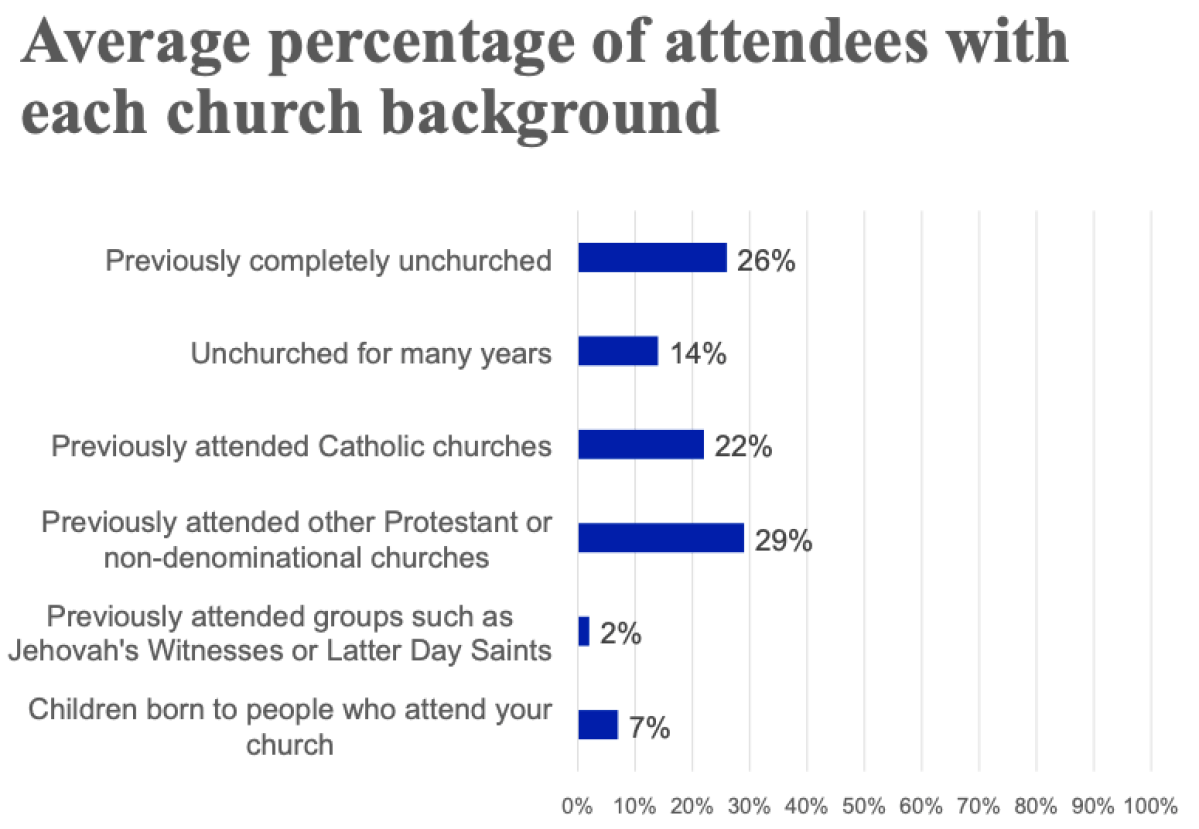
LifeWay Research

This contributes to Latinos now making up a bigger portion of US evangelicals. The Pew Research Center reports that the percentage of US evangelicals that identify as Latino grew from 7 percent in 2007 to 11 percent in 2014.

Investing time instead of planning events

Latino pastors who have worked inside and outside Hispanic ministry contexts can attest to the differences reflected in the data. Comparing the Hispanic church plants and new ministries surveyed in 2019 with overall church plants surveyed by LifeWay in 2015:

  • New Hispanic congregations were more than twice as likely to keep up evangelistic visits and door-to-door outreach beyond the initial launch of the ministry.
  • New Hispanic congregations were less likely, however, to engage in local politics or use “fun social events” to meet people in the community.
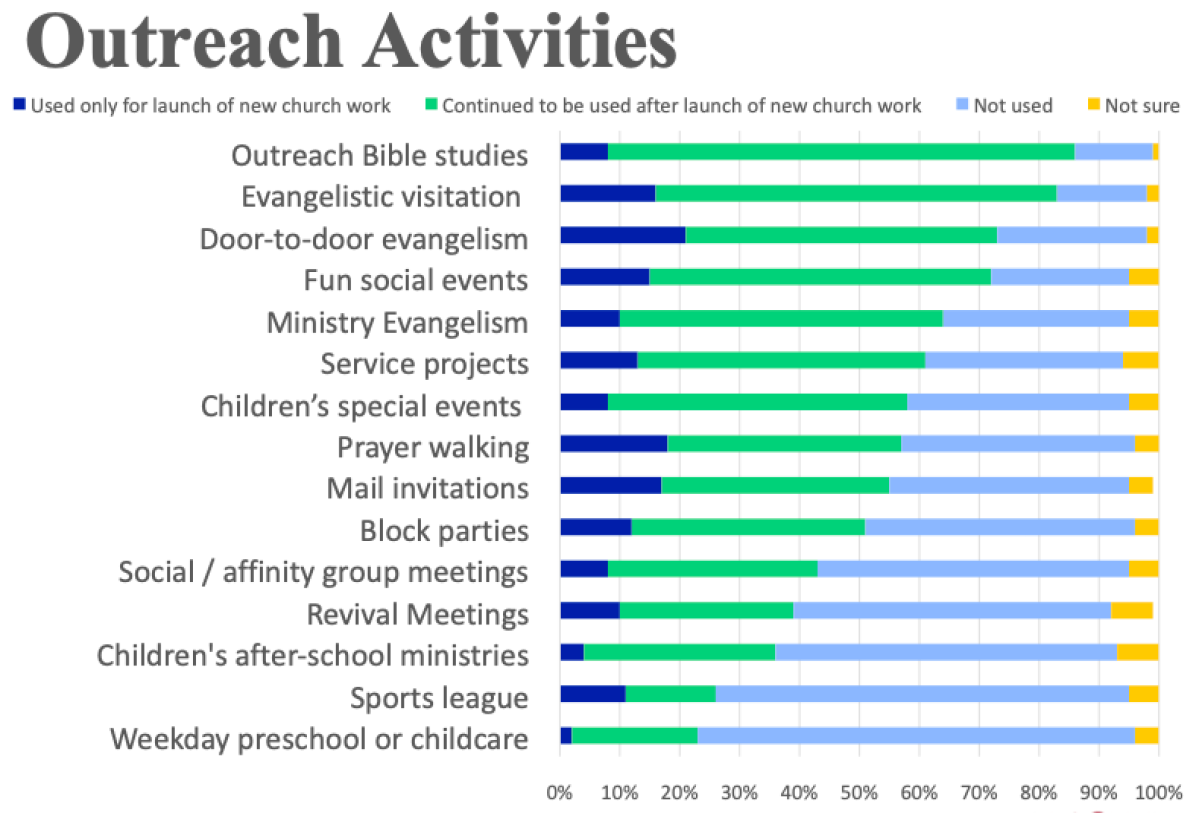
LifeWay Research

For the Latino community, structured, scheduled events aren’t necessarily a good fit with their time-intensive approach to building relationships, said Marco DeLeon, pastor of Storehouse McAllen, an Acts 29 church in the Rio Grande Valley in Texas.

The 33-year-old pastor, a Mexican American citizen born in the US, works with churches reaching out to Latino communities in Texas, Nevada, and Georgia. He presses pastors to focus less on Latino names in their roles, service calendars, and event registrations. Look instead, he said, at how much time has been invested in the relationship.

“They were more worried about trying to figure them out than getting to know them,” DeLeon said, and they were trying to do so in church contexts where the Latino people were not comfortable. To build trust, DeLeon explained, “You need a table with food on it and you need a lot of time.”

Pastors who say the following are appropriate measures of success for Hispanic church plants:


83% new commitments to Jesus
51% regular stories of life change
48% growth in attendance
47% being financially self-sufficient
46% planting other new churches
41% regular stories of community impact
34% meeting in own building

LifeWay Research

Alejandro Aguilar, pastor of Iglesia Oasis in Crystal Lake, Illinois, also wanted to see more time invested and less of a focus on numbers as a measure of success (half of surveyed pastors agree). Since the Latino community faces more marginalization than the average evangelical congregation in the US, their churches have unique needs and assets in ministry.

“The Anglo churches are not always ready for the stories Latinos bring to their doors,” said Aguilar, who emigrated from Mexico. When asked by other pastors how to reach Latino people, he advises, “Listen to the stories. Take your time.”

Waiting for growth

When Aguilar began his ministry career at Willow Creek Community Church, a multisite megachurch in the Chicago area, he saw the size of the church as a sign he was ministering as powerfully as possible.

While white church leaders expect ministries to grow quickly, many Latino ministers—brought up under American and Latin American megachurch pastors—expect them to grow large. Nearly half (49%) of the Hispanic church plants and other new ministries surveyed are within the largest US denomination, the Southern Baptist Convention, which has over 500 congregations with 1,000 or more people.

Though they know that recent immigrants and Spanish speakers will be more difficult to reach, many Latino ministers still measure success by the numbers, Aguilar said. The church planting movement, which involves starting from scratch in strategic locations, is a “totally and completely different language for many (Latino leaders),” he explained.

At Iglesia Oasis, he prioritizes going deeper with his congregation to understand the challenges they’re facing, including poverty, domestic violence, anxiety, or depression.

LifeWay names mentoring and financial support from denominations or “parent” churches as ways to help Latino leaders sustain new plants.

Almost half (48%) of the new Hispanic congregations surveyed are not financially self-sufficient and receive significantly less funding: $12,863 in outside donations the first year, compared to $43,514 at church plants overall.

It’s likely that money will be tight for members tithing within new Hispanic congregations as well. According to Pew’s Religious Landscape Survey, 54 percent of Latino evangelicals make $30,000 or less per year, compared to 32 percent of white evangelicals.

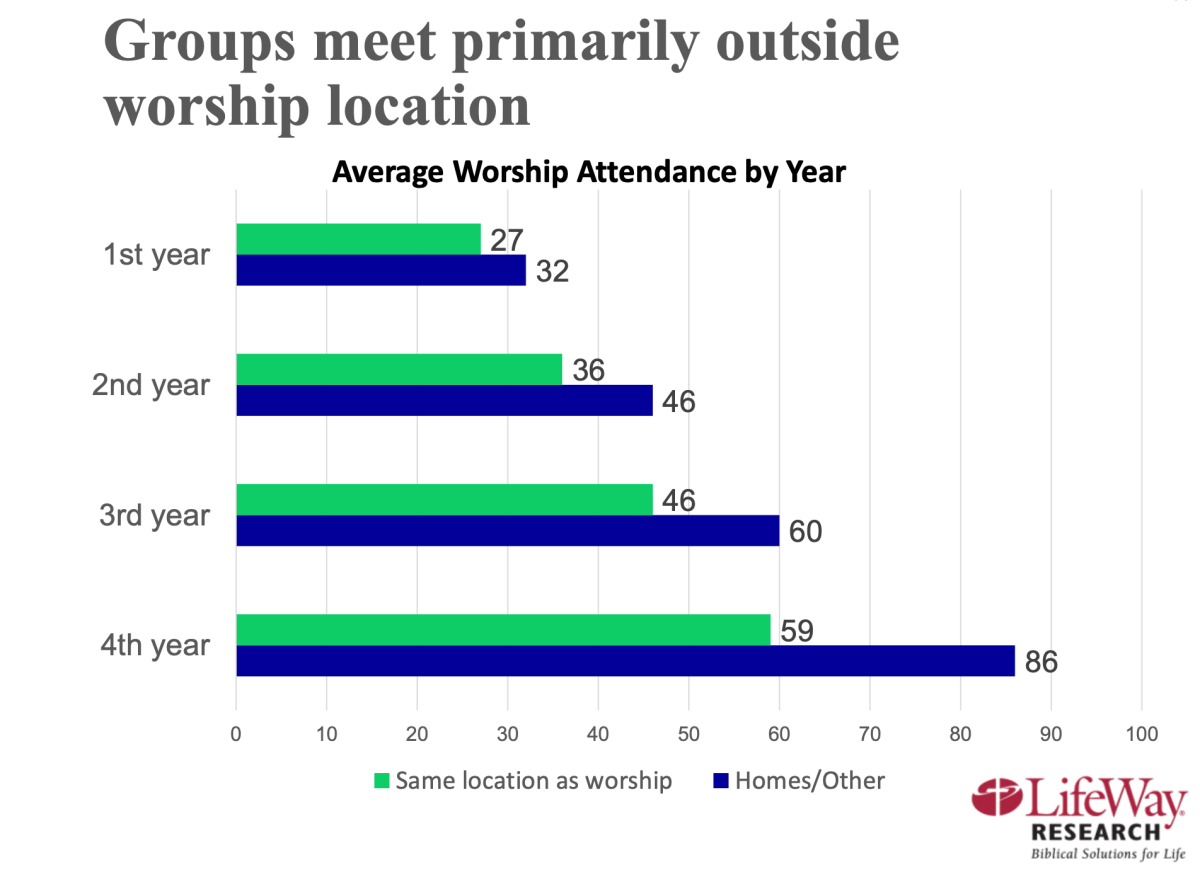
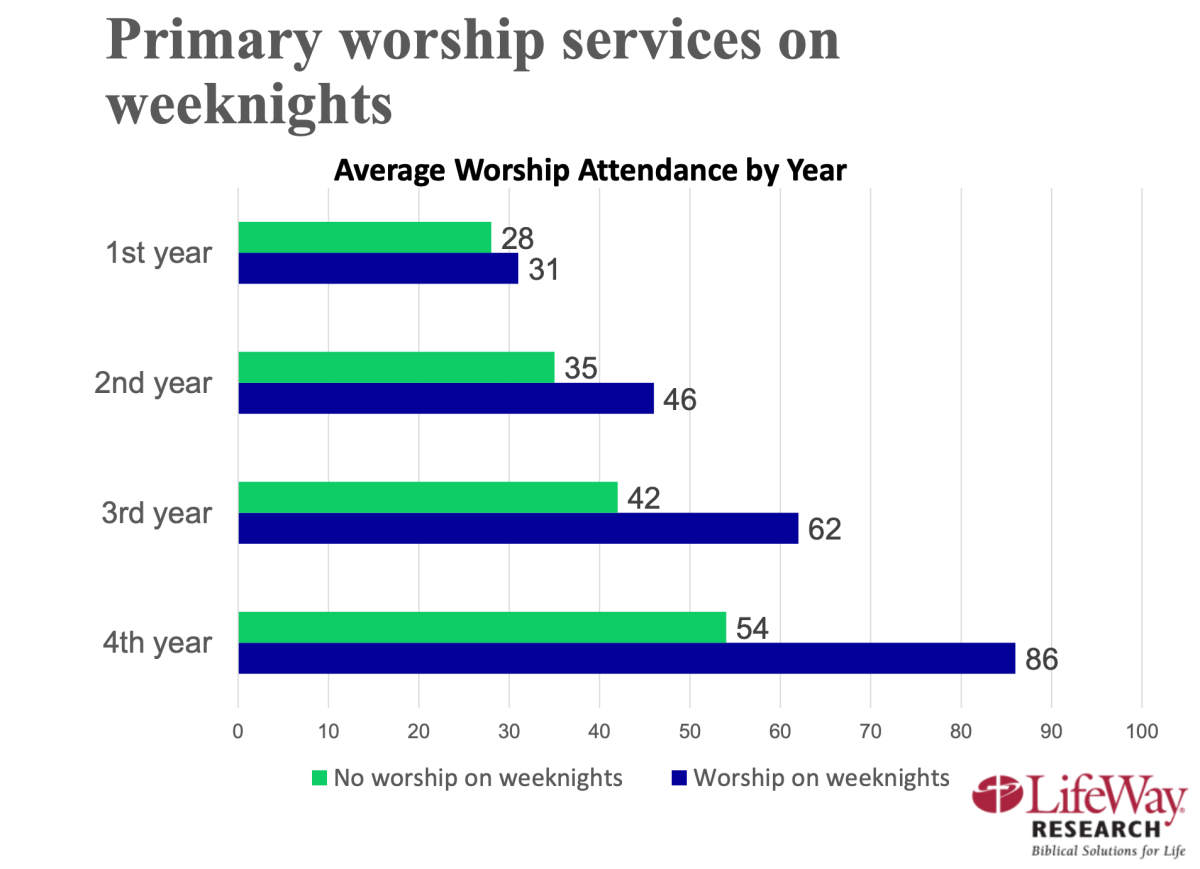
LifeWay also found that significant factors contributing to higher worship attendance year-over-year included meeting primarily outside the worship location (such as in members’ homes) and holding worship services on weeknights.
Facing fear and suspicion in the pews

Immigration is another variable that affects new Hispanic congregations in particular. Among respondents, 25 percent reported that at least one member of their leadership team had undocumented legal status, while on average 21 percent of their attendees lacked legal status.

That can have a large impact on church participation. In a previous story, pastors told CT about how members stopped coming to church due to the threat of raids by Immigration and Customs Enforcement. Some of the church’s most faithful servants “stopped showing up,” one South Carolina pastor said. As one Christian community development advocate told CT, if parents are deported, the children they leave behind become orphans who need care from the church.

Close family ties are important to many Latinos. When mixed with immigration, multigenerational ministries are also multicultural, DeLeon explained.

A first-, second-, or third-generation immigrant often approaches church involvement differently, with some newer immigrants unsure about expectations around meetings and membership, suspicious of being recruited into some kind of cult or service club, or being asked to trade in their culture for a new one.

“What I often see is the American church trying to fit Hispanic people into this system,” DeLeon said, “confusing assimilation with discipleship.”

While the second generation may inherit some of their parents’ apprehensions, DeLeon has observed that by the third generation most are not surprised by event-based outreach or efforts to assimilate them into the culture of the church—get them involved in a small group, sign up for nursery duty, attend women’s ministry events, etc.

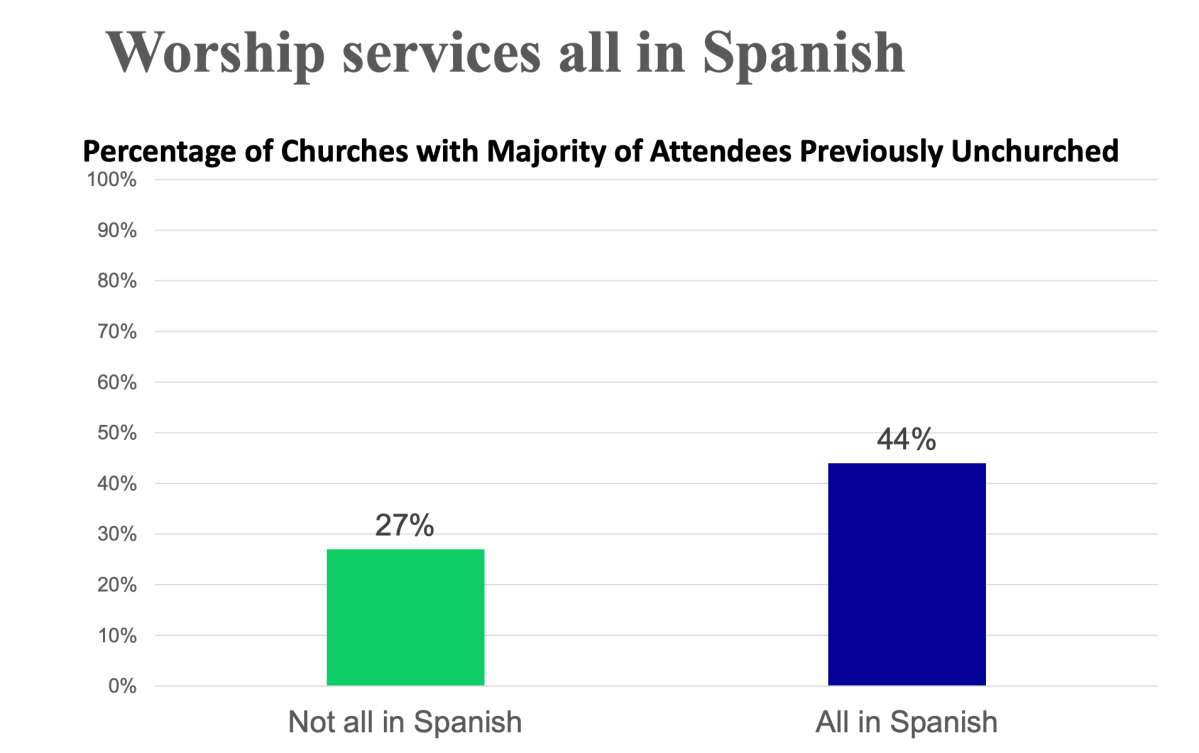
To address cultural disconnects, leadership is key. Shared language is beneficial, and the LifeWay survey showed that Spanish-language worship was an integral part of the vast majority of new Hispanic congregations: 64 percent conduct services all in Spanish, while 13 percent have bilingual services. (Others offer translation services.)

LifeWay even found that having a worship service all in Spanish was a statistically significant factor in new Hispanic congregations having unchurched attendees:
LifeWay Research

LifeWay also found that worship songs with Latin rhythms—regularly incorporated into services by 32 percent of those surveyed—were a statistically significant factor in new Hispanic congregations starting a daughter church:
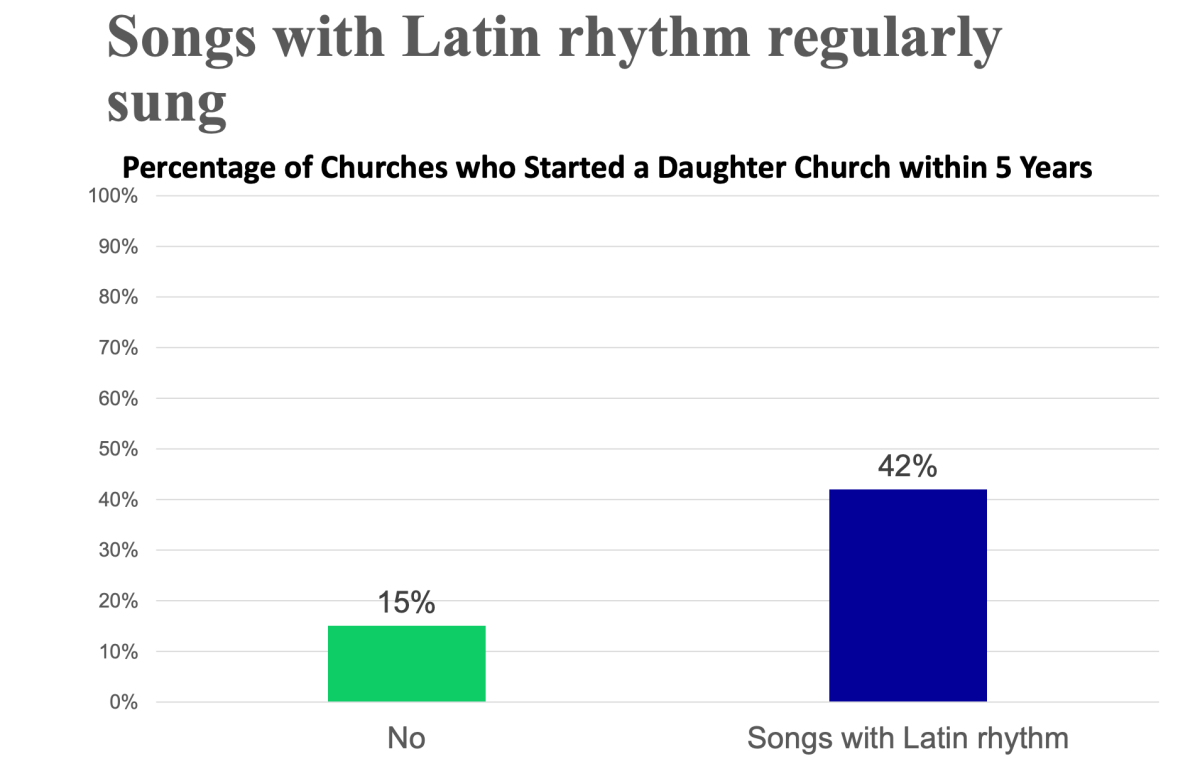
LifeWay Research

LifeWay’s research also touched on the need for cultural sensitivity and hiring culturally Latino pastors (not just Spanish speakers), but even they will need to prepare to think cross-culturally since not all Latinos are the same.

For example, only 24 percent of the new congregations surveyed are led by a pastor who identifies as Mexican, while 42 percent said most of their congregation is Mexican.

“While there are crossovers in Hispanic cultures, there are differences,” DeLeon said. If the pastors of Hispanic church plants have spent enough time with their congregants to see and understand that difference, he sees that as a metric worth noting.

The results of the full study can be found here.

Methodology:

LifeWay Research conducted the study March 15–June 26, 2019. The study was sponsored by the Assemblies of God, Baptist Missionary Association of America, Converge, Evangelical Free Church of America, Evangelical Covenant Church, Mission to North America, North American Mission Board, Reformed Church in America, The Wesleyan Church, The Wesleyan Church West Michigan District, The United Methodist Church, and Vineyard.

Members of the Church Planting Leadership Fellowship provided lists of Hispanic new church works. Each was invited to participate in the online survey. Leaders of 218 Hispanic new church works completed the survey.

New church works were defined as church starts, church mergers, revitalizations, restarts, Hispanic ministry within a non-Hispanic church, and new sites for an existing congregation.

Ideas

We Love and Loathe God

Columnist; Contributor

If we can’t admit that, we won’t make much headway.

Christianity Today July 24, 2019
Rick Szuecs / Source images: Envato / Unsplash

With this essay, I will stop introducing chapters of the book that will come out in the spring, When Did We Forget God? (Tyndale). The essays I’ve published here have been mostly critical in nature—it’s my inner prophet coming to the surface. Or maybe just my inner Scrooge. I have a couple more chapters analyzing the horizontal temptation in how we read the Bible and the small-groups movement, and the imaginative reader can probably guess what I might say in such chapters. Let’s just say the temptation to make our faith about ourselves and our feelings is with us always, even to the end of this moral, therapeutic, deist age.

But it would be irresponsible to not at least point some way forward, and the third part of the book attempts to do just that. But now that I’ve finished it, I realize I need to do a lot more reading and thinking about desire, and especially desire for God. So the third part is really just a few forays into a very complex topic.

This column will continue, but it will be more on an occasional basis. As I’ve been preparing these essays for online, I’ve been taking notes on topics that I have not addressed in the book but that might make for good reflections here. But I don’t think I’m smart enough to have something worth reading each and every week, so from this point on, this series will appear as the Lord inspires, or as hubris makes me think he’s doing so.

For now, here is a chapter from the third part of the book.

The Beginning of Desire

The writer of Proverbs says that the fear of the Lord is the beginning of wisdom. The fear he refers to is a healthy reverence and awe. But there is another type of fear we have to wrestle with in our relationship with God. In terms of that fear, I’d put it like this: The fear of God is the beginning of longing for him.

I ended the last chapter noting that we do,in fact, long to know and love God at some deep level. We do desire God. In spite of all the ways we have forgotten him, that is, marginalized God in our flurry of horizontal activity, we still want God. This appears to contradict what I’ve been arguing. Not really.

If I were to turn now and say all we have to do is make up our minds to start desiring God, I will have moved from hyperbole to fiction.

I have drawn a stark contrast between the vertical and horizontal dimensions of faith to bring some clarity and urgency to the problem. Such stark contrast is hyperbole, using language in a dramatic way to drive home a point. But if I were to turn now and say all we have to do is make up our minds to start desiring God, I will have moved from hyperbole to fiction. Because it’s not that simple.

Deep down we desire God still, yes, despite all the focus on the horizontal. And yet the reason for the horizontal focus is not just that we have forgotten God—as if we just got distracted, like going to the store to buy milk, then filling the shopping cart but going home without what we came for. No, we have forgotten God because we deliberately try to erase him from our memory. That’s because sometimes God is like a bad dream that leaves us confused and anxious.

It is crucial that we recognize this dimension of our relationship with God. If God doesn’t at times leave us confused and anxious, we have not yet met the living God.

Just ask Abraham, who could not for his life figure out how God was going to produce a great nation from his aged loins.

Ask Moses, whose whole purpose in life was to lead the people into the Promised Land, only to be denied entry himself.

Ask David, who in many a psalm complained that the Lord did not hear him.

Ask Jeremiah, who was furious with God for prodding him to preach.

Ask Jesus, who felt as if God had forsaken him on the cross.

Every believer sooner or later knows it is a fearsome thing to fall into the hands of this God. Which is why any believer worth his or her salt is deeply ambivalent about God. Yes, we yearn to be ruled by Unfailing Wisdom—and yet we resent having to submit to anyone or anything. We crave intimacy with Pure Benevolence—but we fear the loss of independence. We resent the one we long for, and we are afraid of the One we desire. In short, we love God and we hate God.

One reason we resent God and just as soon forget about him is that he refuses to come to us in the way we think we need him to come to us.

We can make no progress in the spiritual life until we acknowledge this. If we think we really do love God simply, and all we need is a gentle reminder to put him back on the throne of our lives, we’re kidding ourselves. We’re living a fantasy faith. That is simply not the sordid and splendid reality of the human heart.

One large reason we resent God and just as soon forget about him is that he refuses to come to us in the way we think we need him to come to us. We reason like this: God is magnificent and wondrous, who knows no limits; thus he will come to us in unmistakable splendor. Yet our prayers waft into the silent beyond. Worship feels like a mud puddle of words. We ask for healing and we end up paying medical bills. We long for love and file for divorce.

Where is the God of miracle and wonder when we need him? He does not seem very dependable. And rather than look to him and be disappointed time and again, we decide to forget the vertical and focus on the horizontal. We’re sensible enough not to abandon Christian faith because in spite of our confusion we still believe it the way to eternal life. Just don’t ask us to take seriously the presence of God.

Maybe the glorious God shows up other people’s lives. Maybe back in the Bible days. Maybe once in our life a long, long time ago. But not today, not here, not in the foreseeable future.

The God of miracle and wonder, of course, is in large part a figment of our imagination. It’s the way we want God to be. It’s not the way he is day to day, eternity to eternity.
Oh yes, there are miracles and wonders in the Bible. To be sure, some have experienced the power and the glory of God today. No question about it. But these are not nearly as obvious as we sometimes think. Remember that many saw and heard the resurrected Lord right before their very eyes and ears, and yet they still doubted (Matt. 28:17).

We are wiser to think of miracle and wonder as God’s defibrillator. We are sometimes so dead to God we need an electric shock to the heart to wake us up. But after that, things return to normal, and God returns to his normal mode of address. Man does not live by divine defibrillator alone, for a life of miracle and wonder would kill us. Instead, God comes to us as silently and subtly as the steady beating of our hearts.

If the first step in desiring God is to recognize how much we resent his presence, the second step is to accept how, in fact, he has chosen to be with us. We have to know what it is we desire. If we desire miracles, we will never find God. If we desire God, we must give up miracles and look for him in the mundane.

In the human and inadequate words of the preacher.

In the confusing language and idioms of the Bible.

In the bread and wine of Communion.

In the water of baptism.

In the gathering or two or three come together for prayer.

In the everyday experience of mystery, of not knowing, of wonder, of the perplexing—of which life is chock full.

If we look for God in any place but the mundane, we will not find him, because it is there that he comes and dwells among us, full of grace and truth.

Mark Galli is editor in chief of Christianity Today.

Official Evaluation

An officially appointed committee consisting of Dr. Sherwood E. Wirt, chairman, Dr. W. Stanley Mooneyham, and Dr. J. Sherrard Rice drew up an evaluation of “what the U. S. Congress on Evangelism means to the future of the Church.” Here is the complete text:

The first U. S. Congress on Evangelism can best be described, we believe, in the words of Acts 4:31: “And when they had prayed, the place was shaken where they were assembled together.”

During these five days past we have seen the Church in microcosm. We have seen her radiant in the splendor of her united witness to the Lord Jesus Christ. We have seen the frailty, impotence and sin of her daily walk. We have joined in the Church’s struggle to carry out her ministry of healing and redemptive love right here on Grant Street. We have beheld the Church rocked, challenged, and even exposed by the humanity around her; and we have sought to learn all over again what it means to follow Jesus.

We believe that what has happened this week in Minneapolis has not happened before in our lifetimes. We thank God for the experience. We believe that evangelicalism in America has had a new birth of freedom: freedom from old cliches, freedom from narrow loyalities, freedom from restricted fellowship, freedom in Christ to proclaim the Gospel in love to the family of mankind.

We shall go from this city in the strong conviction that we shall never be the same, and we are carrying with us a message that will make sure that our churches will never be the same. Our fervent prayer and desire is that we shall be empowered to win men and women to Jesus Christ in such a fresh and appealing way that God the Holy Spirit will be pleased to send spiritual awakening to our land and to the world.

As the Word of God has been preached in full power from this platform, we have tasted the new wine of God’s liberating spirit, and the old wineskins seem strangely inadequate to contain it. The wind of the Spirit has blown through our assembly. Together we have undergone a baptism of love, and we covet it for our churches. We do not believe as Karl Marx did that men can change that world; but we believe that God can. We dedicate ourselves to be instruments, available to the moving of his Spirit, and responding in obedience to his command with the word of the prophet: “Here am I, send me.”

Theology

Your Peak Life Now: How to Face Career Decline with Grace and Faith

The best way to prepare for our inevitable demise is a healthy focus on death, discipleship, and worship.

Christianity Today July 24, 2019
Rodan Can / Unsplash

I visited my hometown about a decade after I graduated high school and stopped at the local greasy spoon joint for a nostalgic junk food meal. I was surprised to see one of the most popular guys in school, star gymnast Tim, behind the counter taking orders. I asked him how long he’d been working there and he shrugged. “Guess I never left high school.”

When I used to bemoan the fact that I wasn’t one of the popular kids, my grandmother would shake her head and tell me, “You don’t want to peak too early in life.” Running into Tim seemed to affirm her words. But as Arthur Brooks reminds us in a recent Atlantic essay titled “Your Professional Decline Is Coming (Much) Sooner Than You Think,” holding onto our peak achievements isn’t just for aging high school gymnasts. Many of us anchor our identity in accomplishments, but when our careers fade—which they inevitably do—our sense of self-worth fades with it and leaves us floundering.

Brooks, a social scientist and former president of the American Enterprise Institute, notes that many of us will have the most productive years of our work lives between ages 30 and 50. After that, we begin a long, slow slide into professional irrelevance. Certainly there are exceptions to the rule. However, while we can expect to make meaningful contributions in the workplace after age 50, we likely won’t be climbing the success ladder at the same rate we once did. And how we navigate that decline can make or break our retirement years.

The more your identity is linked to achievement, says Brooks, the greater the sense of loss when your career downshifts or ends. “Abundant evidence suggests that the waning of ability in people of high accomplishment is especially brutal psychologically. … I strongly suspect that the memory of remarkable ability, if that is the source of one’s self-worth, might, for some, provide an invidious contrast to a later, less remarkable life,” he writes.

Roughly a third of the US population is over age 50, which means a whole lot of us are facing this kind of professional decline, and most of us will eventually find ourselves frustrated and disoriented by a world that’s no longer interested in what we have to offer. For all of human history, people have been trying to make sense of this existential dark space—the downward arc that comes at the beginning of the end. Popular culture often brands it a “midlife crisis,” and indeed, coming to terms with mortality can first occur during the vicissitudes of our 40s and 50s. However, questions of purpose, identity, and meaning persist well into our final decades.

From a biblical perspective, there are two main antidotes: meditating on death and meditating on God.

First, it behooves us to think about our own mortality. This insight wouldn’t be news to Qohelet, the Preacher-King who penned the book of Ecclesiastes. He writes from the vantage point of someone who’s tasted an entire orchard of worldly fruits, including work, pleasure, power, wealth, and wisdom. His assessment in the end: Those successes were as permanent as the smoke from a fire and as meaningful as an unsolvable riddle. The Hebrew word hebel, which is translated as “meaningless” in the NIV and as “vanity” in the KJV, is used 33 times throughout the book. The word carries connotations of futility and delusion, but in context of the whole Book of Ecclesiastes, it also gestures toward the strange and subtle liberation that comes with embracing our own death.

In his book Living Life Backward: How Ecclesiastes Teaches Us to Live in Light of the End, David Gibson suggests that the author of Ecclesiastes understands the cure to the despair of a declining career:

The Preacher will argue that wisdom, pleasure, work, and possessions are very often the bubbles we live in to insulate ourselves from reality. And his needle, the sharp point he uses to burst the bubbles, is death. It is the great reality facing all human beings as they go about their business on earth. Death is the one ultimate certainty that we erase from our minds and busy ourselves to avoid facing.

Gibson concludes that contemplating death frees us to truly enjoy life by uncoupling us from a fascination with worldly success and affirmation. He writes, “This is the main message of Ecclesiastes in a nutshell: Life in God’s world is gift, not gain.”

While Qohelet urges his hearers to savor the sweet parts of their lives (Ecc.5:18–20), he also suggests that we can only fully appreciate that sweetness by taking a counterintuitive approach: “It is better to go to a house of mourning than to go to a house of feasting,” he writes, “for death is the destiny of everyone; the living should take this to heart” (Ecc. 7:2).

For those of us nearing or inhabiting our so-called “retirement years,” this lesson is everywhere—in the death of loved ones, lost jobs, cancer diagnoses, and other life-altering illnesses. I’ve seen it myself. In the wake of being diagnosed recently with a rare immune system disorder, my earlier ambitions and accomplishments seem, well, mostly meaningless. And yet I feel less afraid and more free.

Brooks affirms this truth. “Embracing death reminds us that everything is temporary, and can make each day of life more meaningful,” he writes. “‘Death destroys a man,’ E. M. Forster wrote, but ‘the idea of Death saves him.’” He goes on to cite several “death-to-self” practices, including choosing an exit plan from your career while at your pinnacle (rather than trying to hold on to that peak), seeking to serve others by passing on knowledge and wisdom, and prioritizing relationships.

The other death-confronting practice familiar to Christians—one that Brooks touches on ever too briefly—is worship. While we often narrowly think of it in the context of corporate singing, Scripture gives us a much more expansive understanding of worship. The forebear of Qohelet, King David, is one example. In response to God’s command to build an altar on the threshing floor owned by Araunah the Jebusite, David asks to purchase the property. Araunah offers to give it to the king, but David is adamant: “No, I insist on paying you for it. I will not sacrifice to the Lord my God burnt offerings that cost me nothing” (2 Sam. 24:24).

When we offer to God something that costs us—even our cherished “peak selves”—we are experiencing a measure of death. Jesus forged discipleship and death into a single, life-surrendering action when he said to his followers, “Whoever wants to be my disciple must deny themselves and take up their cross daily and follow me” (Luke 9:23).

For those of us in the second half of life grappling with career decline, the process of relinquishment involves facing our mortality, embracing a self-denying posture, and worshiping the King. We see this in the story of Job. In the wake of losing his family, business, health, and reputation, Job doesn’t flinch from the temporal nature of life or the searing reality of death. Instead, he worships God. “Naked I came from my mother’s womb, and naked I will depart,” he says. “The Lord gave and the Lord has taken away; may the name of the Lord be praised” (Job 1:21).

We need models like this from Scripture. We also need them from the church today. Although we are all resurrection people, nonetheless, I’ve found that mature believers who are walking through (instead of fleeing from) the Valley of the Shadow can best translate the hope of resurrection for the rest of us. They have long been rehearsing the daily surrender to God that leads to generative, abundant life beyond the pinnacle of career success. At first sniff, their lives may smell like death, but on closer inspection, they’re saturated with the fragrance of worship.

My grandmother was half right. We don’t want to peak too early, but nor do we want to enshrine a peak that was never meant to be a destination. Those high points are but mile markers on the way to our true home.
Michelle Van Loon is an author and speaker. Her book Becoming Sage: Cultivating Meaning, Purpose, and Spirituality at Midlife releases next spring from Moody Publishers.

News
Wire Story

Can Willow Creek Find Closure After Bill Hybels?

The elders: There is “a fracture in our church marked by disbelief, confusion, fear, and hurt.”

Christianity Today July 24, 2019
Mary Fairchild / Flickr

Battered. Weary. Divided.

That’s how elder Shoji Boldt described Willow Creek Community Church at a service of worship and reflection on Tuesday night on the church's main campus in suburban South Barrington.
“We are a house divided on whether we need to dig in and why can't we just move on?” Boldt said.

The service, perhaps the first led by the church's elders, was the latest attempt by one of the nation's largest and most influential evangelical megachurches to move past the controversy surrounding founding pastor Bill Hybels.

Churchgoers packed out the South Barrington campus' smaller Lakeside Auditorium.

Elder Steve Kang said some there wondered why they still were talking about events that had happened in the past. But, Kang said, they weren't just there to apologize for Hybels and the church's handling of the allegations against its former pastor, but also to reconcile with God and with each other.

“God is calling us to return to the gospel of reconciliation — to make the main thing the main thing,” he said.

Allegations of sexual misconduct against Hybels have dominated the news about Willow Creek since they were made public in a March 2018 report in the Chicago Tribune.

Attendance and giving have dropped across the church’s eight Chicago-area campuses. Its entire elder board and the two pastors tasked with leading the church after Hybels retired early — lead pastor Heather Larson and lead teaching pastor Steve Carter — all have stepped down.
The Willow Creek Association, its network of churches around the world, rebranded as the Global Leadership Network as US viewers of its flagship Global Leadership Summit dropped, too.

After initial denials from church leadership, an independent advisory group found the allegations of misconduct, which also included abuse of power, were credible.

Hybels has publicly denied all the allegations.

He and his wife, Lynne, founded Willow Creek in 1975 after surveying hundreds of people about what they were looking for in a church.

It grew to be hugely influential, pioneering the performance-style worship now popular in many churches, affirming women’s leadership when many evangelical churches barred them from preaching and becoming involved in global issues like the AIDS crisis. Hybels eventually would serve as a spiritual advisor to the Chicago Bears and former president Bill Clinton.

But, Hybels said in a 2005 interview with Religion News Service, he never intended to be a pastor and always thought he’d go into his family’s produce business.

“No one is more surprised by the path my life took than I,” Hybels said at the time.

He had planned to retire last fall and leave the church in the hands of a new team of leaders. All of those leaders are now gone.

The new elders, who were installed in January, said there now is “a fracture in our church marked by disbelief, confusion, fear, and hurt” in an email update from elders sent to members on Friday.

“After such a traumatic experience, what does it look like to enter into a gospel-centered season of reconciliation?” the update said.

Hybels was not invited to attend or participate in Tuesday night’s service, according to the church.

"We have reached out to Bill Hybels; however, he has chosen not to engage in dialogue at this time," the elders said in the update.

During the service, Boldt said the elders so far have completed two of the four steps of the truth and reconciliation process outlined by South Africa's retired Anglican Archbishop Desmond Tutu, a process that had been recommended to them by the independent advisory group. That process includes telling the story, naming the hurts, granting forgiveness and renewing or releasing the relationship, she said.

“As we have had the opportunity to engage the stories, we were deeply grieved and disrupted at the core of our being. We are grieved by the personal toll on all of the individuals, on their emotional and physical health, their families and their livelihood,” she said.

“This is the godly grief that leads to repentance.”

The church will continue to move through that process, Boldt said.

But it won't be defined by trauma, she added.

“God has allowed this. He will not allow us to build our church marred by power, abuse, sexual sin and idolatry," she said. "Churches across the world are struggling with these similar issues and we have the opportunity to figure out how to make this right for the kingdom."

The church’s mission and vision remain the same as they ever were, elder John Sleeting said. And it expects to have a new senior pastor in place by the end of the year, he said.

Moving forward does not mean minimizing anybody’s pain, Sleeting said.

And reconciliation is a process that doesn’t happen overnight, elder Mary Square added.

“We will have to live with this dichotomy of God using Willow and people to do amazing things while there was unaddressed sin going on and men and women being hurt,” elder Silvia Escobar said.

Not everybody is convinced that reconciliation may be possible at this point — or wise.

Going into the service, Rob Speight — a church member who describes himself as an advocate for the women who have come forward with allegations of misconduct against Hybels — said that the church's elders have never given a detailed account of the allegations against the pastor.

The service was what he expected, he said: “A lot of platitudes with virtually no substance."

Others who attended Tuesday night’s service said it gave them closure after a year of questions and controversy.

Several said they appreciated the elders’ focus on prayer and Scripture, including Wendy Wasilewski of Arlington Heights, who has attended the church for 28 years.

“I hope through this service there will be healing and people will focus on Jesus,” Wasilewski said.

Bonnie Garcia of Elgin, who has attended Willow Creek for 11 years, said she was “rocked” by the events of the last year.

Garcia said she wanted to believe the women who came forward with allegations of misconduct against Hybels. She also didn’t want to believe that could happen at a church that has done so much for the community — that a pastor who could preach such powerful sermons and write such great books could do such a thing.

“I’ve had my doubts: Do I continue to attend?” she said.

But Jesus always has been the head of the church to her, she said. That has never changed.

Garcia felt ready to move on, she said.

“We don’t need to keep wondering now,” she said. “It’s that closure for me.”

News

Americans Who Know Religion Best Hold Worse Views of Evangelicals

Pew: Religious literacy usually helps Americans appreciate other faiths. Evangelicals score highest when it comes to their own.

Christianity Today July 23, 2019
Chip Somodevilla / Getty Images

There’s an adage that sometimes comes up in the church: “You can’t love what you don’t know.”

Research has shown that people with the greatest understanding of other faiths tend to have more positive views of outside traditions. But a recent survey found one key exception: evangelical Protestants.

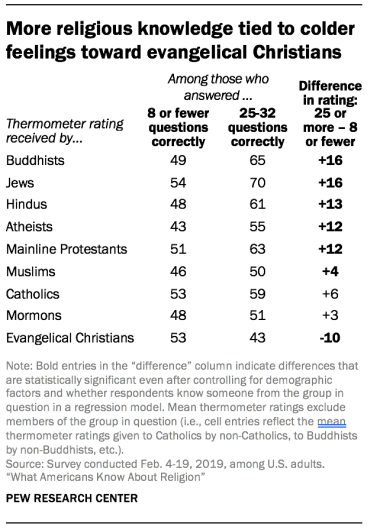
The people who know the most about religion—and scored the highest on Pew Research Center’s religious literacy quiz—actually had worse views of evangelicals than the average American or those with low scores.

“Higher scores on the overall (32- point) religious knowledge scale tend to be associated with warmer evaluations of most religious groups,” the researchers wrote. “One exception to this pattern is evangelical Christians, who are rated most warmly by those at the low end of the religious knowledge scale.

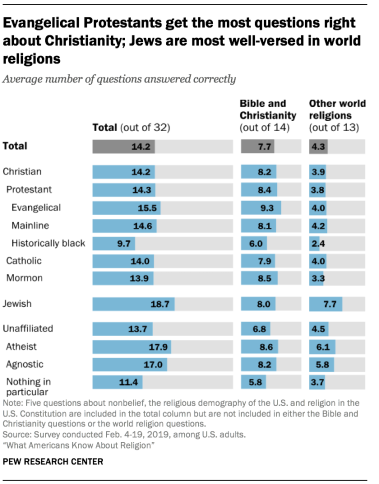
Meanwhile, evangelical Protestants actually know more than the average American about religion, due largely to their familiarity with their own faith. While few in the US can parse Protestant theology or define the prosperity gospel, evangelicals were among the top-performing faith groups in a religious literacy quiz, ranking after Jews, atheists, and agnostics and above other Christian affiliations and religious nones.

Evangelicals—in this survey, a multiethnic sample grouped by affiliation—know the Bible and Christianity better than anyone else, but when it comes to other traditions, their standings fall. Only evangelicals who said they regularly dedicated time to learning about world religions knew more than average about other faiths.

The issue of religious literacy matters more than ever in America’s pluralistic context, and evangelicals have been on both sides of mischaracterizations, misunderstandings, and discrimination over religious beliefs.

“It is crucial that evangelicals, both young and old, have accurate understandings of other religions. Insofar as Christians want to be fairly represented, so they need to do the same for others,” said Nijay Gupta, a Portland Seminary professor who has written about New Testament perspectives on interfaith relations. “With social media and other online communication, the world is getting smaller and caricatures of any religion are easily deconstructed and dismissed.”

Scoring above average on Scripture and sola fide

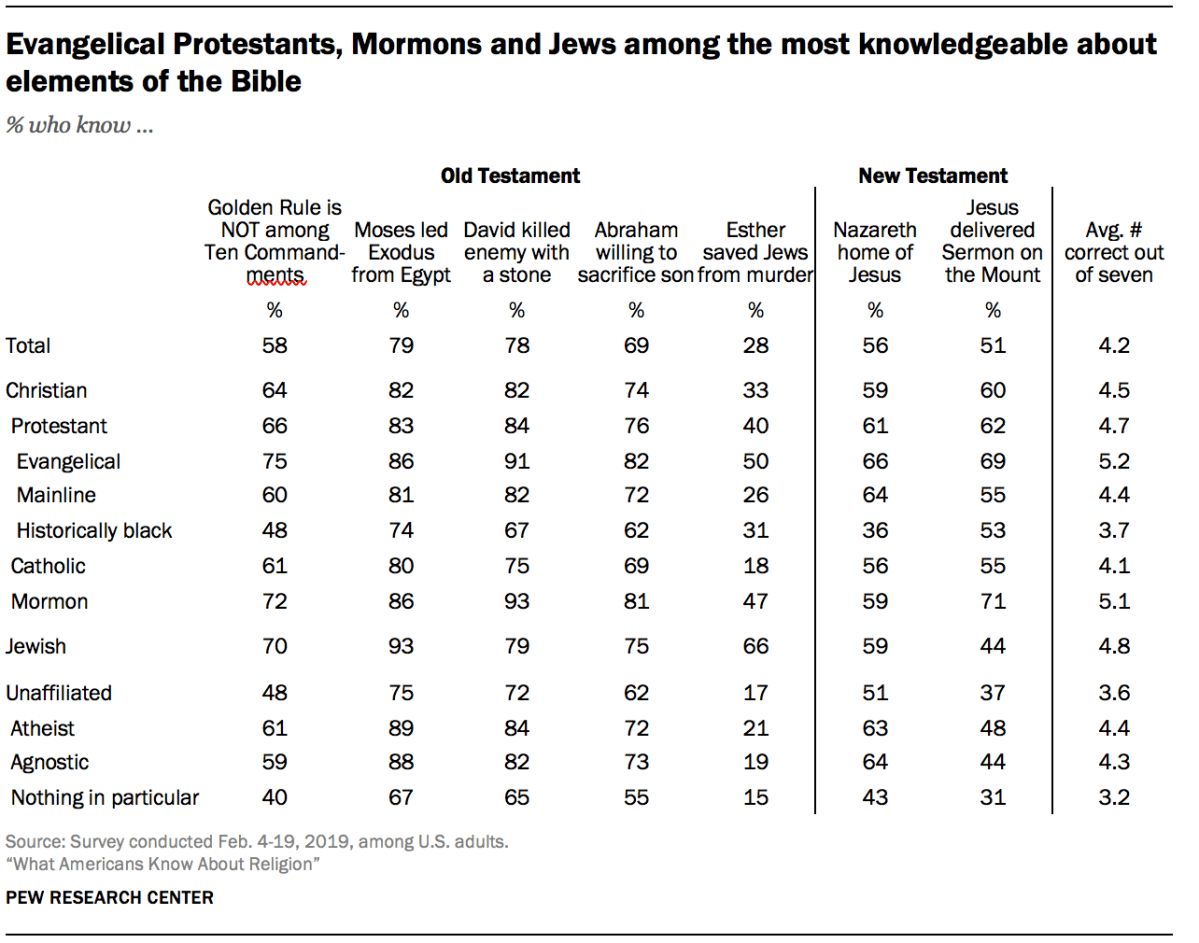
Pew’s 32-question survey included basic questions about religious beliefs and practices; Old and New Testament stories; and religious demographics in the US and globally. Americans answered 14.2 questions right on average (44%), while evangelicals got closer to half, with 15.5 right.

Only around one in five respondents answered the questions about Protestantism correctly—making them among the hardest in the quiz. Around 20 percent of Americans identified Protestants (and not Catholics) as the group that traditionally teaches salvation through faith alone, while 22 percent could define the prosperity gospel as affiliated faith with health and wealth.

Though evangelicals fared the best on this pair of questions, still fewer than half (35% and 37% respectively) got them right. (The State of Theology survey from Ligonier Ministries and LifeWay Research has similarly found that a surprising number of evangelicals affirm heretical beliefs or simply do not know where they stand on certain teachings.)

Among the seven Bible questions, evangelicals scored the highest (5.2), answering over a full question higher than average (4.2). Of the passages in the quiz, the best-known Bible story was David and Goliath, which 91 percent of evangelicals and 72 percent of Americans could identify David as the figure “most closely associated with killing an enemy with a stone.” The least familiar was Esther, whom just half of evangelicals and 28 percent of Americans named as the Old Testament heroine who “saved Jews from murder by appealing to king.”

Knowing other faiths

The scores dropped when it came to the 13 questions about non-Christian faiths and global religion. Evangelicals got just 4 right on average, less than the 4.3 by Americans overall. While most evangelicals knew about Mecca as Islam’s pilgrimage site (59%) and Ramadan as its holy month of fasting (56%), they were far less likely than average to know the core beliefs of minority faiths like Sikhism (34%).

American evangelicals are becoming more interested in understanding other faiths, both as a way to evangelize and to love and serve their diverse neighbors. In the Pew survey, evangelicals who regularly take time to learn about other faiths answered 5.5 of the 13 world religion questions right.

Having a social network that spans faiths also correlates with higher religious literacy. “On average, respondents who know someone from at least seven different religious groups answer 19 questions right, on average, while those who know someone from three or fewer religious groups average 8.6 right.”

Previous Pew surveys have found that white evangelicals are least likely to know a Muslim, but many churches and young evangelicals are intentionally seeking out interfaith and cross-cultural friendships as America grows more diverse.

Today’s evangelical students “often have relatives and friends who are Muslim, Jewish, or Hindu,” said Gupta at Portland Seminary. “They might not be comprehensively well-informed, but because of personal relationships, they want to be respectful.”

Interfaith partnerships used to raise concerns among evangelicals over relativism, or a need for them to put aside their Christian faith to work together. Though those issues can still remain, leaders like John Inazu and Tim Keller have urged the church to embrace pluralism as a context for religious liberty, seeking “common ground even with those who may not share our view of the common good.”

“We as evangelicals ought to remember that the freedom of religion in our country means that others have a right to hold their views as much as we do,” Amos Yong, dean of the School of Theology and School of Intercultural Studies at Fuller Theological Seminary, told CT. “We ought to be less worried that people have convictions (like us), even to the point of defending the rights of people of other faiths to their views, and more concerned that all of us ought hold our convictions in ways that nevertheless enable our respectful interactions and even collaboration with neighbors of other faiths.”

Evangelicals’ reputation

But even as evangelicals grow more open and understanding of other faiths, others’ views of evangelicals have not improved. In a 2017 Pew report, they were the only faith group whose reputation hadn’t warmed up, with fewer than 1 in 3 non-evangelicals viewing evangelical favorably.

In the recent survey, evangelicals were viewed most negatively by the highest scoring respondents of the quiz.

On a temperature scale of warm/favorable to cool/unfavorable, they were rated a low 43 degrees by those who answered 25 or more questions right and a higher 53 degrees by those who answered 8 or fewer right.

This goes against the general finding that “respondents who are highly knowledgeable about a religious group tend to express relatively warm feelings toward that group.” One explanation: Atheists and agnostics, who outperform evangelicals and all other faiths except Jews on the quiz, likely make up a significant portion of the high scorers.

“The popular notion, in the public at large but also among evangelicals themselves, is that evangelicals are rather convinced about their being ‘right’ and other religionists being ‘wrong,’and from this perspective, it is surely understandable that those who feel like they are being labeled as wrong would tend to view the (evangelical) labelers unfavorably,” said Yong at Fuller. “I’d be less concerned about improving reputation for its own sake, but for the sake of the gospel.”

Anyone can take Pew’s religious literacy quiz here. Fewer than 1 percent of respondents earned a perfect score.

Church Life

God Blessed My Church with Migrants

I don’t want to imagine my community without faithful leaders like Cesar Quintero.

Jill Curry / South Tulsa Baptist Church

Jill Curry / South Tulsa Baptist Church

Christianity Today July 23, 2019

Editor’s note: Last Thursday, Politico reported that Trump administration advisers had proposed dropping the US refugee cap to zero next year, to the dismay of advocates like the National Association of Evangelicals’ humanitarian arm World Relief.

The Trump administration already cut the number of refugees the US will accept by more than half of the typical 75,000–95,000 range. Another reduction, advocates say, will prevent family reunifications and leave thousands in peril. Some warn that this move would actually increase the number of asylum seekers at the US southern border.

Faced with the threat of blocking nearly all refugees, many leaders have ready testimony of how their congregations have been blessed and strengthened by migrants who fled to the US.

Eric Costanzo leads a church in suburban Tulsa, Oklahoma. Over the past decade, the government has resettled increasing numbers of refugees in their city, the largest group being evangelical Christians from Myanmar . Many have found an unlikely home at South Tulsa Baptist Church , a congregation of around 1,200 people which now has more than 150 immigrants and refugees from 30 countries involved in its programs. These refugees and immigrants serve in ministries like sewing classes, a Chinese school for all ages including families who have adopted from China, and international potlucks.

Costanzo’s church recently opened a refugee resource center where some of the refugees themselves volunteer. Other refugees and immigrants have connected the church to mission trips, partnerships, and church planting opportunities.

The Oklahoma pastor shared with CT about one leader in his church who has demonstrated the potential among immigrants and refugees when given the opportunity to thrive in a safe and stable country—knowing there are thousands of others who are serving their congregations and communities with a unique sense of gratitude and compassion.

I first met Cesar Quintero in early 2018 through our church’s multifaceted ESL program. He and his wife Elena, who holds dual citizenship, had only recently arrived in the US, having made the difficult decision to remain here rather than returning to the scarcity and danger of their homeland of Venezuela. Their friends and neighbors had fully expected them to return. They left all their possessions behind. Cesar had to ask a friend to retrieve and mail their most important documents to their new home in Tulsa.

Like everyone who meets Cesar, I was immediately taken with him. He is incredibly engaging. He is also an idea factory and one of the most entrepreneurial people I’ve ever met. (I fully expect to see him on Shark Tank someday.)

Cesar was eager to get involved in the work we are doing, and it took almost no time for him to put down roots in our church. “One of my main goals in life is to make people laugh,” said Cesar, “and I have experienced more laughter and joy with my teachers and friends at our church than I ever could have imagined.”

Jill Curry / South Tulsa Baptist Church

For the last year and a half, Cesar has been working with our church’s international and refugee ministry toward two main goals: help fellow immigrants become better connected in the community and help people in Tulsa and wherever else God places him to better understand who immigrants are and how much they have to contribute.

Cesar has a background in TV and radio, which makes him an excellent communicator. It is powerful to watch the walls of fear and misunderstanding that many people have built up regarding immigrants come down quickly as he speaks. Each time he addresses a group of Christians, he concludes with Galatians 3:28: There is neither Jew nor Gentile, neither slave nor free, nor is there male and female, for you are all one in Christ Jesus.

Cesar spent most of his career in Caracas, the capital of Venezuela, when there were still ample opportunities to find success. He worked in the entertainment industry, ran a radio program, and even became a top salesman. (He won a trip to Hawaii after a particularly great year. Providentially, the travel visa for that vacation would later enable him to begin the legal immigration process of obtaining a green card.)

But things changed.

“In the last several years, we have watched our country go from being one of the richest in Latin America to one of the poorest and most violent,” Cesar said. “There are shortages of food and medicine, and I’ve actually witnessed people eating out of the garbage.”

Not long before immigrating to the US, Cesar and his sister were themselves victims of what Venezuelans call a secuestro express, which in Spanish means “express kidnapping.” Cesar talks about this event almost in passing, so I press him for more details—you’re held captive until kidnappers empty enough from your accounts to satisfy their demands, threatening your family or ratcheting up the torture if it’s not enough.

Though God looked out for him during his secuestro, Cesar said that afterward his emotions finally released and he felt the trauma linger for years. The risk of violence was not a fear; it was a reality.

Cesar and Elena made the decision to settle in Tulsa, a place where they experience a sense of health, safety, and peace that they had lost back home. They can dream bigger here. “We both have personal and career goals,” he said. “We are committed to making a difference in the lives of others and contributing from our success to the improvement of this greatcountry.”

And that’s how Cesar ended up at our church. In the midst of applying for and receiving his green card, he began volunteering and networking around Tulsa. He joined our advanced English class and soon became the social coordinator, organizing meals and get-togethers for their families. He also facilitates a book discussion group for those who want extra practice outside of class.

As his involvement grew, Cesar became a key leader in our international Bible studies and one of our paid translators for study materials and Sunday morning sermons.

He’s arranging for students in the English class—native speakers of Burmese, Arabic, Hindi, Chinese, and Spanish—to serve as volunteer translators in schools. The administrators were thrilled with his plan to train the volunteers and have them “on call” to help, and our local community college has reached out to Cesar and asked him to present this plan for their campuses as well.

“I believe God has many things for me to do and contribute in Tulsa,” said Cesar, a certified yoga instructor who teaches “stretching and fitness” classes at church. “I want to do my best to help other immigrants understand why it is so important to learn English and improve their lives so that they too can help those in need.”

Last year, Cesar was among a small group of our immigrants and refugees who were invited to engage in a private dialogue with US Senator James Lankford. Even though Cesar is not yet eligible to vote, Lankford took interest in his perspective and what he was able to share on behalf of fellow immigrants.

Cesar wants his thankfulness to not only be known, but to be contagious:

I want to continue speaking to groups and sharing with others how God has provided for me and Elena, and I want continue learning every possible way to say ‘thank you’ in English to the people of my church.

Even if I could learn all the words, it would never be enough. I want to thank them all for their generosity—not only in giving money but in giving their time and commitment to immigrants like me. I know it all comes from love.

In the year that he came to the US, the number of refugees allowed in was cut in half. For Venezuelans and others, it has become increasingly difficult to seek safety and a new life in the US. Had it not been for his wife’s dual citizenship, things might have turned out differently and we likely would not have been blessed to know Cesar.

If further efforts to limit refugees, asylum seekers, and TPS holders are successful, I can’t help but think about how many more Cesars we will miss.

Eric Costanzo is lead pastor at South Tulsa Baptist Church in Tulsa, Oklahoma. You can follow him on Twitter @eric_costanzo or visit his website at http://ericcostanzo.me .

News

Christians Fleeing Persecution in Russia Can Stay in Germany

Faced with mounting threats and anti-missionary laws, Baptists win asylum appeal despite supposed constitutional protections in their home country.

Düsseldorf in western Germany.

Düsseldorf in western Germany.

Christianity Today July 23, 2019
Michael Luhrenberg / Getty Images

As evangelicals increasingly become the target of Russia’s severe anti-evangelism laws, a German court ruled this month in favor of a Baptist family who fled attacks, insults, and threats in their homeland.

Germany’s Federal Office for Migration and Refugees (BAMF) initially rejected the Russian Christians’ asylum application because it did not consider their persecution to be the result of the Russian government, which guarantees freedom of belief in its constitution, the evangelical news outlet Idea.de reported.

But a Düsseldorf court overturned the decision in early July. The decision cited Russia’s 2017 ban on Jehovah’s Witnesses and concluded that it’s probable for Baptists, as a fellow evangelistically oriented faith group, to suffer government persecution as well. They have been granted the right to stay.

“In general, Germany is very sympathetic to persecuted religious groups, especially to Christians,” Thomas K. Johnson, special advisor for the World Evangelical Alliance’s International Institute for Religious Freedom, told CT. “This is not a precedent; the precedents are already very old. This is a continuation.”

While in Russia, the Baptist family suffered repeated insults, physical violence, and threatening phone calls over their missionary activities, and police refused to offer protection, according to the family’s lawyer, Zaza Koschuaschwili. They said they were followed by young men in black uniforms.

Last year, Pentecostals and Baptists faced the most punishments under Russia’s anti-missionary laws, which bar adherents from sharing their faith anywhere but designated church sites.

The religious freedom news service Forum 18 shared stories of a Baptist church being raided, a Baptist pastor punished for displaying worship times, and a pair of Baptists charged for discussing their beliefs at a bus stop. The Baptist Union's Moscow Theological Seminary is among several Protestant schools that have faced additional government scrutiny and punishments over the past year; the seminary was banned from admitting new students and had to suspend activities for 60 days for alleged violations.

The Russians fleeing to Germany join approximately 1.5 million people who entered the country around the 2015 refugee crisis as well as an existing population of “Russian Germans” that dates back three decades.

“After 1989, Germany opened its doors to many in Eastern Europe who had a German cultural background, many of these were Baptists in the former Soviet Union,” said. “There are today many large Baptist churches in Germany where one might hear as much Russian as German.”

Two Baptist denominations in Germany—the International Baptist Convention and the Union of Evangelical Free Churches (Baptists) in Germany—number around 60 and around 800 churches each, according to the Baptist World Alliance.

News

From DC to Mecca, Should ‘Human Dignity’ Be the New ‘Religious Freedom’?

Shift in human rights language could allow for greater acceptance in the Muslim world.

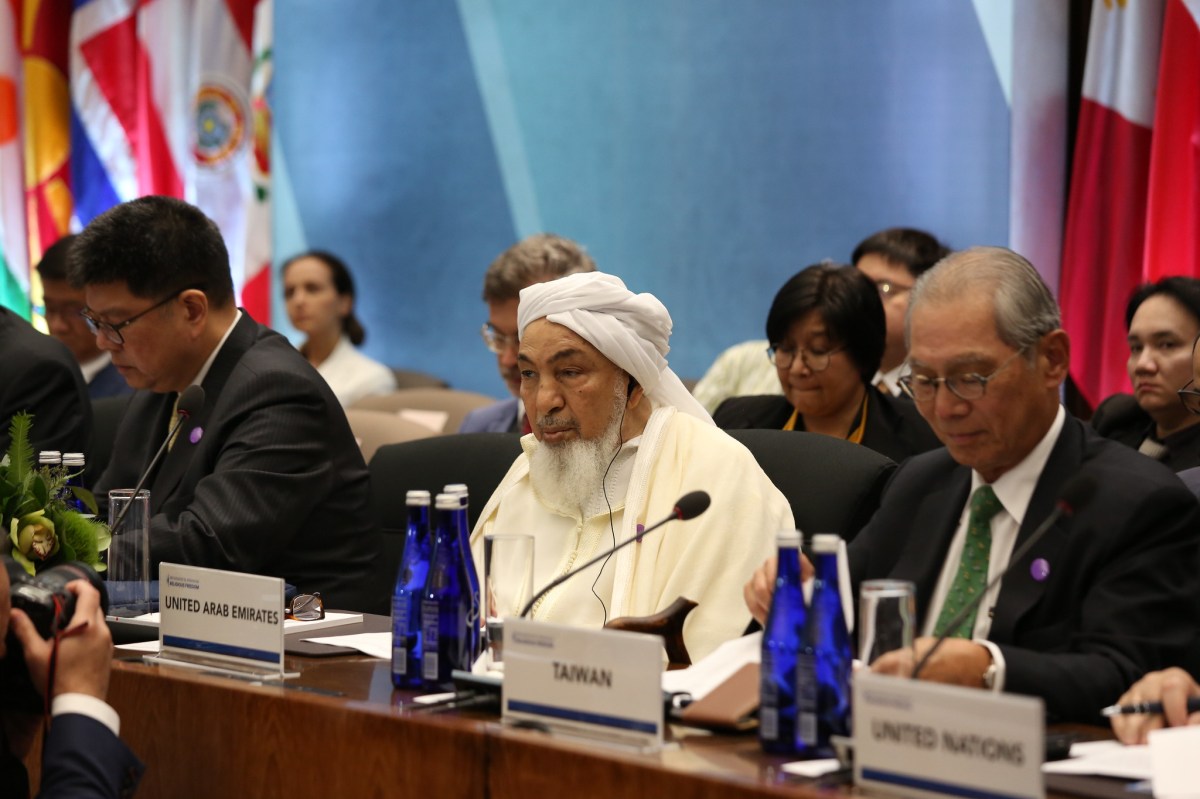
Heads of foreign delegations participate in the State Department's second Ministerial to Advance Religious Freedom.

Heads of foreign delegations participate in the State Department's second Ministerial to Advance Religious Freedom.

Christianity Today July 22, 2019
US State Department

In his opening remarks at the second US Ministerial to Advance Religious Freedom, Secretary of State Mike Pompeo challenged every major world religion and secular society—and also invited them in.

“We all agree that fighting so that each person is free to believe, free to assemble, and to teach the tenets of his or her own faith is not optional,” said Pompeo last week to the almost 1,000 participants from civil society and more than 100 invited foreign delegations gathered at the US State Department. “Indeed, it is a moral imperative that this be permitted.”

But do all actually agree? A change in human rights language might make the difference.

And could Saudi Arabia improbably become the next champion?

At the first ministerial last year, the State Department invited participating nations to sign the Potomac Declaration and Call to Action, validating a vision of religious freedom grounded in the 1948 Universal Declaration of Human Rights (UDHR).

At a side event during the second ministerial, Knox Thames, the State Department’s Special Advisor for Religious Minorities, spelled out several international cooperative accomplishments. But he told CT that it would have taken far too much negotiation to get other nations to put their pen to the Potomac paper.

The panel, organized by the Religious Freedom Institute (RFI), studied six recent international human rights declarations, including the Potomac one.

RFI’s director for education, David Trimble, emphasized that each generation does well to restate the UDHR, because “language changes” and the once-meaningful 1950s concept of freedom of religion has faded with the millennial generation.

Thus, the term might need to be updated, and panelist Brett Scharffs, director of the International Center for Law and Religion Studies, emphasized one of the six declarations that might be especially helpful in the Muslim world.

The Punta del Este Declaration on Human Dignity for Everyone, Everywhere, was signed in December 2018 in Uruguay by 83 state and civil society representatives—including 11 from Muslim-majority nations.

“Using the term human dignity opened doors that were closed before, because it is a term in the Qur’an,” said Scharffs, noting that the term was also used in the preamble to the United Nations charter.

“A return to this word might rejuvenate the human rights project, which is under threat today.”

The ministerial concerned itself primarily with religious freedom, as this “first freedom” is increasingly restricted for everyone, everywhere. According to the latest study by the Pew Research Center, only 13 percent of nations treat all religious groups “generally the same.”

Pew’s findings cover a ten-year period of study, with religious restrictions rising fastest in Europe. Meanwhile, the Middle East is still home to the greatest restrictions on religion, but its levels have actually been in decline since 2016.

“Muslim-majority countries are largely at a very different place now, increasingly open to claims of human rights, including religious freedom,” said Timothy Shah, RFI’s vice president for strategy and international research.

“But they are also understandably worried that a more robust embrace of human rights and religious freedom might lead to the very moral and social chaos they increasingly observe—quite acutely and properly—in Western countries.”

The RFI side event highlighted only one Muslim document: the Marrakesh Declaration, written in 2016 and previously covered by CT (as well as Arab Christian reactions). Its focus was on the protection of religious minorities in the Muslim world.

But other declarations have followed in its wake.

That same year, the Jakarta Declaration was issued from Indonesia, offering cultural heritage as an antidote to Islamic extremism.

In 2017, the Bahrain Declaration denounced “compelled religion” and declared “freedom of choice” to be a “divine gift.” Signed by the head of state, it was more powerful than just the deliberation of scholars.

Last February, Pope Francis and Ahmed el-Tayyeb, the Grand Sheikh of al-Azhar in Cairo, signed the Declaration on Human Fraternity in Abu Dhabi, emphasizing “freedom of belief, thought, expression, and action.” It was signed prior to a 135,000-person Mass, the largest Christian worship gathering ever held in the Arabian Peninsula.

Shaykh Abdullah bin Bayyah participates at the Ministerial to Advance Religious Freedom.US State Department
Shaykh Abdullah bin Bayyah participates at the Ministerial to Advance Religious Freedom.

The leading Muslim scholar behind the Arab world efforts is Shaykh Abdullah bin Bayyah, president of the Forum for Promoting Peace in Muslim Societies. He was a keynote speaker at the ministerial, seizing on the concept uniting the Muslim declarations and now reflected in the Western-issued Punta del Este document.

“Intolerance degrades human dignity,” bin Bayyah said, “and poses a grave challenge to humanity.”

But he did not mention what might be the Muslim world’s most significant declaration—if only because of location.

The above documents were trumpeted abroad, especially in the West, as examples of Muslim fidelity. Much quieter has been the reception of the Mecca Declaration, issued two months ago.

Signed by 1,200 scholars from 139 countries, the 30-point charter was organized by King Salman of Saudi Arabia during the final and holiest days of Ramadan.

The word dignity is mentioned throughout:

  • Point 11 commits all individuals to combat the violation of human rights.
  • Point 21 commits all world leaders to prevent discrimination based on religion.
  • And point 22 commits all state governments to protect religious sanctuaries and the rights of religious minorities.
  • Other points call for religious dialogue, protection of the environment, and the empowerment of women.

“This has broken huge ground,” said Johnnie Moore, a commissioner at the US Commission for International Religious Freedom. “It came from Mecca! It is not what one would expect from the heart of Wahhabi Islam.”

Within this context, Moore found great importance in the Saudi signal to its own establishment that this is the group of scholars—led by bin Bayyah—that they must follow.

“Still, we shouldn’t have outsized expectations,” he said. “Much work remains to be done.”

Salim Munayer, head of the Musalaha reconciliation ministry in Jerusalem, said that Palestinians are aware of the declaration, and hopes it will filter down to the Muslim street.

Like the other declarations, it is a product of the Muslim elite, and Munayer celebrates it as a clear condemnation of terrorism. But he fears it might have been pushed by US pressure on Saudi to reform its image, rather than from internal conviction.

Either way, the Mecca Declaration is not very precise in its language.

“The problem is how can you talk about rights, without defining the interpretation of Islamic sharia?” Munayer said.

“Freedom does need to be contextualized to different cultures. But if not qualified, it might not change anything. Human rights must be based upon more than sharia.”

Paul Marshall, the Wilson Professor of Religious Freedom at Baylor University, appreciated the Mecca Declaration’s emphasis given to contemporary issues—including abortion and non-intervention in the sovereignty of nations. This was unexpected from Saudi Arabia, and helpful.

But he shares Munayer’s concerns. “[The document] has troubling words concerning personal freedom and freedom of speech,” he said. “The rhetoric—equality, diversity—sounds good. But without specifics, we don’t know what it means.”

For example, Point 17 warns that personal freedom must not destroy social mores. Bin Bayyah emphasized this at the ministerial.

There is a “balance between having principles on one hand, and their practical applications on the other,” he said, describing “secondary rights” that he did not define. “[These] must be secured in a gradual and strategic manner that preserves social order.”

Bin Bayyah was clear that religious freedom for minorities is an “uncompromising principle” that must be enshrined in legislation and social values. But “a great deal of wisdom” is required lest pursuit of “an ideal state” annul the social contract—and “create the opposite of what we seek.”

Bin Bayyah’s speech esteemed the UDHR and used its language to make his point. Its Article 29 “qualifies” the prior series of absolute rights, in reference to limitations determined by law to secure morality, public order, and the general welfare.

“These qualifiers provide the leadership of each society with some autonomy,” he said, “and place upon our conception of citizenship a lot of relativity.”

He went on specifically to call for a ban on the denigration of religious symbols.

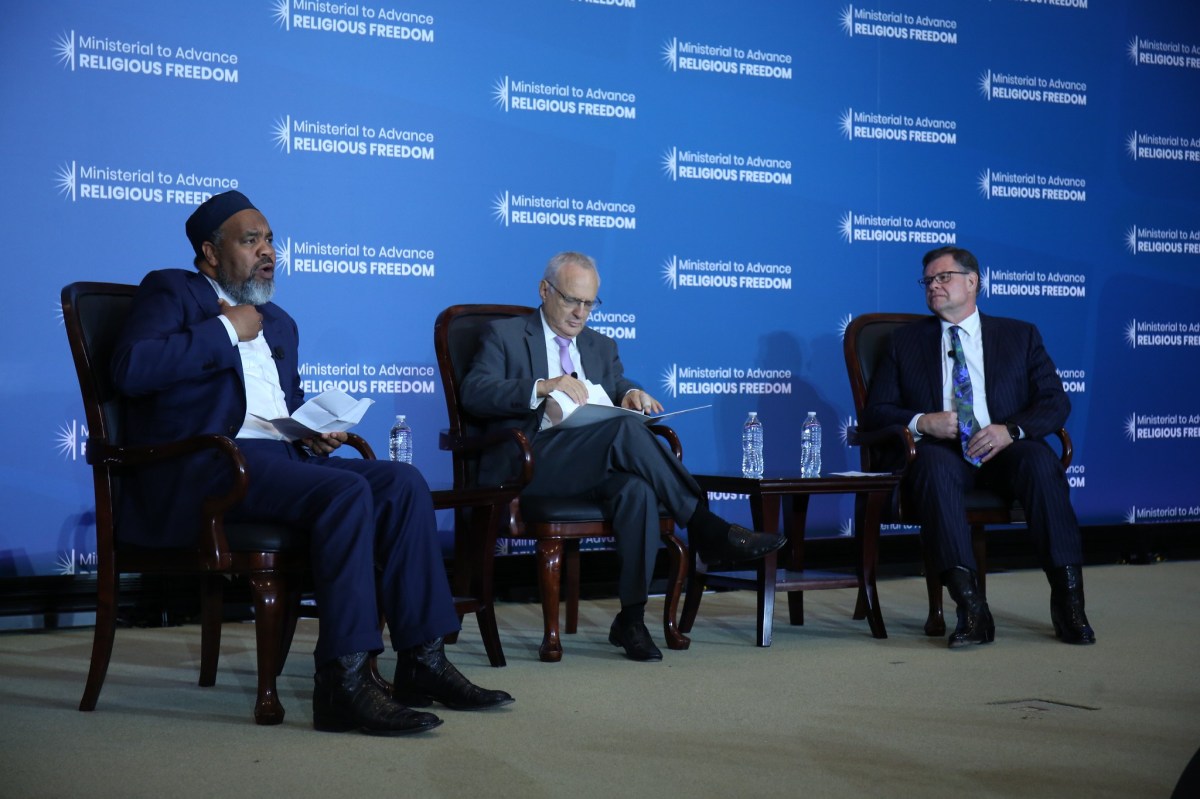
Imam Mohamed Magid (left) and pastor Bob Roberts (right) speak on a panel at the Ministerial to Advance Religious Freedom.US State Department
Imam Mohamed Magid (left) and pastor Bob Roberts (right) speak on a panel at the Ministerial to Advance Religious Freedom.

Mohamed Magid, imam of the All Dulles Area Muslim Society outside of Washington, DC, is a disciple of bin Bayyah and a contributor to the Mecca Declaration. He serves 5,000 families across seven mosques—two of which meet in Jewish synagogues, and one in a church.

He said the declaration was meant to be broad enough for interpretation, mindful of local sensitivities, but not limiting in application.

Magid stated he pushed for its Point 29, to demand the declaration be practically implemented.

“Mecca is an action plan of principles that we want the Muslim community to act upon,” the Sudanese-American scholar said, “and to have the world know this is what Muslims believe in.”

Each point can become a conference, and follow-up plans are already under discussion.

“In Muslim countries where there are restrictions against people of other faiths, we have to work hard and push for them to get their religious rights,” he said. “I will use this as my tool to say, ‘Hey, you signed this.’”

All must be done in a manner allowing society to stay in harmony, said Magid. But asked specifically if his interpretation includes the right of conversion, he said: “Absolutely. The Qur’an states there is no compulsion in religion.”

In remarks to close the ministerial, Vice President Mike Pence singled out several nations of the world for their religious freedom violations—including Saudi Arabia. For example, the kingdom has detained blogger Raif Badawi since 2012 on charges of apostasy and insulting Islam.

But as Pompeo opened with an invitation, Pence closed with consensus. And rather than changing language—the word dignity was not mentioned—he chose instead to renew the traditional American creed.

“We’re gathered here, 106 nations strong, because we believe in the freedom of conscience—the right of all people to live out their lives according to their deeply held religious beliefs,” Pence said. “We are, and will forever remain, dedicated to the principle that we are endowed by our Creator with certain unalienable rights—that among them are life, liberty, and the pursuit of happiness.”

But again, do all actually agree? Only six Muslim-majority nations signed the ministerial-ending Statement on Respect for Religion or Belief.

Bob Roberts, pastor of Northwood Church in Texas, urges patience. Deeply engaged with Magid in promoting evangelical-Muslim dialogue, he reminds fellow Christians how long it took the US to develop its own understanding of human rights.

“Don’t try to swallow the whole elephant at once,” he said, referring to Saudi acceptance of the UDHR. “This is our mistake in America. We want everyone to be just like us, overnight.”

Statements mean nothing without laws, Roberts emphasized, and there remain inconsistencies.

“It would be telling if Saudi doesn’t pass some laws,” he said; for example, migrants should be able to worship legally and publicly. “If they were to do just this one, it would make a huge statement to the world.”

But the Muslim world is getting closer, reaching even to the holiest city of Islam. And within this context, he believes the Mecca Declaration is a major development, both forced and forceful.

“If Saudi Arabia doesn’t say something, it gets left behind,” he said. “But when Saudi Arabia does say something, it pushes everyone else forward.”

Correction: An earlier version of this article implied that Saudi Arabia chose not to sign the ministerial’s closing statement. Saudi Arabia did not attend the ministerial.

Theology

What the Ordination Debate Misses: Laywomen in Ministry

Complementarians and egalitarians share common ground in lay leadership.

Christianity Today July 22, 2019
Pearl / Lightstock

As managing editor of the Christian Research Journal and a women’s ministry trainer in the Presbyterian Church in America (PCA), Melanie Cogdill has had ample opportunity to closely observe the unique discipleship challenges faced by evangelical women. In Beyond the Roles: A Biblical Foundation for Women and Ministry, Cogdill has gathered essays from various authors who explore a theological foundation for women’s ministry and also delve into 14 practical issues often found in female-centered ministries. CT spoke with Cogdill to find out more about her burden for women’s discipleship in the church.

Why were you particularly burdened for a book that went “beyond the roles”?

Several years ago, I was in the exhibit hall for the Evangelical Theological Society, where the attendees are more than 95 percent men. The books some publishers had put out were ones for women that focused on marriage and motherhood. Literally hundreds of books come across my desk at work each year, and I have very rarely if ever seen a volume that addresses laywomen in ministry.

Sure, many books address exegetical issues regarding women’s roles in ordained leadership but not the particular issues women face as they minister to other women. As someone on the national women’s leadership team for my denomination, I wanted to let church leaders know that there is a fully developed ministry philosophy that doesn’t focus on a woman’s stage of life or marital status but that is all about equipping women in discipleship in the local church.

These essays don’t cover the exegetical debate about women's ordination. Why not?

I have spent my career working in theology and apologetics, and I have seen many, many books written on this issue from both sides. As someone who believes in theological, academic scholarship, the debate is very important, and there are two very distinct, opposite conclusions on what Scripture teaches about this issue. But at the end of the day, I want to encourage women in the pews of Christian churches everywhere to use their gifts in their denominational context.

At its core, the Christian faith is about knowing and worshiping God. There is a need to equip, train, and encourage women to do that in the context of all creedal churches. That means the lessons for egalitarians and complementarians are the same. The debate between egalitarianism and complementarianism, while at times hotly debated in terms of exegesis, ministry practice, and ordination, is not a gospel issue nor is it an essential of the Christian faith. The need for ministry to and for women is relevant to all evangelicals and Protestant churches regardless of denominational affiliation—not only in light of #MeToo and #ChurchToo issues but also because we all need to pro-actively disciple women and train women to disciple others.

The first section, with contributions from eight different women, is oriented toward a theology of women’s ministry. Did a consistent theme emerge?

The first section of this book really deals with the foundations of women’s ministry, which include studying the Word of God, having a robust theology of imago Dei, pursuing unity in the church, and discipling women through gospel friendships. The foundation for the discipleship of women has to be a theological one. In this section, writers first and foremost encouraged readers that ministry to women—and for that matter to men and youth of both genders—should be based on Scripture and provide a gospel-centered focus to all aspects of ministry.

What does shared male-female lay ministry look like in the church?

Scripture calls men and women to be co-laborers and partners in ministry. With the ongoing debate about gender roles and male-female relationships—both in the church and outside—how do we reclaim that collaborative vision, again, irrespective of one’s view on women’s ordination? Remember that not all men in our churches are ordained ministers. In fact, the majority are not. We work together in the church by making spaces and ways for all laity, both men and women, to be encouraged and equipped to use their gifts in ministry, not so people can follow their proverbial passions, but so we can equip and disciple all of Christ’s church. That’s the goal as Jesus laid out in Matthew 28.

In your opinion, what are the most pressing challenges for women in the PCA and other complementarian contexts?

As a single member in a denomination of more than 1,900 churches in North America with many different ministry and cultural contexts, I would not want to or be able to speak on behalf of an entire denomination. But I will say, as someone who is a women’s ministry trainer for the PCA, women’s ministry needs to move from a model driven by personalities, events, and markets to one that is founded on sound theology and Scripture. I don’t think that is an issue to have division over.Christians at times can be reactive to the small number of more than 1,900 PCA churches in regards to ministry opportunities for women. Our denomination doesn’t ordain women, but beyond that, there is so much that women are doing. Women are better suited to minister to other women than men are in some circumstances. If a woman has suffered abuse, trauma, or rape, discipleship spaces for women ministering to women are more helpful than a man in those situations.

I certainly do not negate any woman’s experience, where she has not found places to serve in her particular church or been discouraged from serving and has felt frustrated by that. However, I don’t think we can draw conclusions that all women do not have a space to serve in the PCA. As a layperson, I serve and have served on denominational committees with men. There are opportunities for service, and where there are not, I want to encourage church leaders to think about how to use the gifts of the entire congregation—both women and men.

All Christians are called to serve in the church, so how can that be facilitated, not as a matter of checking some to-do list, but toward the broader goal of discipling God’s people and proclaiming the gospel? Our goal is to know the living God and make him known. So how can we utilize the gifts of lay people, including women, by helping the body of Christ in their pursuit of knowing God and making him known?

More generally, what are the pressing problems for women’s ministry in the larger church?

One hurdle that I see in the larger evangelical church is that the conversation about equipping women has been centered on seasons of life—particularly marriage and parenting. But Christian women should not be defined by their season of life. This is not to say that marriage and parenting should be ignored, but it frankly has become an idol for women. Our identity always needs to be first and foremost in Christ and in the pursuit of knowing and glorifying him, regardless of the season of life in which women find themselves.

Another hurdle that applies to the larger evangelical church, in the context of women’s ministry, is that we need to listen more carefully to each other. We need to believe the best about each other—per 1 Corinthians 13—and our ministry philosophy choices, as we seek to apply our biblical convictions in a culture that is increasingly hostile to a Christian worldview. We can have unity around the gospel but not uniformity of practice of ministry. That is a space that has tension in it, but we need to overcome the hurdles of thinking that ministry philosophy must be the same in different contexts. I work in apologetics with Christians of all different denominations and traditions, and of course, we have theological differences—some of which are substantial—but we can unite around the defense of the Christian faith.

Conversely, what excites you the most about the future of this conversation?

There are two distinctives that we like to communicate about women’s ministries: They need to be Word-based and relationally driven. Our vision is one in which women’s ministries are founded in the Word of God being our authority. They’re also a space for women to, as we put it, “think biblically, think Christianly, and live in community with believers in the church.” I am very excited about encouraging churches and church leaders to see the importance of women’s ministry, not as a silo venture like a Christian sorority, but as a ministry that seeks to reach all women with the gospel.

A second edition of Beyond the Roles: A Biblical Foundation for Women and Ministry will release this August.

Apple PodcastsDown ArrowDown ArrowDown Arrowarrow_left_altLeft ArrowLeft ArrowRight ArrowRight ArrowRight Arrowarrow_up_altUp ArrowUp ArrowAvailable at Amazoncaret-downCloseCloseEmailEmailExpandExpandExternalExternalFacebookfacebook-squareGiftGiftGooglegoogleGoogle KeephamburgerInstagraminstagram-squareLinkLinklinkedin-squareListenListenListenChristianity TodayCT Creative Studio Logologo_orgMegaphoneMenuMenupausePinterestPlayPlayPocketPodcastRSSRSSSaveSaveSaveSearchSearchsearchSpotifyStitcherTelegramTable of ContentsTable of Contentstwitter-squareWhatsAppXYouTubeYouTube