Pastors

When Words About God Become the Word of the Lord

Decades of listening to sermons have convinced me of these four truths.

CT Pastors November 16, 2020
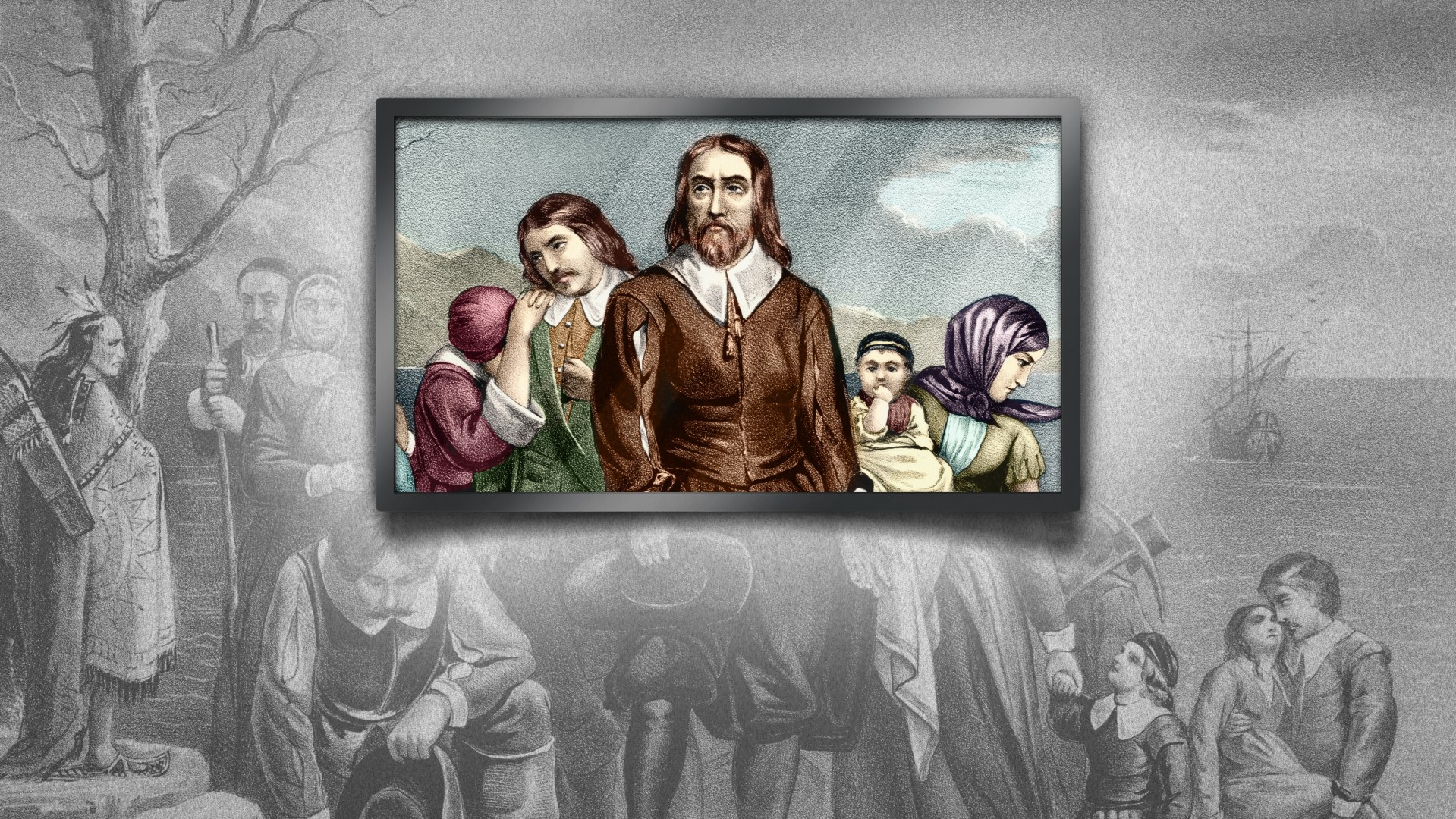
Illustration by Rick Szuecs / Source image: York Creative / Lightstock

By any account the past six months have been the hardest time in my life. The challenges of keeping a university safe and open amid a pandemic has meant reinventing much of what we do in teaching, research, housing, dining, student life, and athletics. In this time of unprecedented professional stress, I have been thrown back on the deepest resources I can grasp. Among them is the rich tradition of preaching that has been my portion—in my youth, in my studies as a religious historian, and in my week-to-week experience in church.

Though never a preacher, I have lived a life in sermons. My father, James “Buck” Hatch, was an exceptional minister and teacher who set a very high standard for communicating from the pulpit and lectern. His gift was not eloquence per se but a rare ability of speaking in ways that actually changed outlooks and lives. Almost two decades after his death, I still get notes from people whose lives were powerfully transformed by his spoken word.

These days my interest in sermons concerns their diminished power. This is true particularly, and ironically, among evangelicals, for whom sermons carry great weight as a means of grace. Deeply committed to biblical authority, evangelicals put extraordinary faith in what Eugene Peterson called “the extraordinary truth-releasing, God-witnessing, culture-challenging realities” in the Bible as it is forthrightly proclaimed. Expounding God’s Word is an awesome responsibility. The great preacher Charles Spurgeon noted that it was nothing less than to “open the door and let the lion out.”

Sermons have relinquished their roar. Though at times eloquent and erudite, they’re more often routine and predictable. They fail to stir the imagination, challenge the will, and make hearts “strangely warmed,” as John Wesley once said. I covet sermons that amaze people in seeing anew the mighty acts of God on their behalf, ones about hope and joy that actually inspire real hope and joy. We need more sermons to reveal ordinary life as part of a larger story, a profound and majestic drama that invites hearers to become actors in all God is doing. How might this happen? I offer four modest suggestions applicable to almost any kind of sermon.

Powerful preaching peels away the film of familiarity.

Sermons should assume that however pious those in the pews, we see only in part and need our eyes reopened to the wonder of God. Too much evangelical preaching assumes we basically understand how the world works and require but a few moralistic reminders to adjust our pilgrimage back onto a straight path. Mostly we run on automatic pilot, comfortably covered in a film of familiarity that fails to challenge us with the profound truths of Scripture. As suggested in words of poet Malcolm Guite:

How hard to hear the things I think I know,

To peel aside the thin familiar film

That wraps and seals your secret just below:

An undiscovered good, a hidden realm.

Preaching the gospel entails turning the water of the humdrum and uninspiring into wine infused with the grandeur of God. To use a musical metaphor, preaching transposes minor key experiences into major key majesty. We are too often tone deaf to the beauty, holiness, and mystery of God’s kingdom. A skillful linguist or musician opens mind and heart to detect the reality that resides beneath surfaces. The apostle Paul prays for the church that their eyes of their understanding would be enlightened to understand their hope, their calling, and the fullness of their bountiful inheritance (Eph. 1:18–19).

Great sermons know eternity enters our live in the present. Christian pilgrims need our imaginations renewed. The reality of God is not yesterday or tomorrow; it is today amid our everyday routines when we can encounter God. In Christ we can trust when we cannot see, believe when do not feel, hope when the future looks grim, and pray when the heavens seem locked.

Powerful preaching unlocks the transformative power of the Bible.

Evangelicals possess an unswerving allegiance to the Bible. We believe that the Word is sharper than a two-edged sword (Heb. 4:12) and does not return void (Isa. 55:11). By heart we know the stories of Adam and Eve, Noah and the Flood, Moses and the Ten Commandments, David and Goliath, Nicodemus and new birth, the Good Samaritan, Christ feeding the five thousand, Paul’s Damascus Road conversion.

But such biblical saturation has a downside. By its very repetition, the Bible can feel worn out and remote. Frederick Buchner makes this point strikingly:

When a minister reads out of the Bible, I am sure that at least nine times out of ten the people who happen to be listening at all hear not what is really being read but only what they expect to hear read. And I think that what most people expect to hear read from the Bible is an edifying story, an uplifting thought, a moral lesson—something elevating, obvious, and boring. … His stories are like photographs that have been exposed to the light so long they have faded almost beyond recognition. They are like family anecdotes so ancient and time-honored we groan at their approach.

Preachers must reveal Scripture’s surprising and life-giving power. They should knock people off guard, unsettle their preconceptions, and draw them into fresh realities about God and his world—a world at once much bleaker and much grander than we could ever imagine.

Biblical preaching should transport hearers from one world to another. Franz Kafka once said that if a book “does not wake us, as with a fist hammering on our skull, why then do we read it?” How much more so with Holy Writ, the exposition of which should always astound, convict, surprise, inspire, and engage. Like an artist, the preacher doesn’t so much say what we never knew but brings into sharp relief what is latent, forgotten, or overlooked. A message should leave the hearer with a certain “Wow! Now I understand.”

“The real reason why so few men believe in God,” Thomas Merton wrote, “is that they have ceased to believe that even God can love them.” Too much evangelical preaching falls into the trap of giving moralistic advice to those who feel spiritually inadequate. A little more striving, a little more prayer, a little more devotion—and one might rekindle the flame and get back on the pilgrim’s path.

Gracious preaching, by contrast, conveys that God’s love floods our lives even when we don’t feel it. We learn how to love by being loved; we learn to act graciously by experiencing grace. Sermons should allow grace to wash over the hearer. They should leave one refreshed and comforted that God has acted, and is acting, so wonderfully on their behalf. “Isn’t all of this just too good to be true?”

Powerful preachers know the road to the human heart.

Most of us don’t walk into church on some high spiritual plane. We are often distracted, caught up in the struggles of daily life. We do not stop long enough to consider our spiritual needs. Skillful ministers grasp where people live and speak to their deepest longings, fears, anxieties, and temptations. They diagnose and treat the soul.

By identifying and lifting trying personal realities to the surface, the preacher gains immediate access to the very core of a person and opens their heart to God’s gracious Word. Too many sermons idealize some far-away, stained-glass saints who seem to live blameless lives and do great things for God. By focusing on these ideal types, whether biblical characters or other heroic Christians, a minister generates even more guilt among those worried about not measuring up.

Ministers who understand common feelings of dismay and unworthiness can communicate grace and comfort in their sermons, not mere exhortations to work harder and dream bigger. “You think religion is a matter of knowing things and doing things,” Eugene Peterson preached. “It is not. It is a matter of letting God do something for you: letting him love you, letting him save you, letting him bless you, letting him command you.”

Powerful preaching begins with the preacher transformed.

One of the startling memories of my childhood was when my father, preaching a sermon on the spiritual life, stopped suddenly and awkwardly dismissed the congregation. He felt convicted of having not assimilated, made real, the truths he addressed. He displayed ruthless honesty with himself and with the congregation. My mother was duly shocked and embarrassed but recalled the sermons that followed were some of the most powerful she could remember.

My father firmly believed the Holy Spirit would never make effectual for a congregation what not come alive to the preacher. Only if the eyes of the preacher’s heart were enlightened did he or she have any hope that the same might happen to others.

Evangelical tradition is fueled by the quest for a living faith that begins from the pulpit. “Light yourself on fire with passion,” John Wesley once said, “and people will come from miles around to see you burn.” This makes preaching an awesome calling. More than merely understand and articulate, a preacher must experience God in fresh ways—and then allow that encounter to overflow into the lives of others. “If preachers decide to preach about hope,” Frederick Buechner once said, “let them preach out of what they themselves hope for.”

Through the power of the Holy Spirit, we can remain centered in a world where peers are jockeying for status and distinction, where material achievement becomes the measure of success, and where service is rendered principally for the recognition it brings. We need constant reminders to lift our eyes and behold a world more splendid than meets the eye. How does one import kingdom values extolling mourning and self-sacrifice, kindness and peacemaking? We need proclaimed, today and every day, the resplendent rainbow of God’s love breaking into the grayness.

Powerful preaching is an awesome responsibility. I admire greatly those who take up the challenge week by week. A nourishing sermon changes words about God into words from God. It renews dull senses, rediscovers the vigor of the Biblical text, and reconnects hearers to the loving face of God. Nourishing sermons flow out of the lived experience of the preacher into the lived experience of the hearer, transposing ordinary life into something far grander, more mysterious and purposeful than anything we could imagine: a life truly worth living.

Nathan Hatch is president of Wake Forest University and author of The Democratization of American Christianity.
News

Sudan’s Partially Answered Prayers

An interview with Archbishop Ezekiel Kondo on religious freedom after Bashir, normalization with Israel, defamation of religions, and what to pray for next.

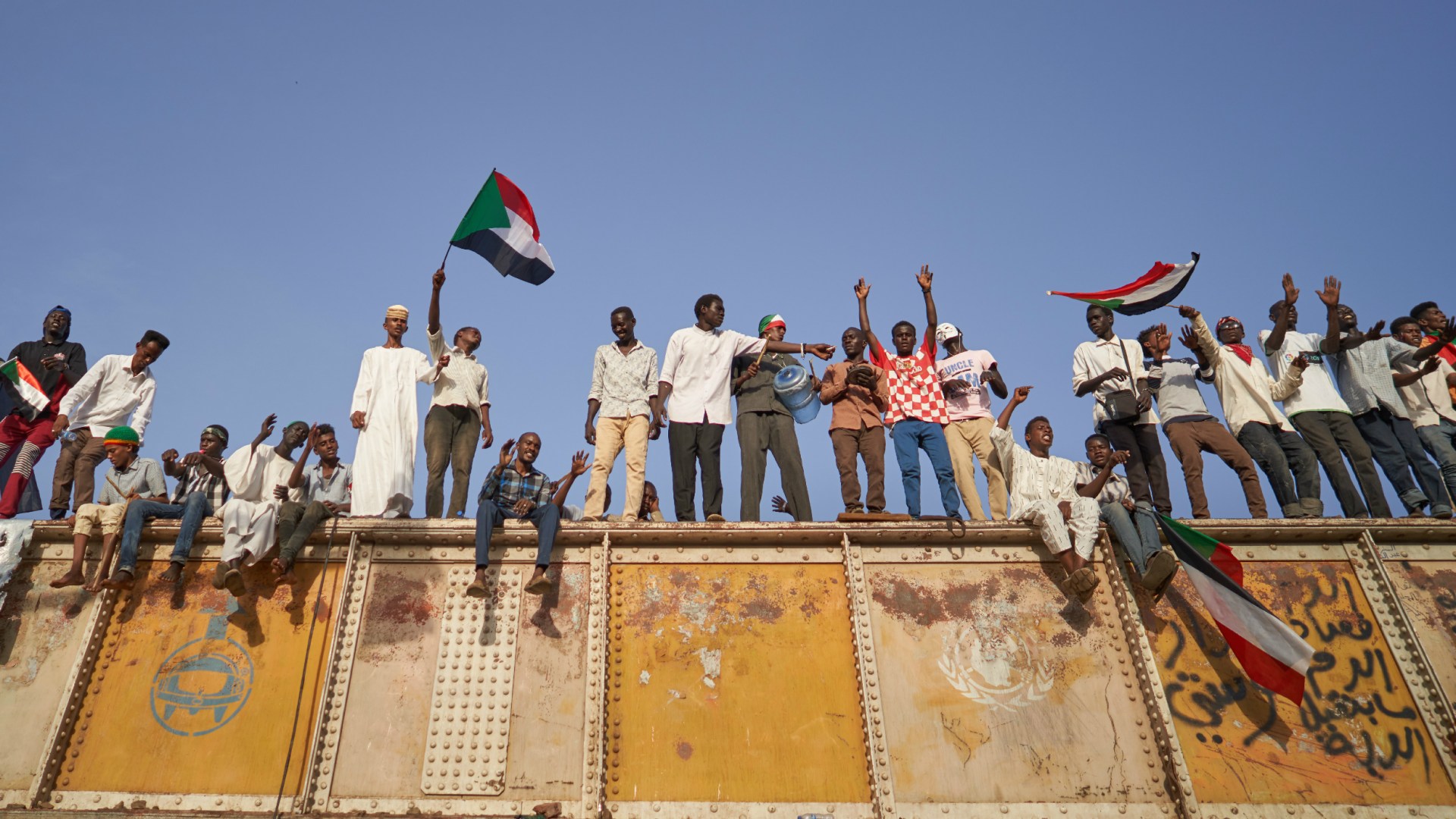
Protesters chant from a railroad track in May 2019 above a mass sit-in outside military headquarters in Khartoum to call on the country's military rulers to cede control.

Protesters chant from a railroad track in May 2019 above a mass sit-in outside military headquarters in Khartoum to call on the country's military rulers to cede control.

Christianity Today November 16, 2020
David Degner / Getty Images

Sudan is rejoining the community of nations.

After 30 years of pariah status under former dictator Omar al-Bashir, the nation has established relations with Israel, taken steps to improve religious freedom, and ensured removal of its US designation as a state sponsor of terrorism.

Archbishop Ezekiel Kondo of Sudan has witnessed the entire history.

Born in 1957 in the Nuba Mountains region, he was ordained an Anglican priest at the age of 31. In 2003, he became bishop of the diocese of Khartoum, Sudan’s capital city.

In 2014, Kondo became archbishop of Sudan within overall administrative unity with South Sudan. And in 2017, he was enthroned as primate of the newly created Anglican Province of Sudan.

A critic of religious persecution under Bashir, Kondo has associated his church with the conservative Global South Movement in the Anglican Communion, as well as GAFCON, which seeks “to guard the unchanging, transforming gospel of Jesus Christ and to proclaim Him to the world.”

CT spoke with Kondo about justice for the Palestinians, the need for a blasphemy law, and his ranking of Sudan’s religious freedom progress on a 10-point scale:

Archbishop Ezekiel Kondo

Your country has begun a process of normalizing with Israel. Are you in favor of this process?

I do support it, for the good of Sudan. Normalizing will be a good thing for development in economy, agriculture, technology, and other areas. It will open doors for relations with other countries.

And spiritually, it will enable [Sudanese] Christians to visit the Holy Land.

Are there Sudanese Christians against normalization?

I don’t think there are any. Israelis are human beings. Christians know that other Arab countries have relations, like Israel’s neighbors, Jordan and Egypt. So why not Sudan? They don’t see any reasons against it.

Historically, Sudan has taken strong stands in support of Palestine. How do Muslims feel about normalization?

Many Sudanese leaders say that by normalizing relations with Israel, it does not mean we stop our support for the oppressed Palestinians.

But some people are saying this is completely wrong, we can’t accept it. There have been demonstrations that burned the flags of both Israel and America.

Opinions are divided, but I think the majority believe that normalizing relations will do no harm to the Palestinian cause. We will still speak out for justice.

Sudan has made strides to improve the situation of religious freedom. On a scale of 1 to 10, how would you rank the situation before the revolution, and now?

There has been no significant change. I would give it a 4, before and after.

There have been two good developments. One, Christmas has been declared a public holiday for everyone. Two, Christian schools can now operate on Saturday. The weekend is Friday and Saturday, with Sunday a working day. Now Christian schools can have Sunday off.

So maybe I can change my opinion, and give Sudan a 5, after the revolution.

There has also been an allowance of alcohol for Christians, and the repeal of the apostasy law.

These do not impact us very much.

Some people interpret the change to say that Christians are now allowed to drink. But actually, the Bible does not allow us to drink!

For apostasy, yes, this is correct. But while there is an official change on paper, in practice I do not think it will change much. Islam is a culture. You can be protected by law, but you cannot be protected from your relatives or the community.

Help us understand the problems that still exist for the Sudanese church.

There remains difficulty in getting approval to build new churches.

There are so many churches that have been built previously with no legal status, and the government has not acted to find solutions. The Ministry of Housing and Planning still has the right to come and demolish them at any time.

In addition, though there is a Christian woman on the Sovereignty Council, there is not a single Christian in the Cabinet of Ministers, or among the state-appointed governors.

What about the blasphemy law in Sudan? Today many Muslims are calling for an international ban on the defamation of religions.

God has made people to be free, and not to be in bondage. But it should not be a total freedom. People should be careful, respect one another, and respect one another’s religion.

In Sudan, if you insult someone’s religion, you can get 10 years in prison. The apostasy law has been repealed, but respect is also important.

It is appropriate there should be an international ban. Let people decide for themselves about religion, that is their freedom. I should be able to change from Islam to Christianity if I want to, or from Christianity to Islam if I want to. But I should not be insulted.

There should be a law that prevents people from incitement.

Do you have the legal and cultural freedom to share your faith with Muslims?

Again, this is possible on paper, but I doubt it in practice. Islam is a culture. It will take some time for people to get used to the change in the apostasy law. But perhaps it will be possible in the long run.

After the revolution, is there a desire in Sudan to change this culture, away from its prior state-led Islamic basis?

There are many in the Council of Ministers who are working very hard to change this, but it will take time. I’m not sure about the Sovereignty Council, which is both civilian and military.

What is the spiritual condition of the Sudanese Church?

Spiritually it is strong, even though some denominations have internal conflicts.

What we lack is biblical teaching. After the secession of South Sudan, many learned people left Sudan to go there. The majority of churches also lack finances. We need to grow in these areas, in order to become self-reliant.

But church buildings are full, despite the difficulty in transportation. People come from great distances, and this is one example that shows their love for the Lord. And COVID-19 has really helped people come together, pray, and study the scriptures.

What prayer requests do you have for the church?

Please do not grow tired of praying for Sudan.

Pray that what has been done in this revolution will be implemented. Pray the same for the peace deals signed with some of the armed groups, and that others will sign. It is only a partial peace right now, not complete.

If peace comes, it will result in a strong economy, as money will shift from war to development. Refugees and the internally displaced will return, in order to develop their own areas and houses. This is very important.

Pray also for the church to be faithful to the gospel.

Do you view the revolution as an answer to prayer?

God works in mysterious ways. Who thought Bashir would leave the presidential seat? No one. But with their bare hands people went to the streets, and he left. This is God’s doing.

Around the world people have been praying earnestly for the suffering of the Sudanese people, and I believe God answered their prayers.

Ideas

Assessing Metropolitan Amfilohije, Whose Religious Freedom Fight Brought Down a Dynasty

An evangelical reflection on the legacy of Montenegro’s Orthodox leader, the highest-ranking clergy worldwide to die of COVID-19.

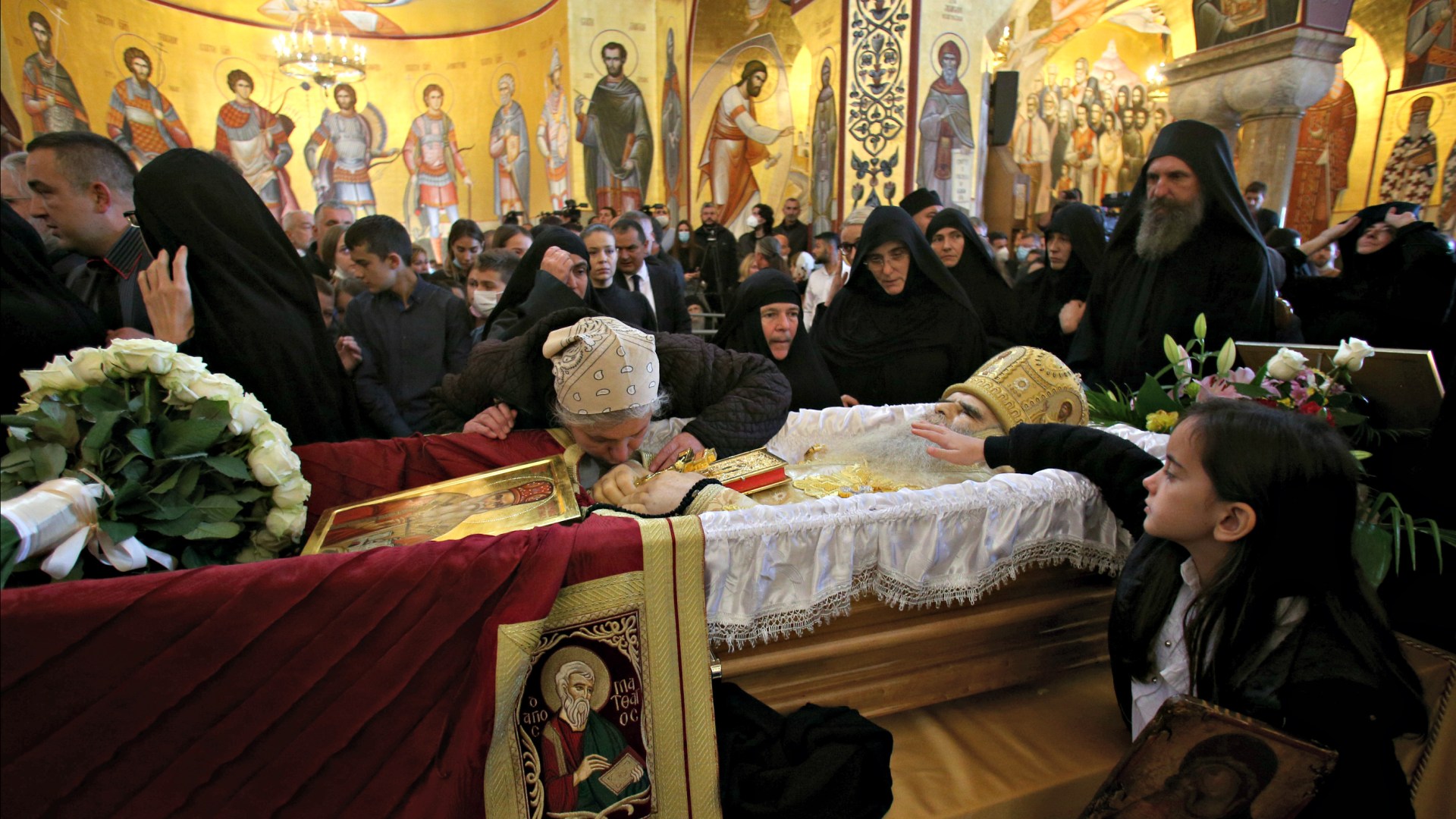
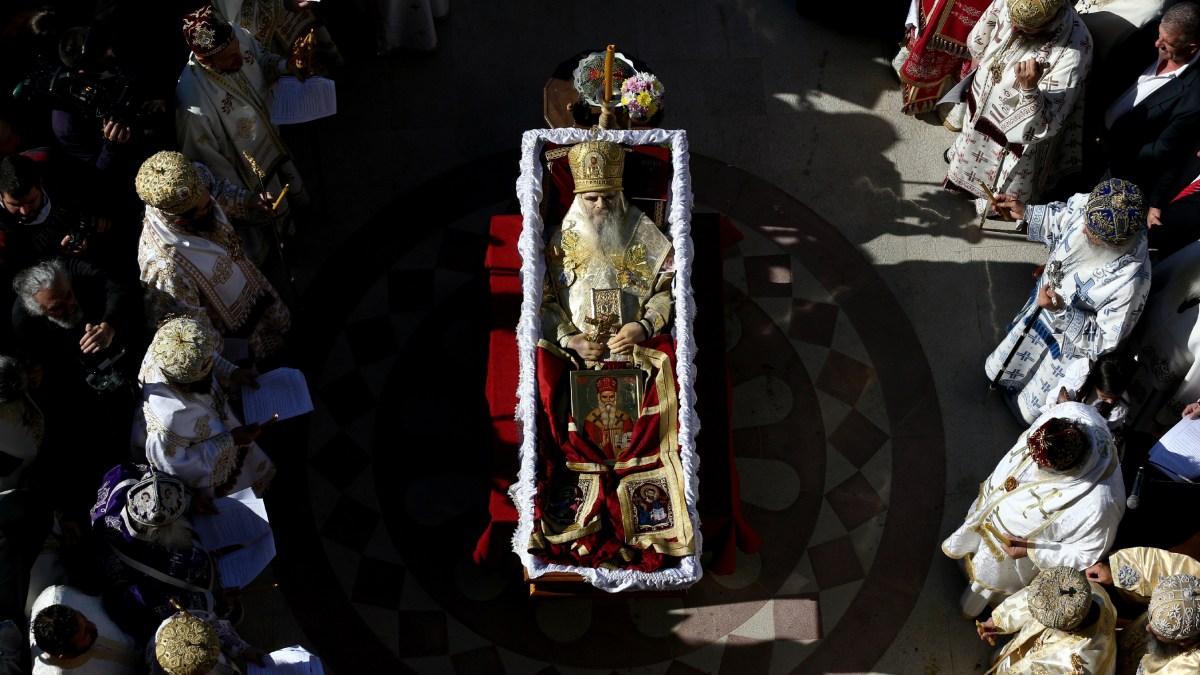
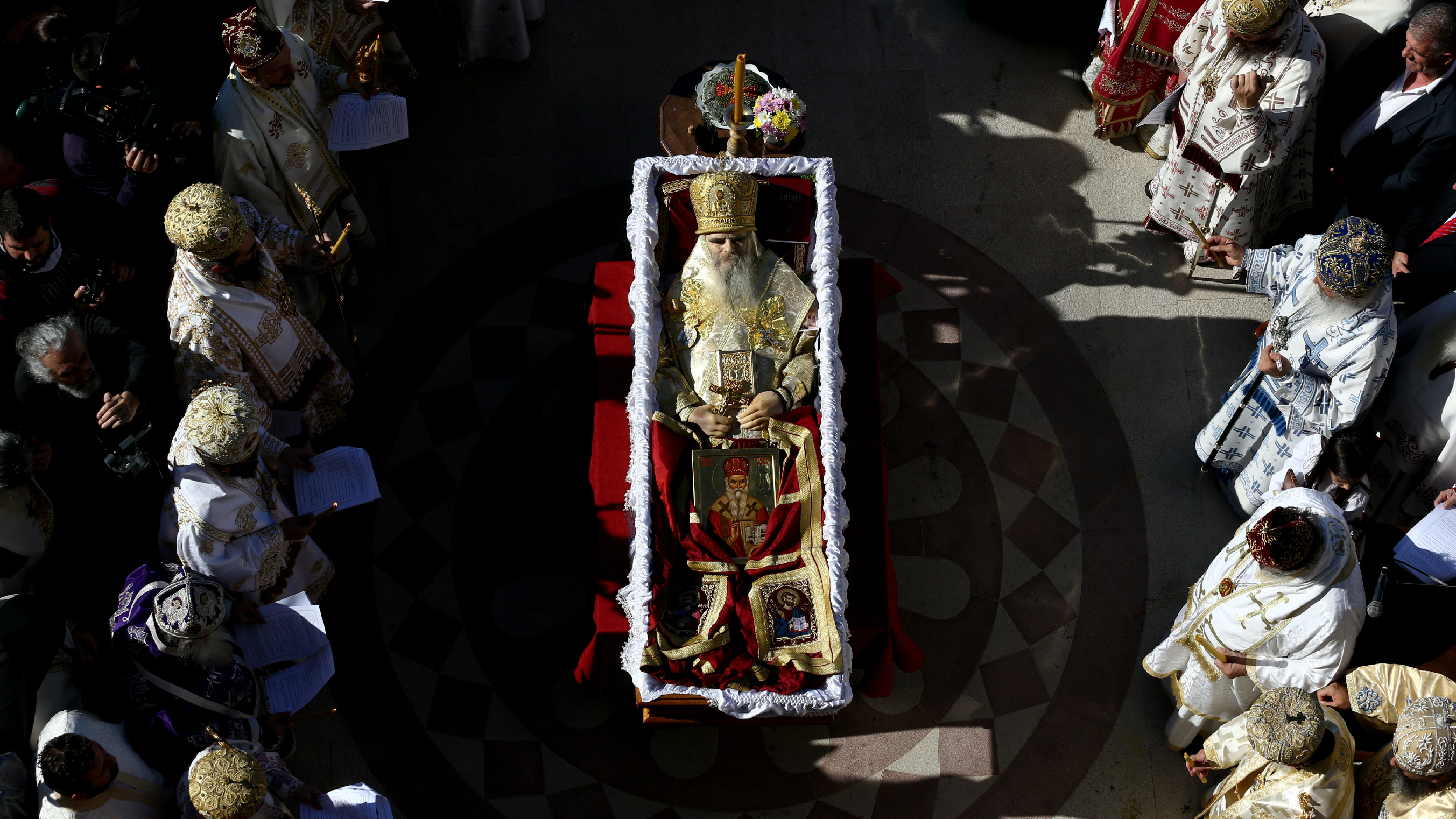
Metropolitan Amfilohije's funeral service on November 1 in Podgorica, Montenegro.

Metropolitan Amfilohije's funeral service on November 1 in Podgorica, Montenegro.

Christianity Today November 16, 2020
Filip Filipovic / Getty Images

This past year, Montenegro witnessed a phenomenon unprecedented in its history. Nationwide nonviolent street processions rallied against a new Law on Religious Freedoms, drafted—many believe—to divest the Serbian Orthodox Church of its historic churches and monasteries.

There is no unified view on these events. Some say the marches defended human rights; some say they were a form of clerical fascism.

Personally, as an evangelical pastor in Montenegro, I prefer to call the protests a revival in the making.

Their informal leader, Metropolitan Amfilohije, passed away October 30 at the age of 82. He is the highest-ranking Christian cleric worldwide to have died from COVID-19 complications.

The metropolitan was an iconic figure. He was a man of great internal strength, remarkable intellect, iron-like determination, and fascinating zeal. But he was also accused of political agitation, hate speech against Muslims and ethnic Montenegrins, and—as the former Yugoslavia dissolved into bloody conflict in the 1990s—uncritical support to the “Serbian cause.”

He was called Dedo (“Grandpa” in Serbian) by the Orthodox faithful, and was compared to Moses, leading the people from Egypt. He may well be canonized as the next Serbian Orthodox saint.

Controversial in life, Metropolitan Amfilohije remains controversial also in death.

His funeral rallied thousands of people to the capital, Podgorica, in the midst of a pandemic, when Montenegro was one of the most infected countries (per capita) in the world. With emotions at their peak, people neglected social distancing and face masks. His dead body was displayed in an open casket, as throngs of people touched and kissed it in veneration. Following the service, they took Communion from a single spoon.

It was not the first time. During the Easter fast, when COVID-19 numbers were low but hysteria was high, the metropolitan led the same practice. This tradition, dating back to the first millennium A.D., is believed to be perfectly safe by Orthodox believers, as “no virus can survive” Holy Communion. [Editor’s note: The head of the Serbian Orthodox Church, Patriarch Irinej, died after testing positive after leading prayers at the funeral.]

Disagreement did not come from secularists only. Many religious leaders, including evangelicals, swiftly switched to online services. Whatever our belief, let us not forget that once the Lord returns, he will come for the faithful, not the knowledgeable.

Metropolitan Amfilohije's funeral service on November 1 in Podgorica, Montenegro.Filip Filipovic / Getty Images
Metropolitan Amfilohije’s funeral service on November 1 in Podgorica, Montenegro.

Right or wrong in such matters, Metropolitan Amfilohije’s life was full of biblical symbolism. Born on Serbian Orthodox Christmas in 1938, he was named Risto Radovic, with his personal name meaning “Christ” in the rural, folksy local dialect. He is said to have embraced faith in Christ at a very young age, akin to the early calling of some of the prophets. And just like Moses, he never entered his Promised Land, dying shortly before the new government made victorious by his protests was formed.

When I think of his life, two verses from the first chapter of 1 Corinthians come to mind.

“God chose the weak things of the world to shame the strong” (1 Cor. 1:27).

Small and physically fragile, Metropolitan Amfilohije was the driving force behind the rebirth of the Orthodox Church in Montenegro. During his first year of service in 1991, the church had only 19 priests. Today more than 1,200 priests serve in 600 churches and monasteries, many of which he rebuilt.

Once decimated and in ruins, the Orthodox Church in Montenegro became a respectable foe to the Montenegrin government, whose uncontested rule seemed indisputable. With the Law on Religious Freedoms, the rivalry turned into an open conflict. But in a reversal of the biblical story, it was an 82-year-old “David” who defeated a younger and stronger “Goliath.”

“He chose the lowly and despised things of the world, and the things that are not, to nullify the things that are” (1 Cor. 1:28).

In post–World War II communist Montenegro, there was little as lowly and despised as a devout believer in Christ. And that is exactly what young Radovic was.

Every civil war leaves deep scars in the people’s consciousness and a country’s soul. The Orthodox Church largely supported the nationalist forces, and therefore the clergy suffered reprisals after the communists took power. Many priests and monks were executed, including the metropolitan at the time. Churches were forcefully shut down and turned into schools, warehouses, and even barns—with animal feces under holy icons.

In such an atmosphere, openly confessing faith resulted in stigmatization, marginalization, persecution, and in many cases, imprisonment. But adhering to Orthodox tradition, Radovic persisted along with his family, and despite all odds left his native Moracha—home to a medieval monastery—to study at the Orthodox seminary in Belgrade. He took his monastic vows in 1967, and in 1985 was installed as bishop of Banat, a diocese in Serbia.

By Orthodox standards, the fruits of Metropolitan Amfilohije’s ministry are plentiful, and in death he will be revered even more.

But from a strictly evangelical perspective, the church he led has only just scratched the surface of unbelief and godlessness.

The same masses who chanted “We will not give up our holy places” are still largely uninformed about their faith, with most unchanged and unreached with the gospel. The Orthodox infrastructure is impressive, but there is far more effort put into physical—rather than spiritual—rebuilding. (The Orthodox argue that one encourages the other, and there is some truth here.)

In spite of all Orthodox church efforts to “Christianize” Montenegro, they consistently fail to “evangelize.” Everything ends with collective religion, rather than personal spirituality. People are largely unaware of the necessity of repentance, leaving them vulnerable to popular deceits such as strident nationalism and the equation of faith with proper ritual and holiday observance.

Among the many accomplishments of his lifelong ministry, Metropolitan Amfilohije’s crowning achievement will most likely be political. He was the decisive force that overturned a political structure that ruled for 30 years, winning freedom for his people.

Evangelical-Orthodox relations started off on the wrong foot back in the 1990s. The Orthodox did not take evangelicals seriously due to our small size and generally didn’t consider us to be a real church. Our interactions were sporadic and not always pleasant.

But now, months of street processions have returned religion to a heavily secularized Montenegrin society. All of a sudden, it has become easy to get into a conversation on faith and spiritual topics. We ought to thank the Orthodox church for this.

Our true encounter has yet to happen.

My hope and my prayer is that when it does, the Orthodox will not see us as a threat. The task of reaching Montenegro for Christ is too great for any single denomination. The time is short, and the enemy of the gospel is strong. There is no place for animosities, self-righteousness, or spiritual arrogance between churches. No one can claim a monopoly on God or put the Holy Spirit into a pre-designed box.

We should not be in competition. Our theologies differ, but we are coworkers in the gospel.

Sinisa Nadazdin is pastor of Gospel of Jesus Christ Church in Podgorica, Montenegro.

Speaking Out is Christianity Today’s guest opinion column and (unlike an editorial) does not necessarily represent the opinion of the magazine.

News

As Armenians Burn Homes, Will Azerbaijan Protect Churches?

Fate of Dadivank monastery among the many questions amid delayed transfer of territory under Nagorno-Karabakh armistice deal.

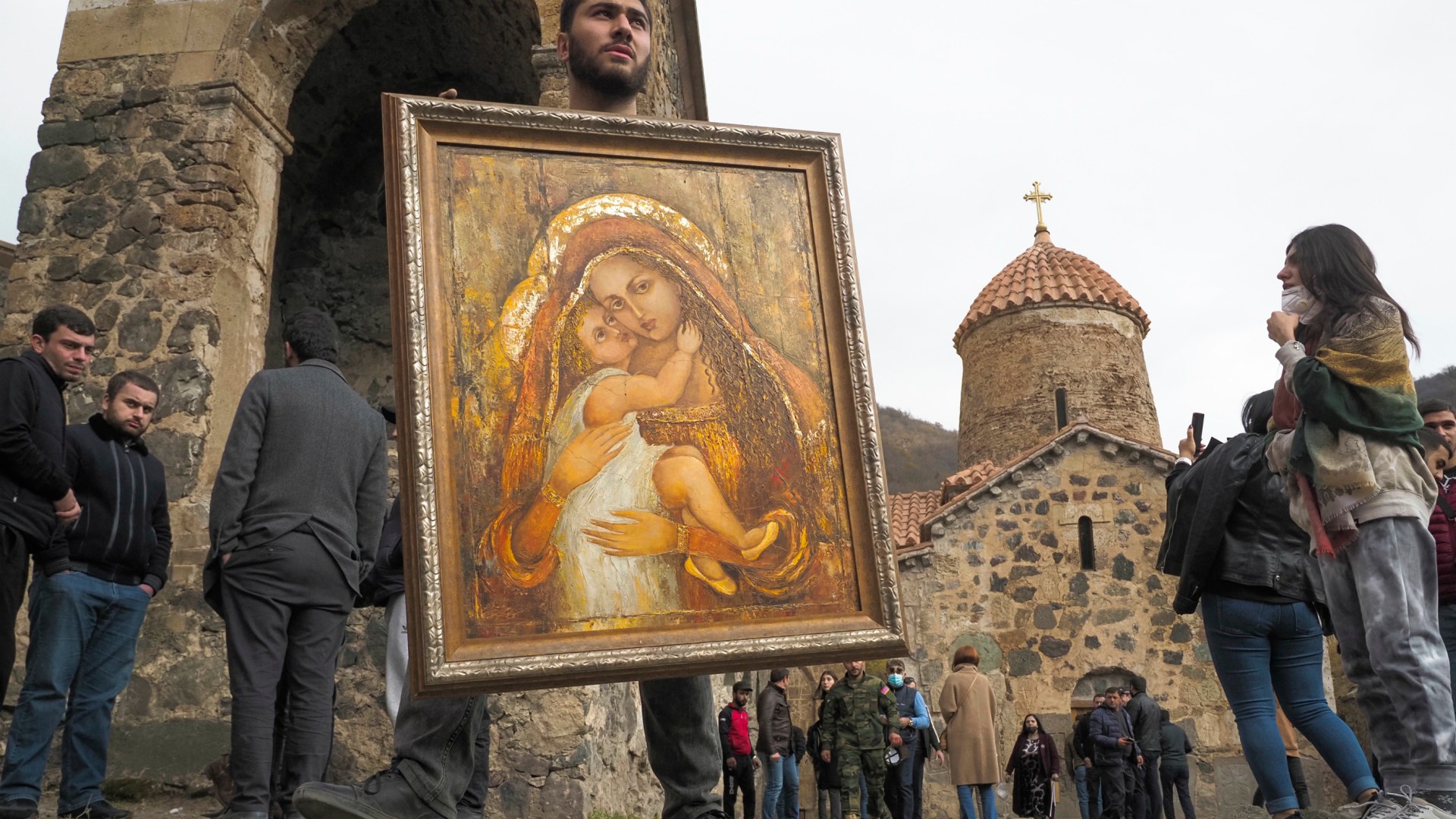
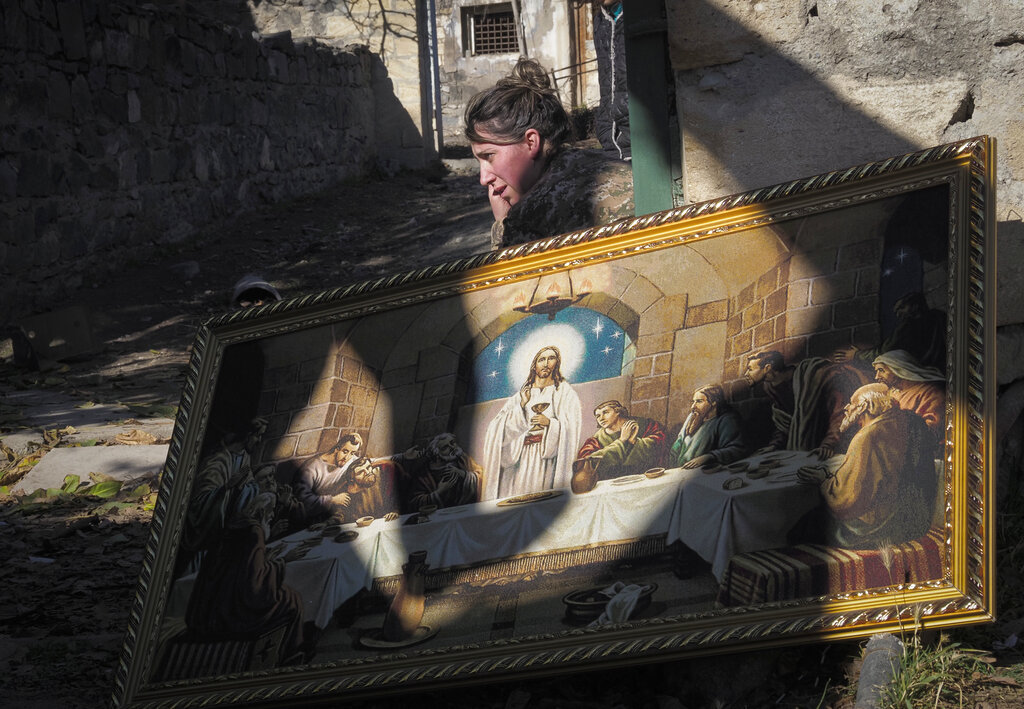
A man holds an icon from the Dadivank, an Armenian Apostolic Church monastery dating to the ninth century, as ethnic Armenians leave the separatist region of Nagorno-Karabakh on November 14.

A man holds an icon from the Dadivank, an Armenian Apostolic Church monastery dating to the ninth century, as ethnic Armenians leave the separatist region of Nagorno-Karabakh on November 14.

Christianity Today November 15, 2020
Dmitry Lovetsky / AP

Editor’s note: Catholicos Karekin II has issued a plea to protect Artsakh’s churches. CT’s complete coverage of Armenian Christians is here.

MOSCOW (AP) — Azerbaijan on Sunday postponed taking control of a territory ceded by Armenian forces in a cease-fire agreement, but denounced civilians leaving the area for burning houses.

The cease-fire ended six weeks of intense fighting between Azerbaijan and Armenia over the Nagorno-Karabakh region and territories outside its formal borders that had been under the control of Armenian forces since 1994. The agreement calls for Azerbaijan to take control of the outlying territories. The first, Kelbajar, was to be turned over on Sunday.
But Azerbaijan agreed to delay the takeover until November 25 after a request from Armenia. Azerbaijani presidential aide Hikmet Hajiyev said worsening weather conditions made the withdrawal of Armenian forces and civilians difficult along the single road through mountainous territory that connects Kelbajar with Armenia.
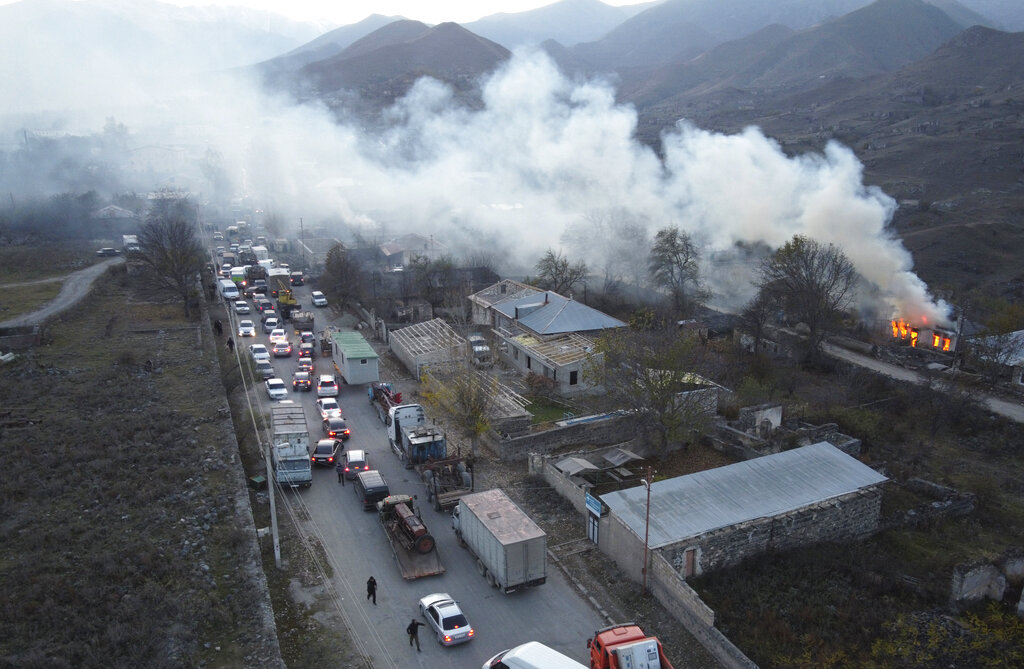
After the cease-fire was announced on Tuesday, many distraught residents preparing to evacuate set their houses ablaze to make them unusable to Azerbaijanis who would move in.

Smoke rises from a burning house as cars and trucks stuck in a huge traffic jam climbing along the road from Kelbajar leaving the separatist region of Nagorno-Karabakh to Armenia on Nov. 14.Dmitry Lovetsky / AP
Smoke rises from a burning house as cars and trucks stuck in a huge traffic jam climbing along the road from Kelbajar leaving the separatist region of Nagorno-Karabakh to Armenia on Nov. 14.

Prior to a separatist war that ended in 1994, Kelbajar was populated almost exclusively by Azerbaijanis. But the territory then came under Armenian control and Armenians moved in. Azerbaijan deemed their presence illegal.

“The placement and settlement of the Armenian population in the occupied territory of the Kelbajar region was illegal … All illegal settlements there must be evicted,” Hajiyev said.

The imminent renewal of Azerbaijani control raised wide concerns about the fate of Armenian cultural and religious sites, particularly Dadivank, a noted Armenian Apostolic Church monastery that dates back to the ninth century.

Azerbaijani President Ilham Aliyev assured Russian President Vladimir Putin, who negotiated the cease-fire and is sending about 2,000 peacekeeping troops, that Christian churches would be protected. [Editor’s note: Radio Free Europe offers a photo gallery.]

“Christians of Azerbaijan will have access to these churches,” Aliyev’s office said in a statement Sunday.

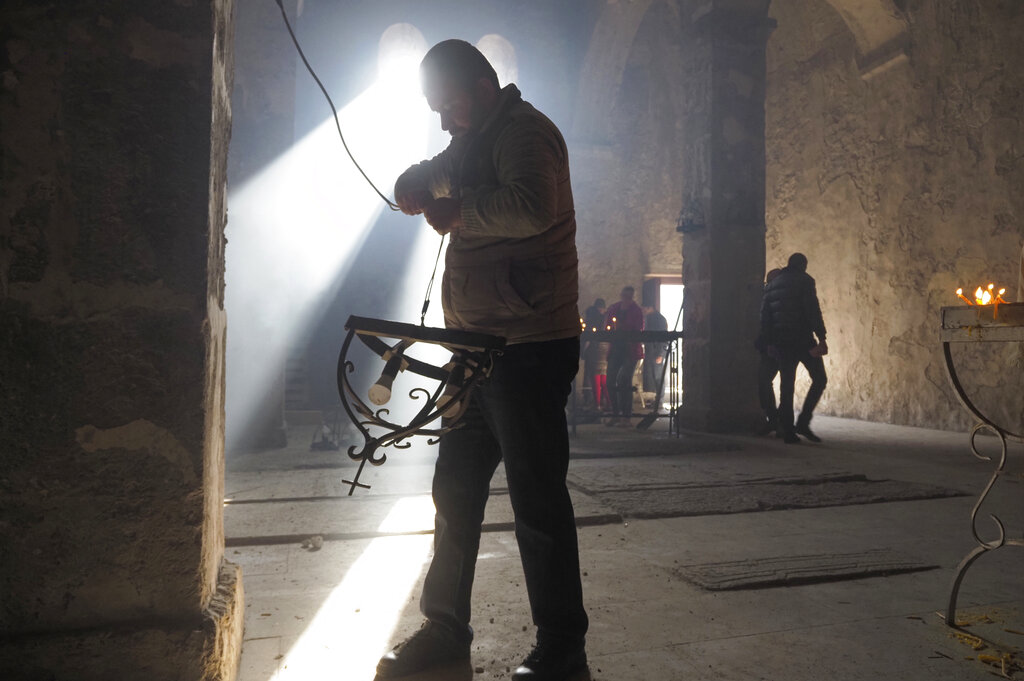
A man removes lamps inside a church of the Dadivank, an Armenian Apostolic Church monastery dating to the ninth century, as ethnic Armenians leave the separatist region of Nagorno-Karabakh to Armenia, Saturday, Nov. 14, 2020.Dmitry Lovetsky / AP
A man removes lamps inside a church of the Dadivank, an Armenian Apostolic Church monastery dating to the ninth century, as ethnic Armenians leave the separatist region of Nagorno-Karabakh to Armenia, Saturday, Nov. 14, 2020.

Azerbaijan is about 95 percent Muslim and Armenia is overwhelmingly Christian. Azerbaijan accuses Armenians of desecrating Muslim sites during their decades of control of Nagorno-Karabakh and surrounding territories, including housing livestock in mosques.

The Armenian Foreign Ministry on Sunday denounced vandalization of the Ghazanchetsots cathedral in the Azerbaijan-held city of Shusha (Shushi) as “outrageous.” The Armenian Apostolic Church earlier said vandals defaced walls of the church after Azerbaijani forces took the city.

Nagorno-Karabakh was an autonomous republic of Azerbaijan during the Soviet period. A movement to join with Armenia arose in the late Soviet years and after the Soviet Union collapsed, a war erupted in which an estimated 30,000 died and hundreds of thousands of people were displaced.

Sirarpi Safaryan sits near her house in Kalbajar before leaving the separatist region of Nagorno-Karabakh to Armenia, on Saturday, Nov. 14, 2020.Dmitry Lovetsky / AP
Sirarpi Safaryan sits near her house in Kalbajar before leaving the separatist region of Nagorno-Karabakh to Armenia, on Saturday, Nov. 14, 2020.

Sporadic clashes erupted after the war ended in 1994 and international mediators unsuccessfully sought for a resolution of the dispute. Full-scale fighting flared anew on September 27. Azerbaijan made significant advances and a week ago announced that it had seized the strategically critical city of Shusha. The cease-fire agreement came two days later.

Armenia says 1,434 servicemen died in this year’s fighting, but civilian casualties are unclear. Azerbaijan hasn’t stated its losses.

The cease-fire agreement and cession of territories was a strong blow to Armenia and prompted protests against Prime Minister Nikol Pashinian.

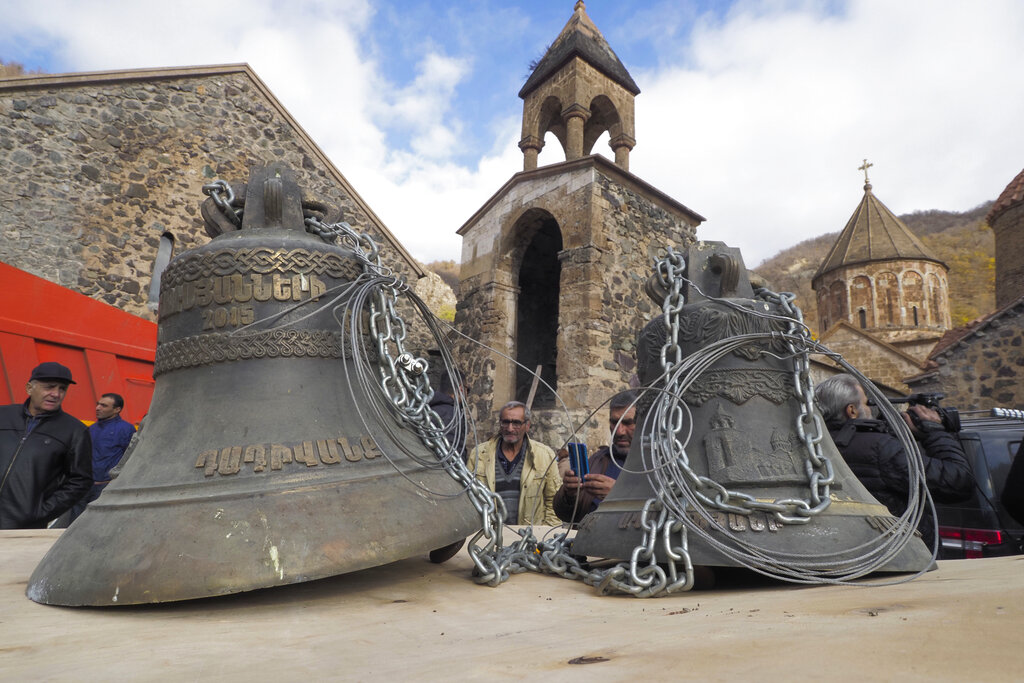
Bells removed from the Dadivank, an Armenian Apostolic Church monastery dating to the ninth century, as ethnic Armenians leave the separatist region of Nagorno-Karabakh to Armenia on Nov. 14.Dmitry Lovetsky / AP
Bells removed from the Dadivank, an Armenian Apostolic Church monastery dating to the ninth century, as ethnic Armenians leave the separatist region of Nagorno-Karabakh to Armenia on Nov. 14.

On Saturday, Artur Vanetsyan, the leader of a small center-right party who formerly headed the national security service, was arrested on suspicion of plotting to assassinate Pashinian. He was released from custody Sunday and it was unclear if the charges against him would stand.

The agreement also dismayed many Armenians who had hoped for Russian support in the conflict. Russia and Armenia are part of a defense alliance and Russia has a large military base in Armenia.

“Our nation has lost everything, our heritage, everything. We have nothing left. I can’t say anything. I’m only begging Russian people to help us, so that at least others can have a better life in our own land,” said Seda Gabrilyan, a weeping mourner at the Sunday burial of a Nagorno-Karabakh soldier in Stepanakert, the regional capital.

Aida Sultanova in London, Avet Demourian in Yerevan, Armenia, and Kostya Manenkov in Stepanakert, contributed to this report.

Books
Review

The Mayflower Pilgrims—as Not Seen on TV

Pop culture has given us a distorted picture of the religious separatists who founded Plymouth Colony. Historian John Turner sets the record straight.

Christianity Today November 13, 2020
Source Image: Library of Congress / Edits by Rick Szuecs

Pilgrims have become a staple of American life and culture. We hear them referenced in political speeches by both Republicans and Democrats and see them depicted in artwork in museums across the country. Wildly historically inaccurate (and often risqué) Pilgrim costumes usually crop up at Halloween parties. Television programs, from WGN’s Salem to Sky One’s Jamestown, feature Pilgrims, Puritans, and other sources of early American drama.

They Knew They Were Pilgrims: Plymouth Colony and the Contest for American Liberty

They Knew They Were Pilgrims: Plymouth Colony and the Contest for American Liberty

Yale University Press

464 pages

$30.39

Of course, with Thanksgiving only a few weeks away, op-eds concerning the good, the bad, and the ugly side of the Pilgrims’ arrival in America will be shared all across social media. Already this year, they have been enlisted as part of the pushback against the New York Times’s much-debated 1619 Project, with the National Association of Scholars launching the 1620 Project to invoke “the year in which the pilgrims landed at Plymouth Rock and the Mayflower Compact was signed.”

Historian John G. Turner enters into this much-contested territory with his latest book, They Knew They Were Pilgrims: Plymouth Colony and the Contest for American Liberty. Published in conjunction with the 400th anniversary of the founding of Plymouth Colony, the book centers on the concept of liberty: how the colonists pursued it and exercised it, even as they differed in their understanding of what it entailed.

Invention and Reinvention

Debates over the meaning of Christian liberty, as well as the boundaries of liberty of conscience, are a common feature of early American history, and in Turner’s narrative, groups such as Catholics, Quakers, the Wampanoag community, and other Native Americans bring these disputes into sharp (and often violent) focus.

At the same time, Turner demonstrates how the quest for liberty took on many new forms during this period, like the liberty to garner wealth and change one’s lot in life, the liberty to dispossess Indians of their land, and the liberty to experiment with different models of societal governance and church organization. He is quick to emphasize the ironies in these competing ideas of liberty, illustrating how Plymouth’s band of religious separatists went from being the persecuted to the persecutors. Put another way, many of his book’s central figures seem to embody the adage “Liberty for me but not for thee.”

But even as these same figures took advantage of the opportunities for invention and reinvention afforded by their newfound liberty, they were plagued by a sense of insecurity. They Knew They Were Pilgrims contains many scenes of uncertainty and anxiety toward the future. In addition to stressing over the preservation of their liberty, the Pilgrims were fearful of the indigenous population, nervous about the political climate in England, suspicious of Satanic influence behind their hardships, and worried for the state of their own souls and the health of Christ’s earthly church.

Alongside this angst, Turner’s narrative showcases a high amount of drama, ranging from land disputes to debates over proper baptismal practices to instances of sexual assault. Brawls occasionally broke out when certain individuals refused to remove their hats in deference to colonial authority figures.

Readers may be familiar with some of Turner’s central characters and storylines, like Roger Williams and his religiously tolerant Rhode Island colony, Thomas Morton and his infamous maypole, and Anne Hutchinson, whose battles with church authorities got her banished from the Massachusetts Bay Colony in what came to be known as the Antinomian Controversy. But the book also gives extended attention to other notable and lesser-known figures, including the rebellious dissenter Samuel Gorton; the long-aggrieved Joanna Cotton, the wife of a serially adulterous minister; and Awashonks, a female Native American tribal chief who aided the English during King Philip’s War. Such an interesting array of historical figures makes for engrossing reading, as do the many tensions, clashes, and tragedies in which they were embroiled.

In mapping the multifaceted contests for liberty among the Pilgrim generation, Turner does an excellent job situating Plymouth Colony within the larger context of British colonization in the New World and theological disputes among English Protestants. Highlighting the volume of letters the colonists wrote and received, he shows that they were aware of and actively involved in the happenings of other English settlements as well as the mother country. For example, following the expulsion of Anne Hutchinson from the Massachusetts Bay Colony, the church in Scituate, a Plymouth Colony town just down the coast from Boston, prayed that her theological views would not bring heresy into their own domain. And Plymouth sent representatives to a synod at present-day Newton, Massachusetts, where they condemned Hutchinson’s influence.

This web of connections between the colonies also manifested itself in the various pacts made with each other and with the indigenous peoples, not to mention the numerous conflicts with Native Americans, particularly King Philip’s War (1675–1678), that affected the entire population. It also shows up in the many examples Turner gives of various men and women traveling from one colony to another, either landing in, passing through, or being banished from Plymouth Colony.

In sum, Turner shows conclusively that Plymouth was not the backwater colony depicted by some earlier historians but rather a vibrant theological, economic, political, and cultural community that was actively engaged in the struggle for dominance within the New World.

Correcting Myths

They Knew They Were Pilgrims is particularly helpful in how it positions itself relative to previous accounts of Plymouth Colony. Turner details where he disagrees with older scholarship, explaining why some sources cannot be trusted. And he dispels certain legends that have taken root within the American consciousness, mostly thanks to pop culture.

But one occasionally gets the sense that Turner is exaggerating the extent to which his own work represents a departure from earlier interpretations. After all, plenty of recent books on the New World separatists have corrected many of the myths concerning Plymouth Colony and the Puritan tradition, including Michael P. Winship’s Hot Protestants: A History of Puritanism in England and America and David D. Hall’s The Puritans: A Transatlantic History. Neither book takes Plymouth as its main focus, but both give it considerable attention and fit it within the wider history of English Protestantism and colonialism. Likewise, Lisa Tanya Brooks’s Bancroft Prize-winning Our Beloved Kin: A New History of King Philip’s War closely examines the involvement of Plymouth and its occupants in that conflict. As a detailed study of Plymouth Colony, Turner’s work cannot be matched, but he overstates the matter in presenting it as a pioneering intervention.

This is not to diminish the book’s corrective aspects. Readers with heroic images drawn from A Charlie Brown Thanksgiving and the like will quickly be sobered by the sheer volume of violence and enslavement the Native Americans suffered at the Pilgrims’ hands. Turner also takes aim at the claim that Plymouth Colony planted the seeds of the American Revolution and laid the groundwork for American democracy and freedom of religion. He argues, instead, that we should study the Pilgrims’ 17th-century debates about liberty on their own terms and in their proper context.

All the same, Turner clearly wishes to push back against simplistic portrayals of the Pilgrims as little more than religious fanatics hell-bent on stealing land from Native Americans by any means necessary. He tells an often fraught but always nuanced story of early America and its inhabitants, weaving together their convictions, motives, hopes, and fears. Informative, accessible, and compelling, They Knew They Were Pilgrims is a welcome invitation to rediscover the Mayflower voyage and the founding of Plymouth Colony at a distance of four centuries.

Daniel N. Gullotta is a PhD candidate in American religious history at Stanford University.

Theology

The Bible Is Our Blazing Fire

A look inside our special issue exploring women’s passionate engagement with Scripture.

Illustration by Sarah Gordon

Imprisoned by the Nazis in Ravensbrück, Corrie ten Boom and the other women in her barracks regularly gathered to covertly read from a smuggled Bible. “The blacker the night around us grew, the brighter and truer and more beautiful burned the word of God,” ten Boom wrote in The Hiding Place. They’d crowd around the Bible “like waifs clustered around a blazing fire … holding out our hearts to its warmth and light.”

Though ten Boom had believed and loved the Bible throughout her life, in the brutal conditions of a concentration camp—enduring daily threats and violence, surrounded by evil and death—God’s Word spoke to her with a new potency. “Sometimes I would slip the Bible from its little sack with hands that shook, so mysterious had it become to me,” she said. It was as if “it was new; it had just been written. I marveled sometimes that the ink was dry.”

We, too, can open the familiar Book and encounter unexpected mystery. Well-worn passages we can recite by heart suddenly speak in new ways directly to our hearts. Stories we already know somehow know us. We read, and the living and active Word does its sharp work, convicting us about our innermost thoughts and attitudes (Heb. 4:12). We study, and amid the words we pore over, we encounter the Word of Life himself (1 John 1:1).

Evangelical women have a high commitment to Scripture; in fact, several studies demonstrate that American Christian women read the Bible more frequently than Christian men. The articles below were all featured in our CT special issue, “Why Women Love the Bible.” In these articles, we highlight Scripture’s power in the lives of those facing persecution, persevering amid racism, and enduring life’s storms. We highlight women in church history who studied Scripture as well as women today who turn to it for prayer and evangelism.

For many of us, 2020 has been a difficult year. While the Bible always speaks to us, in good times as well as bad, hardships can deepen our sense of how profoundly we need and desire the “blazing fire” of God’s Word. May it ever burn bright in our lives.

News

First COGIC Bishop to Israel Meets Opposition from Counter-Missionaries

Glenn and Pauline Plummer say they are ambassadors, but some see a secret agenda to convert Jews.

Christianity Today November 11, 2020
Spencer Platt / Getty Images

Glenn and Pauline Plummer had barely unpacked in Israel before the counter-missionaries came after them.

The Church of God in Christ (COGIC) bishop and first lady moved from Detroit in September. They were met by a YouTube video of spliced-together clips showing the couple on Christian TV talking about winning souls, baptizing people, and moving to Israel. The footage was taken from several different sources and from a number of different years, but combined to make it look like the Plummers were planning a major campaign to convert Israeli Jews.

Citing the online evidence, anti-missionary rabbis raised an alarm and demanded investigation into what the COGIC minister and his wife were doing in the country and how they were even allowed visas.

“He is going to baptize the people here in Israel,” warned Tovia Singer, an Orthodox rabbi who heads one anti-evangelical group. “All these groups are out there and they are targeting Jews for conversion. And they are after the very young, the very old. They love to convert anyone, but they go after anyone who is weak.”

Proselytizing—attempting to convert someone to a new faith—is not illegal in Israel as it is in many countries in the world. The laws prohibit attempts to evangelize anyone under 18 and say that missionaries cannot offer material benefits in exchange for conversion. But otherwise, Christian missionaries may urge Jews in the Jewish homeland to change their faith.

Many Jews see proselytizing as offensive, however, especially in Israel. The nation was founded as a Jewish homeland after Nazi Germany eradicated six million Jews and then other countries, including the United States, would not accept Jewish refugees. Conversion, critics say, is another kind of eradication.

The Plummers, for their part, say they understand that and have no intention of attempting to proselytize. They say the video is misleading.

“Never one time in my whole life have I even had a conversation with a Jew about converting to Christianity,” Glenn Plummer said. “I know full well the sensitivity of the Jewish people when it comes to Christians. I know the history of the Catholic Church and of the Crusades. I understand that. And I stand with Jews on that whole point.”

Plummer was appointed Bishop of Israel in November 2019. It is a new position, created by the 6.5-million-member African American Pentecostal church. There are no COGIC congregations in Israel, but church members regularly go on trips to the Holy Land and Plummer has gone more than 20 times since 1996.

When Plummer was anointed for the task by COGIC leaders, he spoke of establishing an embassy in the country and improving relationships between African Americans and Israel.

“The Holy Land is the birthplace of our faith,” he said in his first official statement. “We embrace Israel and are determined to bless Israel in very tangible ways.”

Some Israeli organizations, such as the International Fellowship of Christians and Jews, have reached out to African American Christians in recent years to encourage tourism and establish connections. Organizers hope black Americans, who are almost all Christians and almost all vote Democratic, will support Israel as staunchly as most white evangelicals.

Plummer is considered “a national leader in the pro-Israel community,” according to the Israel Allies Foundation. He founded the Fellowship of Israel and Black Americans.

“God blesses those who bless Israel,” Pauline Plummer told an Israeli paper. “We want to make sure that black Americans understand that the way to bless Israel is to speak well of Israel.”

American Jews who have worked with Plummer in the United States say he is a reliable ally and they think the counter-missionary concerns are misplaced.

“Glenn is quick to defend Israel and Jews in all the time I’ve known him,” said Mark Jacobs, who organizes African American outreach in Michigan for the American Israel Public Affairs Committee, a pro-Israel lobbyist group. “I’ve witnessed him preach that from the pulpit, and it’s evident his convictions are deep and sincere.”

The counter-missionary groups are not reassured, however. They point out that one of Plummer’s previous titles was “COGIC Director to Israel Missions” and some of the promotional material recruiting African Americans for trips to the Holy Land explicitly said, “This is not just a tour, this is a MISSION!”

One rabbi accused Plummer of “slick double-talk,” and a columnist wrote that the COGIC bishop “has perfected the art of nearly-but-not-quite saying something.”

The counter-missionary movement appears to have grown in recent years—if not in size, then in intensity. The movement successfully challenged the launch of a Hebrew-language Christian TV channel this summer, getting Israel’s Cable and Satellite Broadcasting Council to revoke its license. A group physically blocked the entrance to a Messianic Jewish meeting and harassed people entering the building until stopped by a court order. Christian converts to Judaism are given platforms to talk about how evangelicals use deceptive tactics to trick Jews.

The counter-missionaries say Christians like the Plummers may talk about being ambassadors, but they are lying.

“Their real intentions … are to pave the way for missionary activity,” said Rabbi Reuven Wabshat, “to hunt down innocent souls.”

The Plummers, settling into their new home in a suburb of Jerusalem, were surprised by the controversy. They had not experienced oppostion on any of their previous trips.

“I was not prepared for the kind of attack we experienced,” Glenn Plummer said. “We’ve had to contact the police to discuss this.”

They hope the opposition will fade with time. In the meantime, the YouTube video has been removed for copyright violations.

News

Bible Readers in Foxholes: Combat Vets More Engaged in Scripture

The most popular topics for military Bible study are suffering, hopelessness, and loneliness.

Christianity Today November 11, 2020
Chris Hondros / Getty Images

While a majority of military service members identify as Christian, the demands of active duty—frequent moves, long hours, and overseas tours of duty—can strain faith and family.

Ministries have long targeted evangelistic efforts at men and women in uniform in hopes of providing spiritual support, particularly as mental health issues, post-traumatic stress disorder, and suicides continue to climb.

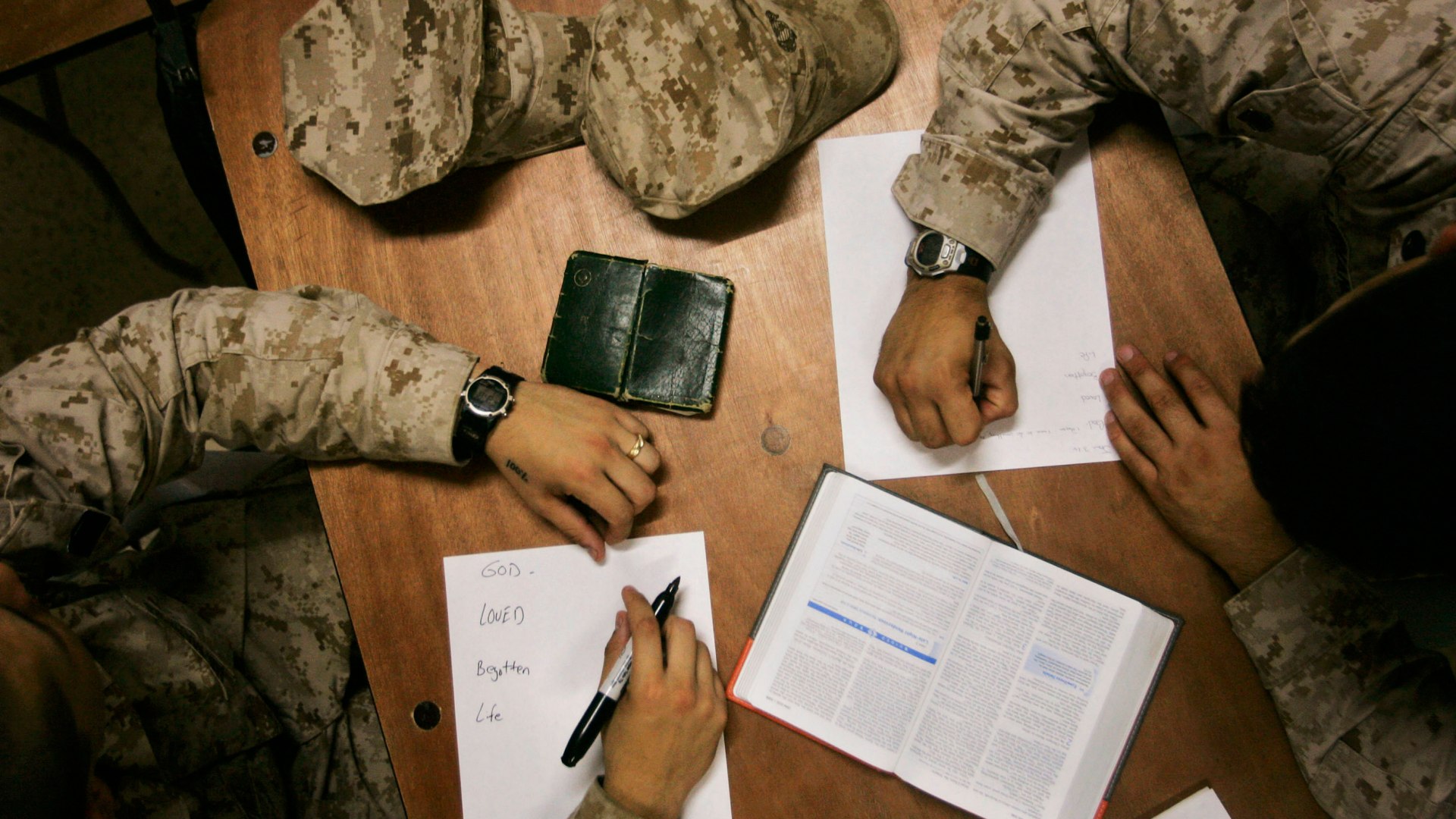
The American Bible Society (ABS), which launched a Veterans Day challenge to recruit a half million military personnel to engage in Bible study, has found that half of service members who open Scripture hope to find a message that addresses pain and suffering (51%), hopelessness (50%), and loneliness (48%).

According to the ABS’s State of the Bible survey with Barna Research, veterans and active duty service members (33%) are about as likely as Americans on average (31%) to read the Bible once a week or more. However, members of the military who have been deployed more often are more likely to engage Scripture.

Bible Gateway reported on the research, saying those deployed to combat zones were more than twice as likely to belong to the highest category of Bible engagement, “Bible centered” (10% of combat veterans compared to 4% of all service members). They were also less likely to fall into the “Bible disengaged” category (43% of combat veterans compared to 53% of those who did not see combat).

The ABS reports that it has distributed 60 million Bibles and related resources to members of the military.

Earlier this fall, the Department of Defense strengthened religious liberty protections for members of the military, implementing Religious Freedom Restoration Act guidance, and last year, the Department of Veterans Affairs revised its policies to allow religious symbols including Bibles to be displayed in VA facilities.

The religious makeup of the military broadly mirrors the population overall, with about 70 percent of active duty personnel identifying as Christian and about 25 percent not affiliating with any religion in particular.

However, the 3,000-member chaplains corps has skewed evangelical Protestant, with Southern Baptists being the most popular denominational affiliation. CT recently covered how a growing number of US military chaplains are foreign born, including 1 in 5 Army chaplains and 1 in 10 Navy chaplains.

Theology

When Political Prophecies Don’t Come to Pass

The Bible includes false prophets and true prophets whose words turn out to be false.

Christianity Today November 11, 2020
Spencer Platt / Getty Images

Prophecy is saying what God says, which is more often about forthtelling than about foretelling.

Sometimes, however, prophecies do predict the future. In late October, Pat Robertson declared that he had heard from the Lord: “Without question, Trump is going to win the election.” To Robertson’s credit, Trump did far better than expected. With Donald Trump’s 70 million votes, reportedly the second-highest total in US history, we might think that Robertson indeed heard something. But did he get the whole story?

In some elections, prophecies are more than 50/50 guesses. In 2016, Jeremiah Johnson, a pastor and prophet, accurately predicted Trump’s first term even before he emerged as a leader in the Republican primaries. Robertson was not alone in seeing another victory for the president in 2020. Most public prophecies, including those by Johnson, sided with Trump, sometimes mentioning a disputed election.

But even some who voted for Trump felt like God was saying that Biden would win this time. Ron Cantor, a Messianic leader based in Israel, said he twice heard from God that Biden would win because of the church’s idolization of Trump. He told followers, “Even if a miracle happened and [Trump] was, in fact, reelected, which seems less likely with each passing hour, proving the other prophets true, the warning here remains the same.”

If the election results hold despite recounts and court challenges, were all those others who predicted Trump’s victory false prophets?

Mistakes in prophecy do not make everyone who’s mistaken a false prophet, any more than mistakes in teaching make everyone who’s mistaken a false teacher. But false prophets exist—even cessationists, who do not believe that the genuine gift of prophecy is for today, agree that they do.

Whether from false prophets or not, very public mistaken prophecies risk great dishonor to God’s name and must be treated especially seriously. People already apt to mock Christians can find more grounds for ridicule. Deuteronomy 18 warns against mistaken prophecy, albeit prophesying “presumptuously”; the Hebrew word typically involves insolent rebellion (such as in Deuteronomy 1:43 and 17:13).

“If what a prophet proclaims in the name of the Lord does not take place or come true, that is a message the Lord has not spoken,” reads Deuteronomy 18:22. “That prophet has spoken presumptuously, so do not be alarmed.”

Hearing from God

Yet even true prophecy can be messier than many of us would like. In the Bible, true prophets often acted in ways that other people considered eccentric (Jer. 19:10; Acts 21:11), and their contemporaries sometimes deemed them mentally unstable (2 Kings 9:11; Jer. 29:26; John 10:20).

In contrast to prophecies about God’s long-range purposes, most prophecies in the Bible about his short-range purposes are conditional, whether stated as such or not. Thus Jonah’s “Forty more days and Nineveh will be overthrown” (Jonah 3:4) was not fulfilled in Jonah’s generation because Nineveh repented.

Jeremiah explains this process plainly: “If at any time I announce that a nation or kingdom is to be uprooted, torn down and destroyed, and if that nation I warned repents of its evil, then I will relent and not inflict on it the disaster I had planned. And if at another time I announce that a nation or kingdom is to be built up and planted, and if it does evil in my sight and does not obey me, then I will reconsider the good I had intended to do for it” (Jer. 18:7–10). Perspectives on how conditional prophecy works vary. My own opinion is that God foreknows human choices or final outcomes, but he also accommodates time-bound people within time.

Similarly, God sometimes deferred promised outcomes. Elijah prophesied the destruction of Ahab’s line (1 Kings 21:20–24). Yet after Ahab humbled himself, God told Elijah privately that because Ahab humbled himself, I won’t bring this disaster while he is alive. Instead, I’ll bring it on his household in the time of his son (21:29). Likewise, God commissioned Elijah with three tasks (1 Kings 19:15–16). Elijah fulfilled directly one of these—calling Elisha. The other two were fulfilled by Elisha and by a prophet whom he in turn commissioned. Most of the mission was fulfilled by somebody else.

Often, biblical prophecies indicate more about what than about when. For example, the first two chapters of Joel depict an imminent locust invasion in terms of the day of the Lord, God’s time for judging. The last chapter, however, seems to depict a real invasion in an ultimate day of God’s judgment (3:9–17, especially verse 14). That is, in prophecies, nearer events may foreshadow later ones, without bothering to specify the time in between. Christians see Old Testament prophecies about the Messiah’s coming this way: No one recognized in advance that Jesus would come twice.

But were most prophecies about the US election conditional? Or were they simply wrong? After all, anybody can say, “The outcome of the election will be such-and-such—provided enough people vote for so-and-so.” (Given the odds against Trump, though, prophecies of his election were rather daring.)

Hearing our own echoes

But even godly people can sometimes misinterpret what they hear. Not everyone always hears God as clearly as Moses did, face to face (Num. 12:6–8). Nathan had to correct the assurance he had given to David after the Lord spoke to him (2 Sam. 7:3–5). Even godly court prophets like Nathan can make wrong assumptions in times of favor.

This problem is not, however, limited to court prophets. When John the Baptist heard that Jesus was healing people, he questioned his identity (Matt. 11:2–3; Luke 7:18–20). Probably John did so because he earlier heard from God that the coming one would baptize in the Spirit and in fire (Matt. 3:11; Luke 3:16). So far as John could tell, Jesus was not baptizing anybody in fire. What John heard from God was right, but John’s inference was wrong because he, like all prophets, had only a piece of the larger picture.

Not only are all prophecies partial, but, more dangerously, sometimes we may confuse our wrong interpretation with God’s message. Some of us might remember times of praying for the right spouse or job; the more emotionally involved we are personally in a decision, the harder it often is to think and hear clearly.

That may be why Luke refrains from calling the Spirit-led speech in Acts 21:4 “prophecy.” Paul’s friends told him “through the Spirit” not to go to Jerusalem. Yet God had already told Paul himself to go to Jerusalem (the probable meaning of Acts 19:21). Paul’s friends rightly heard that he would suffer in Jerusalem (20:23; 21:11) but wrongly inferred from this information that he should not go there (21:12–14; see also 2 Kings 2:3–5, 16–18). Subjectivity is messy, but so long as we need wisdom from the Lord, we have to live with some subjectivity.

This is the case because all prophecy is “in part,” just as teachers “know in part” (1 Cor. 13:9). Until Jesus returns, our knowing is limited and partial (vv. 9–12). Saying that all the prophecies that made it into the Bible are perfect doesn’t mean that none of God’s servants ever uttered imperfect prophecies. That’s why Paul insists that each prophecy must be evaluated (1 Cor. 14:29). He warns us not to quench the Spirit or despise prophecies; instead, we are to test them, keeping what is good and rejecting what is evil (1 Thess. 5:19–22).

Certain popular teachings have made many contemporary prophecies even more problematic. I believe that excesses in “positive confession” teaching have introduced a major source of potential error into prophesying. Even many circles today that repudiate “name it and claim it” theology now engage in “prophetic declarations.” Some of these declarations are intended as affirmations of faith. Jesus, after all, does invite us to command even mountains by our faith (Mark 11:23). But faith is only as good as its object, which Jesus in the previous verse specifies as God (v. 22). Prophetic “declarations” are empty unless authorized and led by God. As Lamentations says, “Who can command and have it done, if the Lord has not ordained it?” (Lam. 3:37, NRSV).

Hearing different things

The most prominent people who claim to speak for God are not always right, but that does not mean that God does not speak. In 2008, an Ethiopian minister who did not know anything about me prophesied accurately about my son and that I was writing two big books. What confused me was that he said that my second book would be larger than the first. I expected my Acts commentary to come out first; it turned out to be over 4,000 pages. Though partly impressed, I thought Mesfin had to be wrong about a larger book. But my miracles book, which turned out to be just 1,100 pages, ended up coming out before my Acts commentary. Mesfin was right, and I was wrong.

This year, many Christians have listened to leaders prophesy that Trump would again win the election. Some, such as Jeremiah Johnson, have continued to affirm that their prophecy will turn out to be true in the end. Others, such as Kris Vallotton, have publicly apologized. For now, many will decide that the prophecy was contingent, mistimed or, more likely, mistaken.

Although I have not been a Trump supporter, I’m someone who wants to see godly prophecies proven true and can understand the disappointment.

I am not a prophet, but my own dreams gave me misgivings. For example, in March 2016, eight months before the election, I dreamed that Trump could be like the biblical Jehu (2 Kings 10:28–31) and needed repentance. In May 2016 I dreamed that God was angry about Trump’s (future) mistreatment of refugee children. Later I dreamed about his words provoking race riots. After the 2016 election, I wrote in my journal, “I wonder why, when I have had these nightmare dreams about him, many others are not seeing the same thing.” The next year I dreamed that I was warning Trump supporters about a coming backlash: “You have sown the wind and you will reap the whirlwind” (from Hosea 8:7).

I was unable to shake those dreams, even though many people I respected supported the president, and for reasons that I understood. Sometimes my own perspective has vacillated, since I am pro-life and appreciate the president’s respect for evangelicals. In August this year, I dreamed that Trump lost the 2020 election. It was just a dream. I have all sorts of dreams, and even when some seem significant, I am not always sure how to interpret them. Some are probably influenced by surveying BBC news before I go to bed. The dreams do motivate me, at least, to pray.

Perspectives differ, and we each have just a piece of the larger puzzle. We can be sure of one thing: The Lord remains in control of history, and we can live by his certain Word in Scripture no matter what else happens.

If, against all odds, Trump suddenly does become president, the prophecies will draw public attention to God’s work. Otherwise, it may instead be that God is drawing attention to needed housecleaning in many charismatic circles. The Spirit’s encouragement does not always translate in the words we want to hear; “prophetic declarations” can dull us to what God is really saying; and depending on what others say God has said can be risky business (see 1 Kings 13:11–32).

As a charismatic Christian myself, I like to see prophecies come true. But prophecies need to be evaluated. Whenever possible, before they go public. And, when necessary, afterward.

Craig Keener is F. M. and Ada Thompson Professor of Biblical Studies at Asbury Theological Seminary. He is the author of Christobiography: Memories, History, and the Reliability of the Gospels, which won a 2020 CT Book Award.

Ideas

Advice for Armenians and Azerbaijanis, from Israel-Palestine

After three decades of reconciliation work in Jerusalem, here’s what I’ve learned when protracted conflict involves religion, land, and history.

Christianity Today November 11, 2020
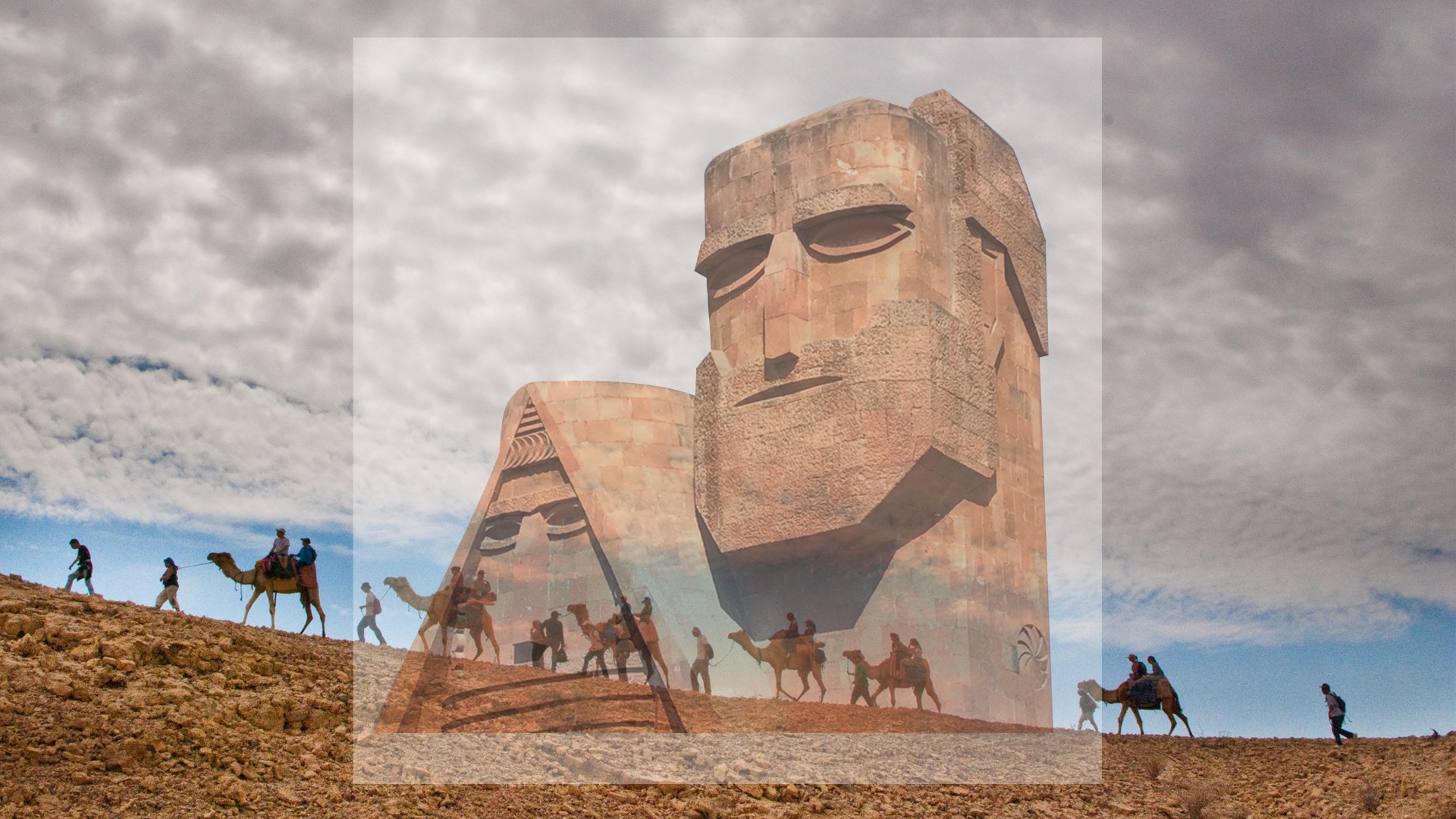
Courtesy of Musalaha / Edits by CT / Source Image: WikiMedia Commons

Editor’s note: CT’s complete coverage of Armenian Christians is here.

A brawl broke out last month between Armenian and Azeri groups in the middle of a highway leading to Jerusalem. Both factions were on their way to exhibit their support or opposition to Israel’s sales of arms to Azerbaijan.

The October 17 incident caught many Palestinians and Israelis by surprise, as Armenian and Azeri communities in the Holy Land are often forgotten or ignored. It also represented the heated reaction around the world by diaspora groups.

This made me reflect on our Palestinian-Israeli conflict in relation to the Armenia-Azerbaijan conflict over Nagorno-Karabakh, where the two sides just announced a Russia-backed agreement to end the fighting.

Musalaha (reconciliation in Arabic), the Jerusalem-based organization I founded and currently serve as its director, has over 30 years of experience in the field of peace-building and reconciliation. We’ve developed a model that addresses obstacles for reconciliation through desert encounters, and have identified six stages in the process of reconciliation (detailed in a book released this month by Langham Publishing). Through our work, we have guided more than 200,000 Israeli and Palestinian men, women, and youth through more than 1,000 activities.

So I by no means claim to be an expert on the situation between Armenia and Azerbaijan. But perhaps my experience and knowledge working for decades on reconciliation in Palestine-Israel may be helpful to Armenians and Azeris living in their respective countries or in the diaspora.

Here are four areas where I believe lessons we’ve learned from our work of reconciliation in our own conflict can apply to Nagorno-Karabakh:

Religious Wars

When the conflict between Armenia and Azerbaijan escalated last month, I began to hear both Armenians and Azeris, as well as many international observers, quickly point to the claim that this conflict is in essence a religious war: Christianity vs. Islam. I could not help but think of the immediate comparison many people make around the world concerning the Palestinian-Israeli conflict, suggesting that our conflict is also a religious conflict between Judaism vs. Islam, or even Judeo-Christianity vs. Islam.

This is a popular assertion in large-scale conflicts; people often point to the most general difference between the groups. This way of thinking falls into the famous “clash of civilizations” thesis, which argues that contemporary wars will be fought not about ideological differences (as in the Cold War), but about religious differences.

This is problematic in many ways. To begin with, it ignores the diversity of religious identities and factions within conflicts. Not only are there diverse religious expressions, practices, and theologies within each religion, but we see conflicting “sides” having supporters from many religious traditions as well. For example, within the Palestinian-Israeli conflict, we can find Jews who support the Palestinian struggle and Muslims who support the State of Israel. In addition, people can often forget about minority communities like the Palestinian Christians, Druze, and others who may not fall into our neat binary perception of conflicts. Similarly, as with the example of the highway brawl, the Azeri supporters were Azeri Jews, and there are also Azeri Jews in the Azeri army. Religious identities simply do not dictate allegiance to one side or another.

Moreover, religion can and does play many roles in conflicts. People may indeed use religious language and theology for fueling division and violence, but the same can be done to build unity and peace. Likewise, religion is not always the main motivation for people’s behavior. We humans are motivated by many factors in life that do not relate to our religious convictions, such as the economy, politics, society, nationalism, ethnicity, family, and more. There are many interests for one to be in conflict; religion is not always one of them.

1 Conflict, 1,000 Interests

Conflicts as big as the Palestinian-Israeli or Armenian-Azeri ones have multiple actors and factions who have many interests in sustaining the conflict and/or many visions for a solution. We can never see these conflicts as simply two sides fighting over one thing.

Rather, these conflicts have many sides both from the region and outside of the region, with many interests to promote. In the Palestinian-Israeli conflict, many countries in Europe, North America, and the Arab world are largely invested in the conflict. In Armenia and Azerbaijan, the roles of Russia, Turkey, Israel, Jordan, Iran, Serbia, and Georgia are all important, and all have their goals to achieve.

Therefore, in order to achieve a solution and peace, these diverse national and international factions need to be acknowledged and addressed. In the same way that dominant powers such as the United Kingdom (more historically) and the United States have contributed to the Palestinian-Israeli conflict’s escalation and exacerbation, and their role needs to be addressed, the same goes for international actors in the Armenian-Azeri conflict.

Trauma and Dehumanization

Recognizing the magnitude of trauma and the importance of collective memory in conflict are key ingredients to moving forward for a brighter future. From my experience, one of the biggest disagreements between people is not necessarily religious or ideological in nature, but historical. The way we people groups construct our collective memory serves as a tool to legitimize our past, present, and future acts.

Furthermore, the major traumatic events in our history—whether that be the Holocaust for Israelis, the Nakba for Palestinians, genocide for Armenians, or ethnic cleansing for Azeris—shape our identity and our relations to the other groups around us. We often understand ourselves to be the ultimate victim in history, and by doing so, ignore our own shortcomings and put the blame on everyone but ourselves. We create an “us versus them” mentality: We are good, moral, and progressive, and they are evil, immoral, and backward. This understanding also follows a zero-sum logic, whereby if the other side wins we automatically and completely lose, and the other way round. Therefore, we cannot afford to allow any success to the other side, for it means our loss.

In essence, our collective memory and trauma allow us to dehumanize any individual and group that does not stand with us. For this reason, if we wish to see any form of reconciliation, we need to address our historical narratives and identity in a critical manner.

This is indeed a difficult task, for the process challenges us at our core. But if Palestinians, Israelis, Armenians, and Azeris want to transform their conflicts, they must attempt to construct a joint historical narrative. One that does not wish to belittle any form of trauma or claim to be the ultimate victim, but sees the pain and suffering of all people in the conflict. In order to create a better future, we need to address our complicated past and humanize our enemy in the process.

Good Neighbors, Bad Neighbors

Conflict transformation and true reconciliation must come from grassroots movements. Leaving the conflict to upper-leadership politicians will not create a genuine change within the people. And even if politicians did advance peace, the resentment of the people will not disappear and the conflict may continue in the future (such as in Colombia). Similarly, politicians are also subject to external pressure from other actors in the region, who may make the transformation almost impossible.

Thus, social mobility is key for creating real and lasting change and prosperity for all. Organizations, institutions, and social clubs need to be dedicated to this subject within the region. These bodies can help promote, train, and mobilize people for the purpose of reconciling the different factions. The importance of civil society cannot be stressed enough.

Armenians and Azeris, as well as Palestinians and Israelis, need to ask themselves how they want to treat their neighbors. This is an extremely important question, for the way you treat your neighbor truly reflects who you are as an individual and as a collective group.

Our theology, ideology, and vision are tested by this mere standard. For what are our religious and spiritual commitments worth if we are unable to love our neighbors? And by loving our neighbors, I also mean concrete acts of justice, mercy, and peace. For us Christians, this is the true test of our love and worship of God. As 1 John 4:20–21 states:

“Those who say, ‘I love God,’ and hate their brothers or sisters, are liars; for those who do not love a brother or sister whom they have seen, cannot love God whom they have not seen. The commandment we have from him is this: those who love God must love their brothers and sisters also” (NRSV).

At the end of the day, Armenia and Azerbaijan will live side by side; the question is how they will live side by side.

And of course this is not a challenging question for this specific conflict alone. We all have conflicts in our life and should reflect on our own contexts. As John instructs: “Perfect love drives out fear.”

Salim Munayer is founder and director of Musalaha in Jerusalem, and the author of Journey Through the Storm: Lessons from Musalaha (Langham Publishing, November 2020).

Speaking Out is Christianity Today’s guest opinion column and (unlike an editorial) does not necessarily represent the opinion of the magazine.

Apple PodcastsDown ArrowDown ArrowDown Arrowarrow_left_altLeft ArrowLeft ArrowRight ArrowRight ArrowRight Arrowarrow_up_altUp ArrowUp ArrowAvailable at Amazoncaret-downCloseCloseEmailEmailExpandExpandExternalExternalFacebookfacebook-squareGiftGiftGooglegoogleGoogle KeephamburgerInstagraminstagram-squareLinkLinklinkedin-squareListenListenListenChristianity TodayCT Creative Studio Logologo_orgMegaphoneMenuMenupausePinterestPlayPlayPocketPodcastRSSRSSSaveSaveSaveSearchSearchsearchSpotifyStitcherTelegramTable of ContentsTable of Contentstwitter-squareWhatsAppXYouTubeYouTube