Books
Review

For Good Mothering Advice, Skip the Mommy Blogs and Look to Christ

Parenting children requires a rich understanding of God’s nature.

Christianity Today May 8, 2020
Illustratioon by Rick Szuecs / Source images: Andrew Howe / Oliver Rossi / Getty / Picturepartners / Envato

Mothers today face an onslaught of mixed messages about how best to parent in the 21st century. Podcasts, blogs, and books on mommy-ing abound, but many of them indulge regularly in shallow parenting advice and fallacies about excessive self-care or “me-time.”

Motherhood: A Confession (Encountering Traditions)

Motherhood: A Confession (Encountering Traditions)

Stanford University Press

208 pages

$17.44

In the midst of the coronavirus quarantine, moms on social media often advise diametrically opposed strategies: Take regular mental health breaks while your children gorge on Netflix, or schedule out every minute of children’s at-home education so they don’t fall behind in productivity. The message seems to be either “love yourself first” or “pour all your energy into your children’s future.”

Neither side answers the more important question: How do we mother like Jesus Christ during this particular cultural moment? In the words of an overused adage, “What would Jesus do?”

In Motherhood: A Confession, Natalie Carnes, associate professor of theology at Baylor University, attempts to answer this question by sharing her personal experience of raising three daughters. She follows the structure and style of Augustine’s autobiography, Confessions, and elevates the conversation about motherhood from the self-centered to the spiritual without ever losing touch with the beauty of the ordinary. Part memoir and part theological study, Motherhood: A Confession explores “how motherhood, infancy, and children disclose what it means to be human in relation to the divine.”

Carnes’s core argument is that mothering imitates God. We birth forth disciples, hand down tradition, and grow our children into the church. By knowing the maternal attributes of God, we better mother our own children, and we also discover how the concept and practice of motherhood fuels a flourishing body of Christ.

In Scripture, God refers to himself as “the God who gave you birth” (Deut. 32:18), and in Isaiah, he compares himself to a nursing mother (Isa. 49:15). In the New Testament, Jesus adopts this metaphor for himself when he speaks to Jerusalem: “How often I have longed to gather your children together, as a hen gathers her chicks under her wings” (Matt. 23:37). Throughout church tradition, too, Christian writers from Origen to Bonaventure have drawn theological insight from imagining God as our mother.

We also find Jesus using birthing imagery to talk about salvation: “No one can see the kingdom of God unless they are born again” (John 3:3). Although preachers and biblical scholars are familiar with this birthing metaphor, they rarely dwell on its significance. Carnes offers a corrective by meditating on what this metaphor means for discipleship and what it reveals about God’s nature. Whereas the early church dramatized this birth image with baptismal fonts shaped like wombs, in the contemporary church, “women and children have remained largely absent from talk of divinity and humanity,” writes Carnes. “But what if their lives were taken as significant sites for theological work?”

If motherhood reveals God’s divine nature, it also reveals our own humanity. Many of us who’ve read Augustine’s Confessions relates to the fourth-century bishop not because of his portrait of holiness but because he authentically relays his struggle with ordering his often disordered loves—sexual desires, pride in his intellect and accomplishments, and the like. So, too, Carnes bares herself before her reader.

When she writes about how motherhood has divided her will in “an unhealable way,” I feel as though she’s telling my story and that of many other women like me. “I yearn for you, but I feel the pull of my work,” she confesses to her daughter. “I have only the episodic negotiations of my divided self [and] I am forced to face my limitations of time and energy.”

Although the enigmas of motherhood and work are left mostly unanswered in the book (as they should be), Carnes offers robust insights into the practice of Christian parenting. If we are to mother like Christ, she says, we must prepare our children “for a cruciform life.” Although it’s tempting to make parenting an end in itself—are we sleep training well, potty training right, educating successfully, raising good citizens, and training moral, upright individuals?—we need to direct our attention to the Cross. Our children belong first and foremost to God, as we all do. The God who bore us into existence also became “as an infinitesimal zygote,” showing how we mothers will become children again to our children. “As we age,” writes Carnes, “we all become our daughter’s daughters.”

The cruciform life is humbling, even humiliating, as we who are currently in authority over our children will someday become needy of their care. In the meantime, we teach our children to pray “not my will, but yours” (Luke 22:42) by first praying this prayer ourselves. We get on our knees and remember that God is the primary parent to us all. He “mothers us to life,” says Carnes, and draws us toward “the expectant Mother Church [that] labors for us all to reborn as little christs.”

By renewing our understanding of God’s maternal qualities, Carnes hopes to help us be better parents, yes. But ultimately, she wants to “help fashion the church’s imagination” to better love the Lord. That is God’s deepest desire for us. As mothers, it’s also our deepest desire for our own children.

Jessica Hooten Wilson is an associate professor of humanities at John Brown University and the author of three books, Giving the Devil His Due: Demonic Authority in the Fiction of Flannery O’Connor and Fyodor Dostoevsky; Walker Percy, Fyodor Dostoevsky, and the Search for Influence; and Reading Walker Percy’s Novels.

Ideas

Want a Healthy Society? Support Moms

How politicians and leaders on both the Left and Right fail to adequately aid mothers.

Delphine Lee

Every election cycle, women’s issues are a flashpoint in the public square. This year is no exception: Candidates on both sides are debating abortion, equal pay, family leave, and maternal mortality.

These political clashes often hinge on deeply held views about who women are, how they’re wired, and what they need. One of the most salient aspects of female identity is our maternal nature—the inclination (broadly speaking) to foster enduring ties with our offspring. Gender essentialism is fraught with land mines and dangerous generalities, and not all women experience the maternal pull. Nonetheless, most of us would agree that women’s biology is in fact distinctive, and the innate potential to bear children and bond with them not only carries great weight for the family but also shapes our commonwealth.

The political Left and Right mishandle these maternal instincts in different ways. For hard-line progressives, female “nature” is a social construct to embrace or escape—it doesn’t serve a normative purpose. We see this view play out legislatively. Liberal Democrats rightly pride themselves on defending family-friendly policies. But they concurrently promote pro-abortion policies that treat a woman’s bond with her child as entirely voluntary and even arbitrary—severed here, supported there. “To Planned Parenthood, an undesired life is no life at all,” writes Russell Moore in National Review.

Those on the Right have a nearly inverse enigma. Both center-right and far-right Republicans tend to value a woman’s distinct maternal nature and the children who come with it. But that helping hand comes up short in other arenas, as mothers are too often left to fend for themselves by conservative politicians and corporate heads who use family-friendly rhetoric but fail to support family-friendly policies and practices.

Although moderate Republicans are finally paying attention to the frequently debated family leave issue, they have a history of dismissing it. “Studies have confirmed the [economic] importance of stable families,” writes Abby McCloskey in National Review. “This creates an interesting challenge for Republicans, given their emphasis on increasing economic opportunity: How can a party that remains tentative about family policy get ahead of the curve?”

Irrespective of one’s politics, it’s fair to say that both sides to one degree or another have enabled what New York Times columnist Ross Douthat calls a “more atomized, fragmented, and post-familial society.” That’s the bad news. The good news is that Christians can turn to biblical anthropology for guidance. As believers who affirm God’s design of male and female, we reject the idea that a mother can “forget the baby at her breast” or in her womb (Is. 49:15) and simply opt out of biological bonds through abortion. We also reject the idea that motherhood is relegated to the lonely living rooms and daycare centers of America, unsupported by the collective village of family, community, government (Rom. 13:1–6), and, in particular, church.

As the body of Christ, our vision is fourfold. We celebrate the fact that God made women in his image (Gen. 1:27) and gave them a unique telos that manifests itself in diverse ways. We point to motherhood as part of that telos and praise the innate virtue of maternal care. We invite the entire church— adopted uncles and aunts, single friends and godparents—to join mothers (and fathers) in raising children to follow Christ (Matt. 18:3–6). And finally, we laud this high calling for how it forms our culture and the kingdom beyond it.

Although this Christian vision doesn’t map cleanly onto the political landscape, it does underscore a sociological truth: Mothers across the globe are imbued with the extraordinary potential to nurture crucial bonds with their kin, and the degree to which we affirm that motherhood is the degree to which our families and communities thrive.

In this election season, Christian leaders and legislators are faced once again with hard questions. How, exactly, do we pursue family leave legislation, flex-work policies, pro-life laws, pro-life practices, and village values? And how do we consistently implement these policies and practices in the church, home, office, and public sphere? The solutions are often labyrinthine—there’s no way around that. But any progress we make is largely contingent on our willingness to view maternal nature not as something to escape, erase, or ignore but as an essential foundation to our social and political health.

Andrea Palpant Dilley is senior associate editor at CT.

Church Life

Letter Writing Isn’t a Lost Art in Egypt. It’s an Ancient Ministry.

Even as technology made communication quicker, these Coptic leaders ministered through snail mail.

Christianity Today May 7, 2020
Illustration by Rick Szuecs / Source images: Phoebe Farag Mikhail & Bishoy Lamie Mikhail / Wafik Habib / Envato

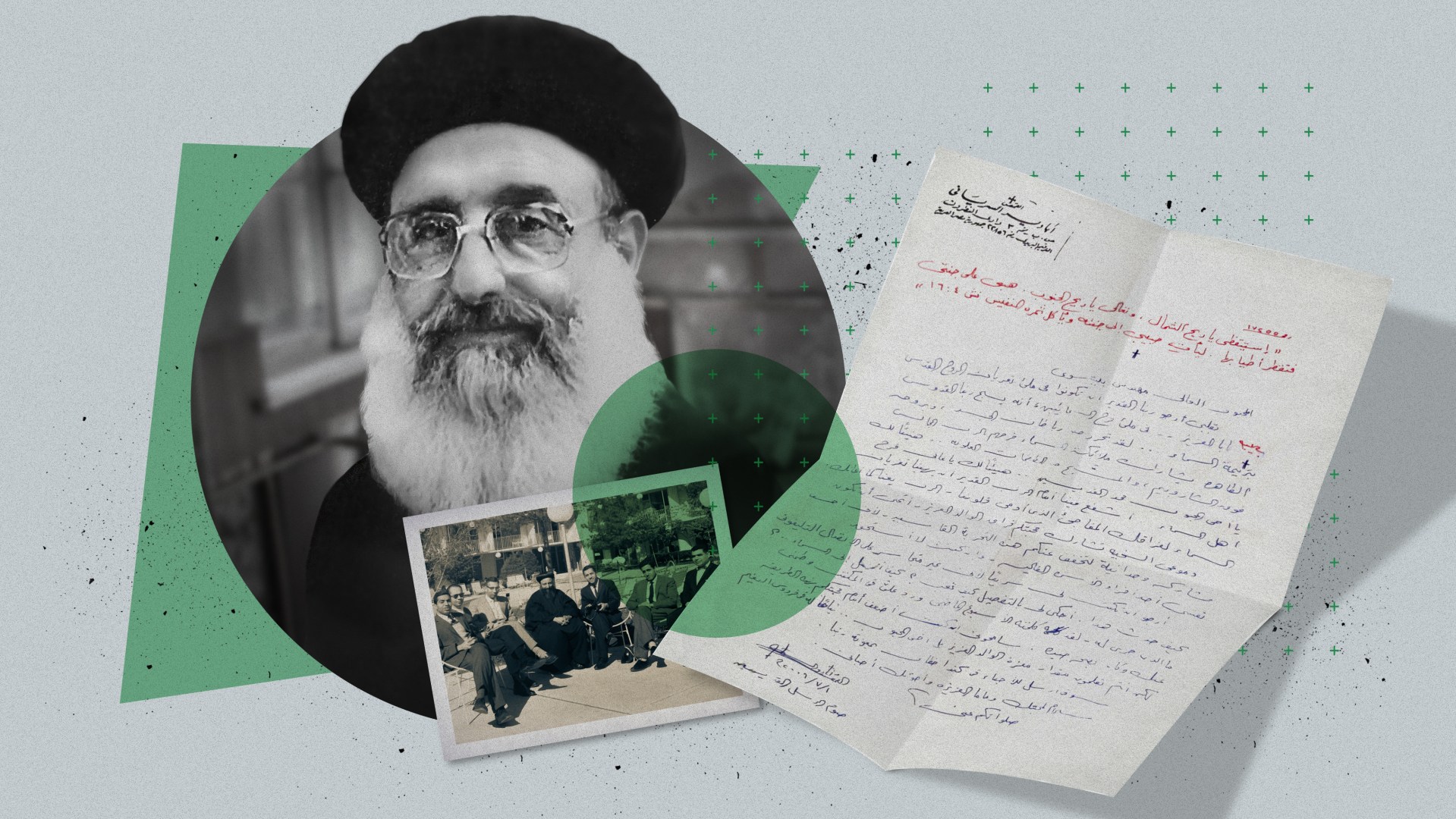
In his rural New Jersey home, Wafik Habib carefully laid out his letter collection before us, now more than a half century old. Handwritten by the late Bishop Samuel to the physician, they represented the bishop’s pastoral care to a nascent diaspora Christian community started in 1950s North America. We could sense the bishop’s presence in the words of comfort and exhortation set to pen and paper.

A few years before our visit to Habib to read his letters from Bishop Samuel, we opened up our own airmail from Egypt. It was a greeting card from Abadir El-Souriany, an elderly monk at the Syrian Monastery of St. Mary. (In the Coptic tradition, bishops are denoted by a single name at ordination and monks are referred to by their first name and the monastery where they serve.)

The card smelled of the Egyptian desert. In it, we found words of blessing.

Abadir had pastored our family in Sudan decades before. Now, newly ordained and assigned to a Coptic Orthodox Church in New Jersey, we received the warm words of Abadir’s letter. They ministered to us as only words from a lifelong pastor to diaspora congregations could.

Of course, sending letters from a distance to churches the Coptic church leaders planted or communities they served follows an apostolic tradition that dates back to the New Testament. Though these letters were addressed to individuals, rather than entire congregations, they achieved the same end: the spread of Christianity, the planting of new churches in new places, and the spiritual growth of these new congregations.

Following in the footsteps of his predecessor, Bishop Samuel, Abadir maintained the relationships he built through letter-writing. The Syrian Monastery—located in a region called Wadi El-Natroun between Alexandria and Cairo, the center of modern Coptic monasticism—served as Abadir’s home base, where he had retired to minister to churches in the Middle East and Africa. In 1969, three years after becoming a monk, Abadir was ordained as a priest and sent out to serve parishes in Egypt and Sudan. He also served Coptic diaspora parishes in Libya and Iraq in the 1970s and 1980s before retiring to the monastery.

Two decades before his ordination, in 1948, Bishop Samuel joined the same monastery before also being commissioned by Pope Kyrillos VI, the Coptic Orthodox Patriarch of Alexandria, to represent the Coptic Orthodox Church in social services and ecumenical affairs, the first position of its kind. Bishop Samuel was also sent to serve the Coptic diaspora communities forming in North America during the first wave of Christian Egyptian immigration in the 1950s and 1960s.

Abadir and Bishop Samuel both entered the ministry under the papacy of Pope Kyrillos VI (1902–1971), who was also well-known for his letters to congregants in Egypt and abroad—many simply Psalms copied down in his own handwriting. Pope Kyrillos rarely preached sermons. Biographer Daniel Fanous nicknamed him the “silent patriarch,” also the title of his biography. Those who wanted to hear his words found them in his letters.

Letters take patience, but they are a physical connection in times of discouragement, loneliness, or grief that can’t be replaced by faster technologies. They are, in their own way, sacred.

Many Copts in North America treasure dearly their letters from Bishop Samuel, taking even more care of them as living memories of his pastoral care after his assassination in 1981 alongside Egyptian president Anwar Sadat. Many of these Copts, like retired physician Habib, collectively formed lay congregations until they could sustain a trained Egyptian priest. Handwritten letters from Egypt uplifted their weary souls. Habib showed us all of his correspondence from the bishop during the 1950s and 1960s, each one filled with words of Scripture, encouragement in his relationship with God, and sage advice.

One such letter, originally written in Arabic in 1966, includes hopes that the young doctor has relaxed after finishing an exam so that he could practice medicine in the US. Bishop Samuel encouraged perseverance in the challenges of carving out a life in a new country, but he was also keenly aware of the perennial struggle of loneliness in any place. In 1953 he wrote a letter to Habib addressing the deep human loneliness that cries out for the Creator.

“How I was glad with your last letter,” he wrote, “in spite of the pain that it contains, except that it is filled with the good longing for the complete fellowship with God, thirsting for the refection of his sweet love, and for the sitting between his hands day and night.”

Rather than advise Habib to look outside himself for support in his loneliness, Bishop Samuel instead pointed out that the loneliness is a “good longing” that is “heard by the Lord Jesus.” Instead of decrying the loneliness and isolation, he wrote,

Then prepare yourself to enjoy these opportunities whenever you are able to. Be alone with yourself, and whenever you feel the ignition of the heart moving you to the prayer and the sitting between his hands, do not postpone these moments. They are blinks of light that ignite in your heart, whenever you have the opportunity, respond to them quickly. Then you will taste the meaning of joy in the bosom of the beloved Jesus.

He added, “Then remember me in your prayers too.” After this, his advice then became practical, exhorting the young doctor to organize his time, balancing this time with God with work, study, church, service, and physical activity.

Bishop Samuel’s letters often addressed the worries and troubles his recipients might be facing, as well as perhaps some of his own. He asked for prayers for his growing ministry—not just in establishing the Coptic Orthodox community in North America, but also his work in Africa. In another letter from 1966, he wrote:

Pray a lot for my weakness, especially for the service in Africa which God opened it before us in His miraculous way which was not in taken into the account. As while we were preparing and thinking from years ago, there are now before me 16 youth from South and West of Sudan (some of them are 2 meters tall). “I hope that they will be giants in faith and work too.” [2 Cor. 8:7] … There are 21 teachers now teaching them the religious and scientific sciences together.

The fruit of this form of pastoral care by Bishop Samuel is now evident. The immigrants he wrote letters to helped establish the first Coptic Orthodox churches in North America. And only 65 years after he prayed the first Coptic Orthodox liturgy in North America, more than 250 congregations have started there, with approximately 1 million adherents.

The Coptic immigrants who established the North American churches thrived on the ongoing pastoral care from the church in Egypt, the commissioning of priests, and the engagement of the Coptic community with the broader society. But many of the earliest immigrants point to Bishop Samuel’s letters as important sustenance during the dry period several decades before the growth of the Coptic community.

In contrast, Abadir served communities in environments more hostile to Christianity. In Iraq, he survived an airport bombing in Baghdad in 1976. Later, many Copts fled the country before the US invasion of Iraq, which also left the indigenous Christians of Iraq vulnerable to persecution. Many Abadir served in Libya were forced to return to Egypt or settle in other countries after the 2011 overthrow of Muammar al-Qaddafi and the subsequent civil war, which left Libya vulnerable to the growth of violent extremist groups like ISIS.

While there still is a large congregation of Copts in Sudan, including those served by the same tall Sudanese youths Bishop Samuel wrote about, many left during the civil war in the 1980s, fearful of reprisals against Christians in the North as Christians in the South rebelled.

Abadir maintained many of those relationships despite the turmoil of these countries. He did so through phone calls and letters, even as new technologies made communication faster and more efficient. Old-fashioned letters from spiritual mentors had a special stamp that an email, text message, or televised sermon couldn’t provide.

One such letter came in 2006 from the Syrian monastery to our home in Cairo, before Bishoy was ordained. Abadir sent it to express his condolences on the repose of Bishoy’s father, Lamie Mansi Mikhail. Like Bishop Samuel, Abadir opened with Scripture, quoting Song of Solomon 4:16 to remind Bishoy of where Lamie had gone—“Let my beloved come to his garden and taste its choice fruits”—and asked for the Holy Spirit to comfort him and his family. But he also acknowledged and shared in our grief:

My nonstop tears share your love during the departure of your dear father—I hope that this sentimental participation reduces this hard trial—as I count myself one member of this precious family—though I am not worthy.

The rest of the letter asks about the circumstances of Lamie’s sickness and death, recognizing how painful sharing this information might be: “I do not dare to call by phone.” He concluded by sending his love and peace to our mother and brothers, promising to also send a letter to Lamie’s family in Canada to console them.

When part of his jaw was removed due to cancer, Abadir’s letters reached where his voice could not. After his death in 2011, his letters became a lifeline from heaven to their recipients—read and reread not just for their encouragement and advice, but because of the concrete connection to the writer.

For those who emigrated from Egypt to new lands, those letters also carried a scent of home. Our memories of their voices and words of encouragement might fail us, but letters revive them again.

We can re-read emails, but we can’t touch them like we can touch letters—the same paper touched by the writer. Letters take patience, but they are a physical connection in times of discouragement, loneliness, or grief that can’t be replaced by faster technologies. They are, in their own way, sacred.

Phoebe Farag Mikhail is the author of Putting Joy into Practice: Seven Ways to Lift Your Spirit from the Early Church (Paraclete Press). She was born in Egypt but grew up in the Northeast US. She is a writing instructor and freelance writer, and blogs at Being in Community.

Bishoy Lamie Mikhail is a priest at St. Antonious & St. Mina Coptic Orthodox Church in East Rutherford, New Jersey. He was born and raised in Sudan and Egypt. He is also the coordinator of the ordained diaconate service for the Coptic Orthodox Archdiocese of North America.

Editor’s note: You can read and share this article in Arabic as 1 of 150+ CT Global translations across 10 languages. Share your feedback here.

You can also now follow CT on WhatsApp and Telegram.

Theology

This Pandemic Hits Americans Where We’re Spiritually Weak

Our cultural values are making us sad: money, mortality, and fear of missing out.

Christianity Today May 7, 2020
Illustratioon by Rick Szuecs / Source images: DragonImages / Chalabala / Envato / Natabene / Twenty20t

In a video chat last night, a friend admitted, “I’ve been crying a lot, and I’m not sure why.” COVID-19 has given us many reasons to weep. We’re out of our routines, the stock market has plunged, and we imagine millions dying. This virus and economic crisis punch us squarely where our spiritual armor is weakest: mortality, money, and our fear of missing out.

In 2 Corinthians 7, Paul distinguishes between two kinds of sorrow—a sorrow that “leads to death,” and a “godly sorrow.” The latter “brings repentance that leads to salvation and leaves no regret” (v. 10). Godly sorrow, he writes, produces “earnestness,” eagerness to repent, and a “longing” and “readiness to see justice done” (v. 11). The question the church faces now is which kind of sorrow COVID-19 will bring.

We are in the midst of the most widespread societal upheaval that many people alive today have ever experienced. Already our institutions, habits, relationships, and culture are shifting before our eyes. Frank M. Snowden, author of Epidemics and Society, shared with the New Yorker, “Epidemics are a category of disease that seem to hold up the mirror to human beings as to who we really are.” The question we are facing is not whether we will experience sorrow and change; the question is how. As biblical prophets walked with people through catastrophes, their advice was never to just endure until it ends. Instead they focused on proactively changing relationships with each other and with God.

As a cultural anthropologist who grew up in a middle-class white United States home and then lived for much of my adult life in Nicaragua, China, and South Africa, I study the ways cultures adapt and change. Social scientists dub people like me WEIRD—Western and educated, from industrialized, rich, and democratic countries. My home culture is especially weird compared to much of the Majority World in our responses to loss and unpredictability. Yes, we WEIRD people have much that will help us against the coronavirus—well-funded research labs, hospitals, and democracy. But dealing with financial, mortal, and daily uncertainties is not our strong suit. This current upheaval slams us up against some of our deepest lies and idols. It demands strong muscles that many of us have let atrophy. Identifying how our culture has left us poorly prepared for this can move us toward the kind of sorrow that produces repentance and justice.

Mortality and the myth of perpetual productivity

In America we learn that we are what we do. We treat those who aren’t productive, young, or fashionable as not worth our attention. Everything in us has been taught to recoil at two of the most pressing realities of COVID-19: lost productivity and dying people.

In middle-class white America, introductions nearly always involve the question “What do you do?” Jobs, college majors, and contributions to an ever-churning productive economy come to define who we are. I have been taught to love schedules, precision, and hard work. Time is our commodity to use or save, not waste or spend. Economists account for human value by measuring wages and the goods we produce, and this seeps into everyday thinking.

Meanwhile, we idolize youth and treat death as the final failure. “No one in America ever looks forward to growing old,” anthropologists Lowell Holmes and Ellen Rhodes Holmes write in an anthropological analysis of American culture. Our magazines, advertisements, and media portray young people as productive, important, and beautiful. Youth are people who matter. As theologian and social worker Joyce Ann Mercer points out, we find it “almost impossible to imagine what vocation means or what forms it might take in older adulthood.” In a culture that shows little regard for the aging or the otherwise seemingly unproductive, COVID-19 forces us to re-account for their value as we face losing them.

In our glorification of youth, we recoil from death. In Nicaragua, I remember learning that someone died when a woman ran past our home wailing with grief. In South Africa at the height of the AIDS pandemic in 2006, a friend told me she had attended a funeral every week for nearly a year. I believe I have attended only two funerals in ten years. In many parts of the world, mourning is a public event, wrapped in widely shared rituals of care. In such cultures, death is still unwelcome, but unlike in my culture, death is familiar and shared in community.

For people who have learned to avoid death and rest at all costs, how might this pandemic lead us to a godly sorrow of repentance? The Christian view of rest and death is radically different from what pervades our culture. Theologian Norman Wirzba writes that “Sabbath is not an optional reprieve in the midst of an otherwise frantic or obsessive life. It is the goal of all existence.” COVID-19 is bringing some people long hours, others temporary waiting, and others layoffs. All need the message that work does not define us. We are made also to rest. The prophet Jeremiah told Israel that for all the time they had refused to practice Sabbath rest, disaster would force rest upon them (2 Chron. 36:21). Are we pushed now into receiving the rest we have neglected to give ourselves?

Death, our final rest, is also not an enemy to fear. In the context of telling his disciples “Do not worry about your life,” Jesus reminded them that God cares even for the grass that is here today and gone tomorrow, and all the more for humans (Matt. 6:25, 30). We do not escape worry by ignoring death, but by facing it with Christ. Accepting godly sorrow in this time might mean learning from experts like medical doctor Atul Gawande about how to start conversations about mortality. Rather than cling desperately to longevity, we can ask God for the life that is truly life. That life includes receiving rest even now.

Money and the expectation of human progress

An estimated $3.6 trillion disappeared in one week as the stock market collapsed. The impact will be felt most not by stockholders but by those at the bottom of social ladders through layoffs, closed nonprofit organizations, and evictions.

Our sorrow as the market crashes is not just about lost money. Americans are not so much addicted to money as we are addicted to progress. Social scientists agree that the narrative of time as a steady movement toward an ever-better future is deeply influential in Western cultures. “The constant pursuit of material wealth is not so much a desire to have things for their own value as to provide evidence for one’s friends and neighbors that one is succeeding and getting ahead,” write anthropologists Holmes and Holmes. This economic crisis strikes fear not just because we imagine layoffs and homelessness (which might motivate us to genuine concern for neighbors) but because our narrative of relentless human betterment is destabilized. Suddenly we find that things are not getting better.

We believe this metanarrative of a perpetually improving future not because God works that way but because we tell ourselves that human-made technology works that way. Since the industrial revolution and the Enlightenment, Western people have grown to trust in human innovation and the upward trend of capitalist growth. We expect economic prosperity because humans will make it so.

The economic pattern of most of the Bible is not upward growth. More often, prosperity comes and goes in cycles or sudden interventions. In the metanarrative of the Bible, God oversees the rise and fall of civilizations. Individuals and societies thrive not because their cleverness mitigates all risk, but by the gracious care of God. Human innovation has an important role to play in coping with COVID-19, but the pandemic has also exposed our over-reliance on human ingenuity for protection.

Godly sorrow as we face the lie of human-made progress will mean remembering the source of Christian hope. Many Americans traveling to the Majority World incorporate “hope” into organizational names like “building hope” and “bringing new hope.” Over the years, though, I have learned that my Majority World brothers and sisters often have the kind of hope that comes of suffering, endurance, and character (Rom. 5:3–5). Hope I grew up with was often an imitation built of privilege, a thriving economy, and a modernist narrative of progress. Living paycheck to paycheck or with no paycheck has the potential to produce hope that is like gold refined by fire (Rev. 3:18). The hope we need now will be built on a God who meets the desperate.

Fear of missing out and human attempts at authenticity

The past weeks brought a flood of emails reading “canceled.” Losing these activities hurts not just because we will miss seeing friends or keeping busy but because our culture teaches us that these activities make us us. Long before the coronavirus, we were living in an epidemic of what Harvard Business School writer Patrick McGinnis dubbed FOMO: fear of missing out.

The cultural commentator David Brooks diagnoses this condition using Kierkegaard’s term “the aesthetic life.” A person in this aesthetic lifestyle lives to “rack up experiences,” becoming “eventually paralyzed by self-consciousness.” “You tell yourself that relationships really matter to you—scheduling drinks, having lunch—but after you’ve had twenty social encounters in a week you forget what all those encounters are supposed to build to.” As we consume both purchases and activities, we have what theologian William Cavanaugh calls a detachment problem. Rather than being too attached to the stuff we buy, we are too quick to discard what matters. We gorge ourselves on activities and products, ever eager to have what’s next.

Many cultural analysts have pointed out that American consumption is fueled by a desire to prove who we are. Whether filling our lives with stuff or activity, we are “concerned primarily with what other people of our social position or age-set have, think, or do,” according to anthropologists Holmes and Holmes. Tim Keller and others note that Westerners use consumption and activity to claim and display their “authentic self.” In contrast to much of the world, Americans use consumption rather than tradition or family as a primary source of identity. Historian Meic Pearse writes in Why the Rest Hates the West, “Only an abundance of riches such as no previous generation has known could possibly console us for the emptiness of our lives, the absence of stable families and relationships, and the lack of any overarching purpose.”

As we give up sports tournaments, concerts, parties, and coffee dates, we are not just missing opportunities to see friends; we are destabilizing our sense of identity and purpose. According to Richard Rohr, fear of death often reveals an even deeper fear of never having really lived. The combination of a novel virus plus canceled activities means we have to face that fear.

What does godly sorrow look like in the face of FOMO? Now can be a time to recognize what makes life good. Have we sought the good life by chasing ever newer and greater experiences? Are we striving to craft some truly authentic self by what we buy and do? Now is a time to stop spending money and labor on what does not satisfy. Instead this is a time to learn to receive from God “what is good,” that “your soul will delight in the richest of fare” (Isaiah 55:2).

As we confront the ways this pandemic has caught us spiritually unprepared, there is no promise that we will feel any less sorrow. But we do determine what this sorrow will produce. In this time of cultural upheaval, our shared sorrow has the potential to spread repentance. Now is the time to replace our reliance on productivity, progress, and social standing with a longing and readiness to see justice done.

Christine Jeske is a professor of cultural anthropology at Wheaton College. She is the author of three books, including the forthcoming The Laziness Myth (Cornell).

News

Why We Opened a Christian University in Iraq Amid ISIS’ Genocide

CT interviews Stephen Rasche on Erbil’s Catholic presence, the need for Christian unity, and why Christians will “no longer be shy” with the gospel.

Christianity Today May 7, 2020
Illustration by Mallory Rentsch / Source Images: Courtesy of Chaldean Church and of Stephen Rasche / WikiMedia Commons / Unsplash

For 25 years, Stephen Rasche was a “bare knuckles” international lawyer. But in 2010, he offered his services to the Chaldean Catholic Church of Erbil in Iraqi Kurdistan and has increasingly dedicated his life to the preservation of this ancient community.

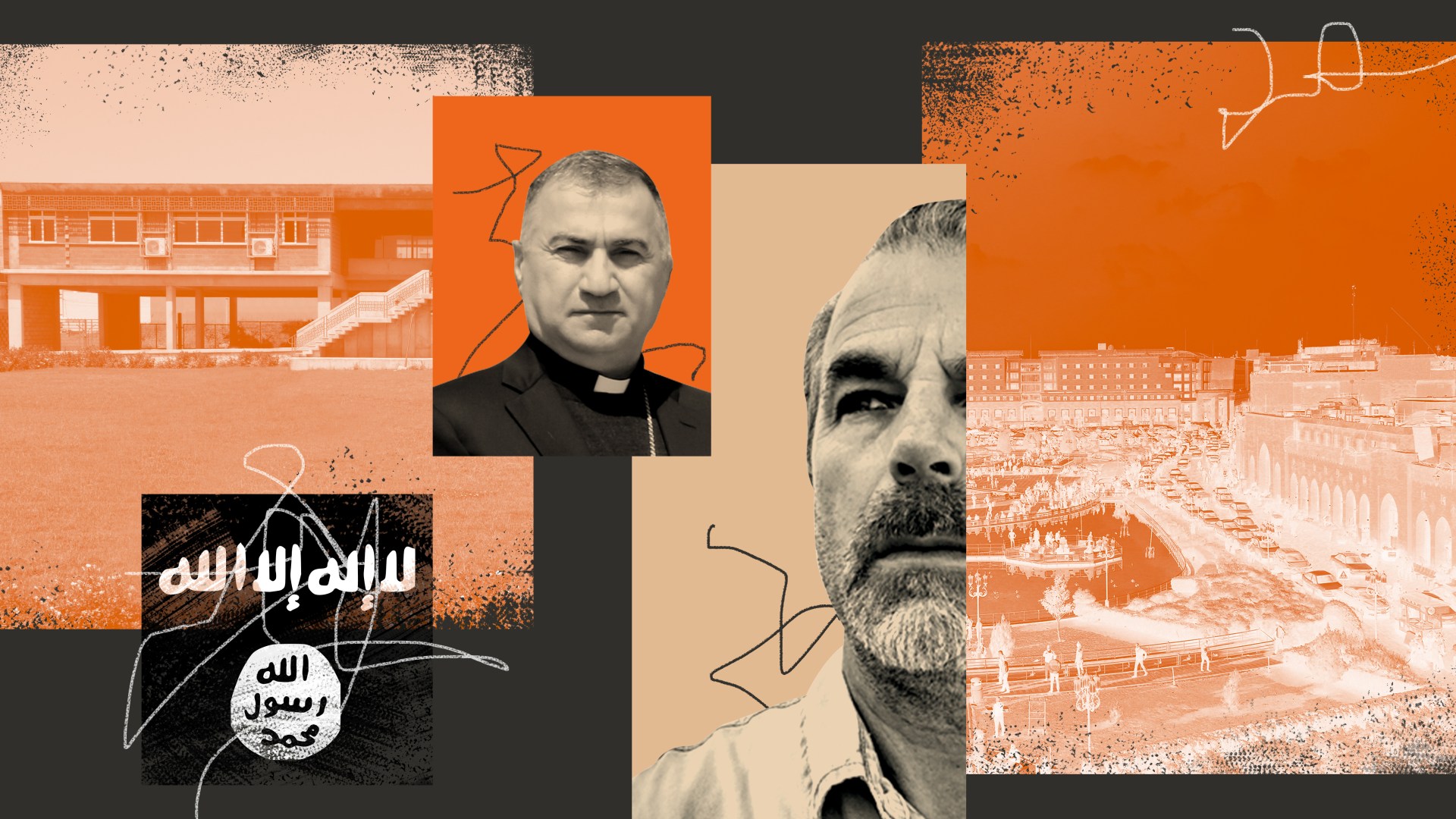
Under the leadership of Archbishop Bashar Matti Warda, in 2015 Rasche helped found the Catholic University of Erbil, where he serves as vice chancellor. Also the director of its Institute for Ancient and Threatened Christianity, Rasche lived this title as ISIS ravaged Iraq’s Christian homelands in the Nineveh Plains and many believers fled to Erbil.

After testifying on their behalf before the United Nations and the US Congress, Rasche allows them to represent themselves in his recent book, The Disappearing People: The Tragic Fate of Christians in the Middle East. The book has won a diverse range of endorsements, from leaders such as Matthew Hassan Kukah, bishop of the Catholic Diocese of Sokoto, Nigeria; Yahya Cholil Staquf, general secretary of Nahdlatul Ulama, the largest Muslim organization in the world; and Thomas Farr, president of the Religious Freedom Institute.

The US State Department’s Office of International Religious Freedom reports that less than 250,000 Christians are living in Iraq, most in Kurdistan or on the Nineveh Plains. Two-thirds belong to the Chaldean Catholic Church.

CT interviewed Rasche about the logic of establishing a university during a genocide, how its Catholic identity functions in a Muslim society, and his enduring optimism for Christianity in Iraq.

What led you personally to invest your life in this endeavor?

In 2010, Bishop Warda had just been made archbishop, and I went to pay him a visit of respect, asking if there was anything I could do to help. “Yes, in fact,” he said. “You Americans have made a big mess here, and you could stay and help me. I have 3,000 displaced families here from the south, they need help, and no one is helping us with them. We don’t have jobs for them, and there’s a whole range of things I would like to do.”

I assisted on and off on a pro-bono basis for the next four years, but by 2014 the situation looked really desperate. ISIS was maybe 30 miles away from Erbil. But in a visit just after Christmas, I sat down with the bishop and the priests who told me, “We are going to stay. Will you be with us here, and help us?”

Honestly, I was skeptical. But after some deep thinking, I tried to determine the right thing to do and if there was a calling in this for me.

Tell us more about that calling.

Being an international transactions lawyer involved a fair amount of bare knuckles litigation. And not a lot of it, quite frankly, was fulfilling in the sense of believing that you were providing a meaningful service to the world or to your fellow brothers and sisters.

An open-heart surgery slowed me down for a couple of months, which allowed me to really ponder what I’d been doing and where I was going, particularly with my faith. How much did I really have? My discernment centered around the Beatitudes and the Sermon on the Mount. Do I really believe this? And if I really do, then what can I do to show it?

I can honestly say that those years on the ground in Iraq, especially 2015–2018 when everything was really difficult, eclipse all the other working years in my life in terms of a sense of worth, purpose, and well-being.

What does it mean practically to have a Catholic university in a Muslim-majority nation?

At a fundamental level, it’s about presence. It’s to say, “Look, we are a Catholic university, and in the middle of all of this, we are here.” Our view is very much long term. We see the importance in planting the seed. At the end of the day, the primary purpose of the university is to serve as an anchor institution for the remaining Christian population, so that they can demonstrate their value to the entire community.

But also, in the US and around the world, there is a discussion about the importance of religious freedom. Well, our Catholic university in Iraq was founded during the genocide. This gives us a unique moral standing and frame of reference that’s not academic. It’s not theoretical. It’s real. We can speak out and be real leaders on this.

Is there any role desired, or possible, in terms of witness and gospel?

Over the last 1,400 years in Iraq and most of the Middle East, proselytizing has been forbidden. What the Christians have done is practice what they call evangelization by example—opening hospitals, founding universities—so that the way you live your Christian life demonstrates your service towards others, regardless of who they are.

There was an unwritten understanding that the Christians would not overtly proselytize and share the gospel, but be indirect and not offend sharia law. But after ISIS and the lack of any real response from the Muslim world, Archbishop Warda says that this agreement is now finished. That as we go forward, we will no longer be shy. We are going to proclaim the gospel, proclaim the teachings of Christ, and whoever comes to us will come.

Interesting.

He basically said, “Look, what else can happen to us? They’ve tried to kill us, destroy us, wipe us out with genocide. And if it means that we’re approaching our end, we’re not going to go quietly—not anymore.”

Christians in Iraq are at a historical inflection point. Their presence here can be extinguished quickly in many ways—primarily if there were to be, God forbid, war or proxy war between the US and Iran. It would take place right where the Christians are living. It would make things completely untenable for them.

But I fully expect that if they make it through this current period, Christians will find ways to assert themselves in ways that they haven’t before. In the past, they tried to walk quietly, keep their heads down, and not cause any trouble. I think those days are over.

Your book features the testimony of local Christians about their situation in Iraq and the Middle East. Many might blame Western policies. Others might pinpoint Islam. But how do Christians identify their own failures? How do they evaluate their own contribution to their dwindling numbers?

In many respects, they blame a continuing division and discord that has left them far more vulnerable than if they were unified and supportive of each other. In some cases, it has also hindered the well-intended support coming from the West. It occurs between different groups within the apostolic churches; between the apostolic churches and the evangelical churches; and even within the evangelical community, where competing groups want to assist the apostolic Christians in different ways.

This division and discord are a failing that goes against the core teachings of Christ. While certainly not unique to the East, it is a failing which has had particularly tragic consequences for Middle Eastern Christians in the face of their many pressures over the last decades.

And these pressures have forced the Christians remaining in Iraq to come to terms with the depth of their faith and what it really means to them. It’s one thing when it’s the drip-drip-drip of 1,400 years of persecution. It’s another thing when you have a full-blown genocide that comes to wipe you out and take everything away. It has happened every 70 years or so, but this is the first time in their living memory, and it really shook them.

There are still Christians in Egypt. There are Christians in Lebanon. But when you look at Iraq, it’s hard to find hope given the current geopolitical and religious realities. Yet in the middle of disaster, nobody builds a university.

That’s right.

So what hope do you have? Projecting into the future, expecting God to strengthen and grow his church in Iraq, what will it look like?

That Christians present such an example of service that the people of Iraq will not be able to deny not only their worth as people but also their worth in how they live their lives.

If they understand that, then that’s all we get to ask for—anywhere. There may not be many Christians in Iraq. But as an old priest said once to me, “Well, remember Christ only had 12, and everyone wanted to kill them, too.”

Church Life

When Your Church Reopens, Here’s How to Meet Safely

A global health expert suggests a phased plan for congregations gathering again amid this pandemic.

Christianity Today May 6, 2020
Illustration by Mallory Rentsch / Source Images: Anshu A / Unsplash / WikiMedia Commons / MirageC / Getty Images

Editor’s Note: An earlier version of this article implied that people should not sing during gatherings. The author’s suggestion is to wear a face mask when singing or talking. (See updated table for more information.)

Over the past four months, the spread of a new coronavirus has exploded across the globe, leaving packed ERs, ICU patients on ventilators, and families grieving over the loss of their loved ones. To limit the spread of this virus, most governments implemented strict stay-at-home orders. This very blunt instrument was necessary because many countries were simply unprepared for the rapid spread of this virus. If nothing was done, the rising number of infections would have overwhelmed health care systems, and deaths would have quickly escalated.

During this period, churches across the US and around the world have closed their doors to in-person worship and ministries. As with many preventive actions, we may never know how this has limited the spread of COVID-19. But as a global health professional who has worked for 25 years to control diseases around the world, I am certain that this has prevented many infections and deaths that would have occurred among congregants and their families and friends.

After six or more weeks of stay-at-home orders in the US, unemployment claims are piling up, people are getting antsy in their homes, and loud voices are increasingly calling for governments to relax their restrictions.

Public health experts warn that the US lacks the testing, contact tracing, and quarantining capabilities needed to bring and keep the pandemic under control, yet some states are already loosening their restrictions and allowing “nonessential” businesses to reopen.

Our churches are now facing a set of difficult decisions: when to resume in-person ministries and how to carry out these ministries safely.

I propose that the way forward is to take a step-by-step approach that helps the global church live out its missional calling, meet the needs of its congregants, and protect the health of those in the church and in the community.

Our guideposts for decision-making

To discern God’s call for the churches I am advising in my city of Seattle, I have relied on two guideposts: biblical truths and scientific knowledge, both of which have been given by God.

The Great Commandment states, “You shall love the Lord your God … and love your neighbor as yourself” (Matt. 22:37–39, ESV). During this pandemic, love for ourselves is expressed in the ways we protect ourselves from getting infected. In the same way, love for our neighbor is expressed in the ways we protect them from getting infected.

Even as we focus on preventing COVID-19 infections, however, we should not neglect spiritual, emotional, and social needs—in ourselves and others. During this period of social distancing, it is perhaps even more important that churches meet these needs.

As Christ’s disciples, these needs are met as we live out our calling to worship, pray, encourage, witness, disciple, and serve. However, we now must do these in a way that minimizes the risk of COVID-19 transmission. Therefore, we need to use scientific knowledge about this virus to prevent its spread in our churches.

Recent scientific knowledge about COVID-19

With the best minds in the world working on COVID-19 right now, there is a rapidly expanding body of scientific knowledge about this virus. We are also accumulating lessons from many countries on what is and is not working to control the spread of COVID-19. Some of these recent insights are particularly relevant to churches as they consider how to resume in-person ministries:

First, we have a better understanding about how the virus spreads.

Contrary to our initial assumptions, we now know that COVID-19 can be transmitted before a person develops symptoms. This explains why the virus spreads so easily and stealthily, and it greatly complicates efforts to contain its spread.

We also know that not every infected person will infect another person. Other factors are needed to facilitate transmission. They include:

  • Infectiousness of a COVID-19 patient
  • Actions that increase the release of respiratory droplets and aerosols into the surrounding air
  • Proximity to an infected person (within six feet is considered high risk)
  • Enclosed environment with limited ventilation to the outside
  • Amount of time spent with an infected person
  • Type of social network, e.g. inter-generational mixing

The more these factors are present, the higher is the risk of transmission. But the more we can mitigate these factors, the lower the risk of transmission. (see table below).

There is growing evidence that younger people and children are less susceptible to COVID-19. Children are also less likely to display symptoms when infected with the coronavirus. However, the quantity of viruses they harbor and their ability to spread to others may not be different. Because older people are more susceptible to getting COVID-19, the implication is that intergenerational contact should be minimized to reduce COVID-19 transmission.

Second, we know much more about harmful effects of COVID-19.

Initially, most of the attention about the danger of COVID-19 focused on the elderly because they have a much higher case-fatality rate. Then we learned that younger adults with common chronic conditions like hypertension and diabetes also have an increased risk of serious complications. In fact, nearly 60 percent of COVID-19 hospital admissions in the US are for those less than 65 years old.

A recent study reported that 45 percent of American adults have factors that place them at risk for serious COVID-19 complications. Because those attending churches are on average older than the general population, an even higher proportion of church congregants are at risk for serious COVID-19 complications.

Third, we have a better understanding of what control measures work.

Testing, contact tracing, and quarantining of cases and contacts can mitigate the COVID-19 epidemic without a major lockdown. However, such actions must be taken very rapidly and effectively. South Korea and Taiwan have done this successfully. Within two or three days from symptom onset, COVID-19 patients are tested and most of their contacts are effectively quarantined. This has worked because South Korea and Taiwan have some of the highest testing rates in the world and a well-trained cadre of contact tracers to quickly locate contacts and implement quarantine. They also use some electronic tracking, which may not be acceptable in other countries.

There is good evidence that using a face mask substantially reduces the release of respiratory droplets and aerosols into the surrounding air, even when a person coughs or shouts. The primary benefit from using a face mask is to reduce the spread of COVID-19 from the source of infection—an infected person. Homemade masks are less effective than surgical masks but still helpful. In addition, wearing a face mask prevents an infected person from rubbing her nose and then depositing viruses on surfaces that she touches. Face mask users also get limited protection from COVID-19 infection.

Fourth, experts agree that COVID-19 will be in the US for the foreseeable future, with fluctuating levels of infection in the community.

Several states have started to lift stay-at-home orders, even though their COVID-19 case counts remain high or have just started to decline. This will lead to an increase in transmission and new cases. This increase can be mitigated by extensive testing, effective contact tracing, and quarantining of contacts. But no state yet has the testing capacity and the trained personnel to carry out effective tracing and quarantining.

Then there is the challenge of COVID-19 spreading from one state to another. As long as one part of the country has a poorly controlled epidemic, states that have significantly reduced their cases will remain vulnerable to COVID-19 spread from those areas. The same can be said of spread from one country to another. A prime example of this is Singapore, which controlled the first wave of infection from China only to experience a second wave of infection from Europe.

Making a science-based plan

The church is a high-risk setting for COVID-19 transmission. Church activities contain multiple factors that facilitate airborne COVID-19 spread (see table below). In addition, our congregants are at greater risk for serious complications from COVID-19. Therefore, churches should carefully consider when and how to resume in-person ministries and have a clear plan to do so. This plan should achieve the following:

  • Mitigate the risk of airborne COVID-19 transmission during church activities.
  • Be able to dial up and dial down church activities as COVID-19 infection in the community waxes and wanes.
  • Be able to rapidly identify contacts with an infected person and help trace them if necessary.
  • Resume in-person church activities only when there is clear evidence of a declining and low level of infection in the community.
https://datawrapper.dwcdn.net

A step-by-step approach to resume in-person ministries

I have developed a four-step plan with modified activities that churches can use. This plan can be dialed up or dialed down depending on the level of infection in the community.

During this pandemic, the plan aims to help churches:

  • Live out their missional calling
  • Meet social, emotional, and spiritual needs
  • Provide protection against COVID-19
  • Support the broader effort to contain COVID-19

When adapting this plan to your church, it is very important to adhere to local government guidelines. Therefore, the number of people allowed to gather in your plan may differ from this plan due to local restrictions. The table only includes some of the more common church activities. When making decisions on how other activities can be implemented safely, consider the factors in the first table and where modified activities should be placed in the second table.

https://datawrapper.dwcdn.net

Living out our missional calling through small group gatherings

As stay-at-home restrictions are loosened, gathering in small numbers will frequently be allowed first. Therefore, small group gatherings should be the first activity to be implemented. We should be excited about this because small group gatherings are a wonderful way to live out God’s call for us. In small groups, we can build deeper relationships with each other, grow in God’s Word, foster a safer environment for mutual accountability, and encourage one another to love and good works. These groups can reach out to many who would not want to enter a church building but would accept an invitation to a home. They can also help prepare for the start of in-person worship services by gathering each week for worship and then joining with other small groups to attend in-person worship when it resumes.

Like the persecuted Christians in Acts 8, who were scattered beyond Jerusalem, our ministries have been scattered from the confines of our church buildings. By building strong small groups in our communities and organizing around them for return, we are building a solid and flexible foundation for eventual church ministry all together.

The risk for COVID-19 transmission in these groups is low. The risk can be further reduced by keeping group members constant and within the same age group. When infection in the community is still high, use of face masks provides an added layer of protection. Because members know each other, they can quickly inform each other if a person develops COVID-19 symptoms. This will facilitate rapid self-quarantine by other group members.

Meeting social, emotional, and spiritual needs

We all need human contact, but sometimes contacts feel superficial. This pandemic offers a chance to build deeper relationships. To reduce the risk of infection, we should reduce the number of people we are in contact with. But meeting with the same people all the time and meeting only with people in our age group also reduce the risk of getting infected. Gathering with the same group of people who are at the same life stage can also better meet our social, emotional, and spiritual needs.

Imagine the strategy as creating small bubbles of safety across the church. The more congregants stay within their bubble, the safer everyone in the congregation will be while infection in the community remains.

Providing protection against COVID-19

When in-person ministries in the church resume, it is essential to observe a physical distance of at least six feet. Although physical distancing is usually observed at the individual level, it can be observed at the level of a social unit. For instance, those who live together as one social unit do not need to be physically separated at church. As a unit they can be physically separated from other social units.

Use of face masks can be very helpful. Because anyone who walks into a church could be an asymptomatic spreader, putting a face mask on everyone entering the church can reduce the spread of the virus. To increase the proportion of face mask users, ask everyone to use them. This takes away the stigma and employs peer pressure to encourage use.

Because face masks, especially homemade ones, will not prevent all transmission, they should not replace other approaches to mitigate the spread of COVID-19. Physical distancing is usually not practical for small group gatherings in a home, so using face masks there is important while there is still a high level of infection in the community.

Supporting the broader effort to contain COVID-19

Because COVID-19 will be with us for the foreseeable future, transmission of this virus could occur during the resumption of in-person church activities. Therefore, for the safety of the whole congregation as well as their friends and neighbors, churches should be prepared to assist public health departments to identify and find the contacts of people who discover they are infected.

The first task is to rapidly identify all the contacts to a COVID-19 patient who attended the church. Then, if requested, churches should be prepared to quickly notify these contacts so they can self-quarantine and be evaluated for COVID-19. In this way, even if these contacts were infected, any transmission onward can be minimized.

Remember, speed is of the essence when it comes to contact identification and tracing. Therefore, your church should set up a system to collect information for all participants. The following are some suggestions for doing this:

  • Keep a log of where every person sits. Assign seat and row number (or table number) to your sanctuary and meeting rooms.
  • Register everyone entering a meeting. Record name, contact information, and where they are sitting. For each household, only one person needs to register but should list the number of people in group.
  • Maintain the record for at least three weeks.
  • Have a designated person in the church responsible for maintaining the meeting registration, liaising with public health department, and helping to identify and notify contacts if necessary.

When to move into different phases

Perhaps the most difficult aspect of using this step-by-step approach is deciding when to move from one step to another—whether to dial up or dial down a church’s activities.

There are many factors to consider. One of the most important factors to consider is the needs of church members. When a real need exists that is best met or can only be met face-to-face, we should find a way to resume in-person ministries more quickly.

Church should closely monitor the level of infection in its community. If it is going up or is still high, it is not the right time to resume in-person ministries. But if the level of infection is going down and is low, then it is safe to move into step 1 of my plan. Specifically, a consistent downward trend in COVID-19 cases and deaths for at least three weeks is one metric to use before considering step 1 of this plan.

But a downward trend is not enough, we also must have a low level of infection. This is where it gets tricky because, without extensive testing, we don’t know the true number of infections in our communities. Until testing gets ramped up, we can only make a guess based on the number of cases and deaths reported. But this is not ideal.

For now, with a downward trend and a low number of reported deaths and cases, we can consider other factors that may move us into step 1 earlier or later. Engaging our church leadership and the general congregation throughout this process is important. Having a clear plan will help our congregants understand why and how we are making these decisions.

As an example, for a population like King County, Washington, where I live (2.2 million people), and with a consistent decline in reported deaths and cases as the foundation, one set of criteria might look like this (using rolling averages over three days):

  • Step 1: Consistently <5 deaths per day for 3 consecutive weeks
  • Step 2: Consistently <1 death per day for 3 consecutive weeks
  • Step 3: Consistently <5 cases per day for 3 consecutive weeks
  • Step 4: Consistently <1 case per day for 3 consecutive weeks

As testing increases and we learn more about COVID-19, churches can develop more precise guidance on when to move from one step to another. Because the COVID-19 pandemic will wax and wane, an increase in the reported number of cases and deaths can be used to move back a step if necessary.

Living our calling

This pandemic has dramatically changed our lives and has turned our world upside down. We are just a couple of months into this pandemic, but the pain and anxieties around us are so real. To serve those in our community, the desire to open our church doors as soon as possible to serve those in our community is understandable.

Our churches can use biblical truths and the available scientific knowledge to guide decisions on when to resume in-person ministries and how to do it safely. As knowledge accumulates, we will be able to make better decisions and the plan that I have proposed can be improved.

Churches in other parts of the world face the same challenges as government-mandated lockdowns eases. The step-by-step plan as described is not hard or expensive to implement and can help ensure a safe environment for congregants around the world.

In closing, I want to remind us of one certainty. The COVID-19 pandemic in its present form will pass. One day we will look back on this time and see clearly that God was with us and was working in our midst for good. Knowing this, we can turn to him today and ask him to give us the discernment, compassion, and faith to make the right decisions for our churches at this time.

My prayer is that this article will help your church live out its missional calling, meet the needs of your congregants, and protect the health of those in your church and community at this critical time.

Daniel Chin is a physician trained in pulmonary and critical care medicine and epidemiology with 25 years of global public health experience. In 2003, he led much of WHO’s support to China to contain the SARS epidemic.

Editor’s note: Want to read or share this article in Spanish, Portuguese, French, Chinese (Simplified or Traditional), Korean, Indonesian, Arabic, Russian, or Filipino? Now you can!

You can also now follow articles like this on our new Telegram channel. Come join us!

News

After SAT and ACT Cancel, Registrations Soar for Classical Education Exam

An alternative college admissions test, used by some Christian schools, draws a record 50,000 students.

Christianity Today May 6, 2020
Rawpixel / iStock / Getty Images

The Classic Learning Test (CLT), a niche college entrance exam aspiring to bring a sense of virtue to standardized tests, saw a 1,000 percent increase in registrations over its short history when the SAT and ACT canceled testing for the remainder of the school year due to COVID-19.

“Because we are able to administer the test remotely, we’re kind of the only game in town,” said Jeremy Tate, who created the CLT four years ago amid a renaissance in Classical education, including among Christians.

At its first administration in June 2016, 47 students took the CLT. With the bump in registration, 50,000 students will take its suite of tests—the CLT, and the CLT-8 and CLT-10, designed for lower grades—during the 2019-2020 academic year. That’s more than double last year’s total.

Though not a Christian company, CLT references figures including John Henry Newman and C. S. Lewis in its promotional materials and stresses the moral, formational dimension to education. The exam has been popular among classical Christian schools, which educate over 40,000 students in the US, and homeschoolers, who make up about 40 percent of CLT test-takers.

So far, 178 colleges and universities in the US accept the exam, mostly Catholic and Protestant schools. For other institutions, the CLT can serve as a supplemental assessment.

The College Board and ACT Inc., the companies that administer the SAT and ACT, respectively, have canceled or postponed in-person testing until the fall, leading many colleges to make the admissions exams an optional part of their applications. In 2018, around 2 million students took the SAT and 1.9 million took the ACT.

While some registrants may turn to the CLT this year for the convenience of taking the test online (CLT uses screen sharing, video cameras, keystroke analysis, and time stamping to monitor student progress), its creators hope they also find a more enriching, engaging test experience.

The two-hour exam emphasizes verbal reasoning, grammar, writing, and logic. It includes extensive literary passages with questions about textual analysis and interpretation.

“What if we required students to read and understand the best that has been thought and said, the texts that have most contributed to society and culture?” said Tate, a former public school teacher and college exam tutor who grew into a critic of Common Core standards and a “teach to the test” mentality.

He has also called out the lack of religious thinkers on the major college admissions tests.

Compared with the SAT and ACT, CLT leans light on mathematics, though it does contain some trigonometry and algebra.

Detractors point out what is also seen as a shortcoming for classical education in general—a focus on Western history that can overlook non-white figures and global schools of thought.

CLT lists 140 authors whose work may appear on the test, and 125 of those are white. Board member Joyce Burgess, co-founder of National Black Home Educators, hopes to advocate for more African Americans in the author bank. “I am very passionate about CLT. It ’s personal because I love the authors that they recommend. I want to see that expanded,” said Burgess.

CLT’s board of academic advisors includes presidents and administrators from more than a dozen Christian colleges and universities, in addition to K-12 heads of school and other leaders in Christian education.

A 2019 Christianity Today cover story followed the popularity of Classical education among evangelicals.

Books
Review

Seeking the Lord of the Traveling Harvest

A journalist sketches an affectionate portrait of the faith and values of itinerant farm workers in America’s heartland.

Christianity Today May 6, 2020
Ittisak Aeksomboonsin / EyeEm / Getty Images

Things are never as difficult as they appear; they are always far more difficult.” A friend of mine once heard this bit of advice from his professor. And although the professor was speaking of theological study, the saying surely applies with equal force to doing an analysis of America, particularly in the era of Donald Trump and COVID-19.

American Harvest: God, Country, and Farming in the Heartland

American Harvest: God, Country, and Farming in the Heartland

Graywolf Press

416 pages

$17.97

In her new book, American Harvest: God, Country, and Farming in the Heartland, journalist Marie Mutsuki Mockett reckons with that complexity with more care and maturity than nearly any other writer operating in what has become a crowded and tedious space: the Trump-country travelogue.

Ever since polls began showing Trump atop the Republican primary field, journalists and media outlets have been producing pieces meant to explain his popularity among some Americans to those who find it inexplicable. At its worst, these pieces are derivative, condescending, and trite, leaving us with little more than the fact that Trump supporters support Trump, as journalist Ashley Feinberg has shown.

That being said, understanding America in 2020 remains difficult, as many of the nation’s journalists struggle to capture that complexity in their work. There are differences of geography—city versus country versus suburb versus exurb. There are racial differences. There are religious differences. There are socioeconomic differences.

And as Mockett demonstrates in her book, any explanation of contemporary America that focuses exclusively on one of those factors is bound to be reductionistic. The people Mockett meets, like the overwhelming majority of people we meet in our day-to-day lives, are complicated, surprising, and interesting, if only we will take the time to see them.

A Curious Travelogue

To demonstrate this, Mockett joined a crew of “custom harvesters.” Custom harvesters are teams of people that travel across the American heartland harvesting crops for farmers who, for whatever reason, are unable to do this themselves. Mockett knew these particular harvesters because they had worked on her own family’s farm in western Nebraska for decades. The owner, Eric Wolgemuth, had become a family friend over the years, someone trusted and respected by everyone in Mockett’s family, even though they knew practically nothing about him. His work spoke for itself.

Wolgemuth comes from Lancaster County, Pennsylvania. He is the descendant of Anabaptists, the theological heirs of the 16th-century Radical Reformation. (The book, regrettably, claims that the movement began in the 15th century, which is incorrect.) Traditionally Mennonite, they have become more conventionally evangelical in recent years. In particular, Mockett spends the most time with Eric and his son Juston, an “exvangelical” and former aspiring pastor who introduces Mockett to the books of Rob Bell and Mike McHargue, among others. Juston and Mockett form a quick friendship due to a shared intellectual curiosity that drives them toward books and conversation.

American Harvest is a travelogue, but of a curious sort: The people with whom Mockett spends the most time are fellow travelers—harvesters making their way up from Texas into the Pacific Northwest. So the book is less a study of any one geographic place (or even region) and more a study of the harvesters themselves and the class they come from—a class commonly found throughout middle America. This makes the book interesting while also introducing one of the defining complexities of writing about contemporary America.

On the one hand, the unique circumstances of Mockett’s relationship with the harvesters positions her to get to know them well. Thanks in part, perhaps, to her background as a novelist, Mockett describes her companions beautifully, demonstrating an affection and sincerity that many coastal journalists have lacked when entering middle America. She manages this even when writing about people who were unkind to her, which is a writerly virtue often lacking in the world of memoirs, particularly memoirs about red states.

On the other hand, it is telling that in her attempt to study “the heartland,” Mockett studies an area roughly the size of Argentina mainly by traveling with a group of people who aren’t even from there and whose bond with the region boils down to commerce mixed with the broad, class-based affinity shared by agricultural workers.

To note this fact is not to fault Mockett. Of any group of rural Americans she might have studied for the book, the harvesters seem the obvious choice because of the knowledge and trust that already existed between her and Wolgemuth. And as already noted, Mockett’s handling of these people is both gentle and perceptive. Yet it’s questionable whether one can tell the story of America’s heartland by telling the stories of people who don’t even have a home there.

America’s small towns have been hollowed out in the postwar years, as Mockett discusses briefly when writing about her hometown of Kimball, Nebraska. As families disappear, along with the culture and memories they carry, it often seems as if the only thing justifying the ongoing existence of these communities is a relatively naked, extractive form of commerce that has become detached from broader, non-commercial concerns. And that creates difficulties for someone who wants to write about the culture of a place, the people of a place.

Certainly, many of the old skills and values of pre-industrial America still exist, and that is something to write about. Yet they are diminished and diminishing. Wolgemuth exemplifies basically all of these virtues—his thrift, his conscientiousness, his remarkable and seemingly infinite technical competence, his faith in God, and his fidelity to family all represent the best of the region. Indeed, his ordinary goodness is so compelling that I found myself wanting to learn more about him as I neared the book’s end.

Yet even so, his life is defined by mobility in a way that complicates the work of building and sustaining a way of life in a place across generations. This is not to denigrate the work of custom harvesters like him, who are only making the best they can out of a challenging situation—and who, after all, play a huge role in feeding our nation. But it is an important point to remember as we consider this book and its picture of middle America in the Trump era.

A Starting Point

Mockett has a complex relationship with Christianity. As the book opens, she is mostly baffled by Christians. The initial framing device for the book, in fact, is a question Mockett poses to her family: “Why are our farmers and harvesters, who are conservative Christians, okay with GMOs, while people in the city, who believe in evolution, are obsessed with organic food?”

Neither of these supposed hypocrisies is nearly as revealing as she supposes. Both questions present the respective groups in simplistic terms. The answer to the first, in particular, is not the least bit surprising to anyone familiar with Christian reflections on science and the natural world. But this is where Mockett begins as she tries to wrap her mind around Christianity, and many of our peers in contemporary American begin in the same place. And so it is worth observing how Mockett’s reflections on faith move toward greater maturity and intelligence. Three points are worth emphasizing.

First, faith makes a discernible difference in the life of the harvesters. It is not always a good difference, but sometimes it is—and when it is, Mockett finds that compelling. Eric, in particular, is something of the hero of the story. His honesty, lack of pretension, and generous spirit heighten Mockett’s interest in Christian faith.

Second, she meets Christians interested in the life of the mind. Though many will rightly lament that the exvangelical Juston is the chief Christian thinker in the story, his willingness to talk, reflect on his own beliefs, and ask questions of Mockett further convinces her of Christianity’s intellectual seriousness.

Third, the work of harvesting, the slow pace of life in the country, and the long drives between farms furnish Mockett with ample opportunity to marvel at the world. One possible reason we talk so much about inhabiting a “disenchanted” world is that most Americans lack both the desire to look at it carefully and the time required for such looking. Between Mockett’s natural inquisitiveness and her experience alongside the harvesters, she learns to see the world the way that Eric does: It can be violent, and it can wear you down, but it can also surprise you with unsought beauty.

There is a very real sense in which, by story’s end, Mockett clearly desires to see the world as Eric sees it. As she witnesses a double rainbow with him and a couple of others, including Juston, she says, “whoever is painting the colors is not going to let go easily. The right side disappears first, and the original left side remains. Then it is just the upper left corner, with the red most prominent. And then the red, too, slips away, and the day is bright and hot and yellow again.”

A profession of faith this is not—not remotely. Yet it does betray a newfound willingness to look at the world and see not a machine, but purpose and intent. As a starting point for a longer conversation about our common life in today’s America, across its many dividing lines, you could surely do a lot worse.

Jake Meador is the editor in chief of Mere Orthodoxy. He is the author of In Search of the Common Good: Christian Fidelity in a Fractured World (InterVarsity Press). He lives in Lincoln, Nebraska with his wife and four children.

Pastors

When Only Two or Three Can Gather

As group sizes shrink, discipleship opportunities can grow.

CT Pastors May 5, 2020
Illustration by Mallory Rentsch / Source Images: Jetta Productions Inc / Getty Images

In 2006, I was leading ministry at a local university for a church. For years, my ministry drew students off campus in large groups to hang out with their mostly Christian friends, and we hoped they would bring non-believers to church gatherings. They rarely did. Over time, our team became convinced we needed to flip the whole ministry on its head.

For the next two years, we pushed students to stay on campus. We equipped them to disciple one another and to minister to the nonbelievers in their dorm rooms and apartments who would never come to a traditional church gathering. Often this discipleship occurred when roommates reached out to their neighbors, or in the context of informal, one-on-one friendship.

God used this shift and these smaller groups of people who were present and intentional with neighbors and friends to make and mature disciples. After a few years of prayerful experimentation with this ministry model, we started a new church with a philosophy that was essentially the same. For the past 10 years, our discipleship priority at the City Church in Fort Worth, Texas, has been building smaller groups of individuals, couples, and families who have committed to discipleship and mission together. Ours is not the only church that has been working in this philosophy. A movement of missional communities stretches back for years across the globe.

The coronavirus pandemic has flipped many normal ministry paradigms on their heads. As different parts of the world start navigating various ways to come out of quarantine, we'll experience more changes. But large gatherings will largely remain off-limits, at least for the foreseeable future. Thankfully, Jesus promised that “where two or three gather in my name, there am I with them” (Matt. 18:20). Is healthy discipleship possible when that becomes the upper limit of regular physical gatherings? Yes! Over nearly 15 years of leading small, embedded communities as the primary discipleship venue for our church, I’ve picked up on a few principles that may be helpful in the ever-changing COVID scene, even when only two or three can gather.

1. Groups of Two or Three Help Each Person Become Deeply Known

Small groups may seem like a ubiquitous part of ministry in 2020. But despite annual campaigns and regular pushes for people to “get connected,” “join a group,” or “go deeper,” many churches have individuals who have not taken that step. In a season where people are barred from their offices, deprived of social obligations, and stuck at home, they have an increased felt need for others.

When our church plant grew to about 80 people, we had to make a vital decision: Was it more important that I (the only staff pastor) know everyone on a surface level or that some leader know everyone at a deeper level, even if it wasn’t me? Our decision to prioritize the latter initially pressed against my pastoral identity: I needed to be needed! But after making this change in direction, I couldn’t deny how much better our new approach was. Our elders, who oversaw 10-30 people each, carried out the actual shepherding of the flock (1 Pet. 5:2) Leaders pursued members, learning and tending to “small” needs that had been expressed, rather than letting them get buried by people wondering if they should bother a busy leader (me). Pastors and leaders addressed divisions and problems long before they became emergency counseling issues. In short, while I had to remind myself I wasn’t the chief shepherd of my church, God's people were better shepherded by equipped leaders, each caring for fewer people.

Everyone wants to be heard, listened to, valued, and cared for. Yet in any church of over 10 or so people, it’s impossible for a pastor to know everyone at that level. In many churches, it’s hard for every person to even have that kind of relationship with a church staff member or elder. But if we equip and deploy leaders well, small groups are one of the best ways to meet this need.

2. Two- or Three-Person Discipleship Can Continue When Other Programs Freeze

Over the past month, I’ve been on multiple calls with church leaders whose staffs are wondering how to manage their workdays: If bands aren’t rehearsing, teachers aren’t leading classes, and other church programs are on hold for the coming weeks (or months), how will thousands of vocational church leaders spend 40-plus hours each week? On one hand, many could likely use a season of rest, personal soul care, and dwelling with God. But that’s a topic for a different article.

On the other hand, there is no better way for ministry staffs to use this time than to be redeployed into discipleship. Per the first point, what better use of our freed-up time than having our leaders know, pursue, love, care for, and shepherd individual members of God’s flock? For example, I know some churches whose staffs are dividing up membership lists and regularly checking in with each person. The coronavirus is hitting at a time of prolific technology. Why can’t staff spend their weekdays reaching out one on one to church members through group texting apps, email, or video calls? One pastor recently told me, “The old-school pastoral house visit has never been as vital as it is now—but we must find a way to do it in a season when people won’t even open their doors!”

In our own church, some of our staff members have started new digital groups to bring two to five church attenders into discipleship relationships. After communicating a few set meeting times during the week and posting an accessible (but secure) link to video calls, these leaders are proactively pursuing these areas of discipleship, through check-ins, prayer, and sermon discussion, at a time when their normal jobs and church programs are on hold.

3. Groups of Two or Three Can Provide Connection for the Isolated

Long before “social distancing” and “shelter in place” became part of our vernacular, people have longed for the kind of connection that increases as group sizes shrink. Whether it’s attending counseling sessions or asking a neighbor for help, we often feel much safer opening up to fewer people. For some, even thinking about sharing an opinion in a group larger five triggers anxiety. Applying this general principle in our current challenging season drives leaders to create human connection for those who need it most: shut-in neighbors, people dealing with shame and guilt, people new to town, and more. Even as we’re forced to isolate, we see increased longing for human connection.

One local church leader named Bobby shared with me the story of a reclusive neighbor, whom we’ll call John. Age made it difficult for John to get out of his house, but John hadn’t responded to offers of help or prayer or even many simple greetings for the first year Bobby lived next door to him. But when an unexpected family death rocked John, Bobby learned that his attempts to show his neighbor love and care had paid off. John reached out, and after months of walking through grief and building a relationship, he joined a small group and later became a believer.

An occasional check-in from a safe distance can ease initial interactions with others in isolation. Maybe it looks like asking, “How are you doing today?” or “I’m doing a Target pickup; do you need anything?” With neighbors, it could be prayer time (from our respective sidewalks) or an invitation to a game night or happy hour (online) with folks from down the street or across the nation. Consider a phone call to an old acquaintance, or a phone number dropped in the mailbox of a vulnerable party who won’t even come to the window, “just in case you need to talk.” Any of this can mean the world to people.

4. Many Members Can Be Equipped to Digitally Disciple Two or Three People

In own my ministry experience, I’ve found that many people think they need to be expert theologians and experienced leaders (and thus feel unqualified) to lead home groups of 10 or church classes of 50. But if asked to meet regularly with one or two sisters or brothers in Christ, the “Oh, I can do that” responses skyrocket. If that's true in “normal” life, it’s even truer in seasons that feel more urgent.

In many churches, leaders are seeing congregations adopt a “wartime mentality.” Folks are eager to understand how they can jump in and do their part. They will also need equipping from church leaders to know how and where they can best serve and lead in their own contexts.

Right now, we are creating step-by-step PDFs for small groups and families with guided questions, a few pages of commentary on a given biblical text, and a list of best practices for video calls. Anyone stepping forward to lead needs personal touch points with pastors, staff, or other leaders, so they can have a weekly Zoom call with group leaders before they lead their online discussions to answer questions, pray, and encourage. And since new leaders will need some development, our church is moving all of our material for starting new groups into an online format, where pastors and staff can walk interested parties through it digitally. As people increasingly want to play their unique part in the body of Christ (Rom. 12; 1 Cor. 12), it is God’s mandate to church leaders to equip them for the work of ministry (Eph. 4:11–13).

5. Groups of Two or Three Allow People to Breathe

Part of discipleship involves helping people breathe—even laugh and find joy—in hard moments. Whether in person or online, smaller, less formal meetings can create space for this in ways large formal gatherings cannot. In my neighborhood last week, six dads gathered in the street; one taped two yardsticks together to create a “social distancing stick,” which gave the others a good laugh. Chris, another local pastor, helped his neighborhood host a food truck, in part to support one neighbor’s suddenly decreased business. They provided an online sign-up for time slots so people didn’t all show up at once.

When I was on sabbatical a few years ago, I read a piece of advice from Jack Miller to a younger pastor: “Being a Christian is fun.” Miller’s words helped me, but if fun is too flippant a word for you right now, maybe we can at least agree that Christians can find joy in all circumstances; that God’s promises that are true in easier times are just as true in harder times; and that we can find peace, hope, and even rest in uncertainty. Smaller groups give space to remind our churches of these biblical truths and to put them into immediate practice.

Church leaders, church members, and the unchurched all need meaningful connections, reminders of God’s promises, and a chance to breathe and laugh—in this season as much as ever. But we also must remember the deep hope we have that surpasses any season and any ministry philosophy: The Christian faith and God’s church has often thrived in times of crisis. They have done so in part because every Christian is filled with the Spirit of God, and God has given each of us his written Word. God has always worked through everyday people. And in this season when only a few people can gather in person, I wholeheartedly expect to see people who might never find their way behind a pulpit step up as faithful leaders to disciple and care for others. Whatever a pastor’s role is during this pandemic, it includes equipping and unleashing the priesthood of all believers to do amazing works of ministry.

Ben Connelly is director of training for Saturate. After 19 years serving in local churches together, Ben and his wife, Jess, now get to serve disciple makers and planter couples across the world, as well as churches and organizations with a desire for sending.

News

ERLC Shifts Staff as Three Longtime Leaders Move On

Russell Moore’s earliest appointees helped define a new era for the Southern Baptist Convention’s public policy arm.

Former ERLC executive vice president Phillip Bethancourt with president Russell Moore

Former ERLC executive vice president Phillip Bethancourt with president Russell Moore

Christianity Today May 5, 2020
Courtesy of ERLC / Alli Rader / Flickr

Three top leaders who served alongside Russell Moore at the Ethics & Religious Liberty Commission (ERLC) since the start of his presidency have left the Southern Baptist entity over the past six months.

Outgoing vice presidents Phillip Bethancourt and Daniel Darling and former director Andrew Walker embodied key emphases of the ERLC in recent years, as it developed new ways to equip churches to address racial justice, sexual abuse, and societal pressures around marriage and family.

The ERLC said in a news release that its mission continues uninterrupted, the staff changes providing an opportunity “to strengthen the work of the organization.”

Bethancourt—who stepped down from his position as executive vice president on April 26 to become pastor of Central Church in College Station, Texas—cited the trio’s work as evidence of “a generational shift on how Southern Baptists engage the public square.”

Days before Bethancourt’s departure, Darling, the ERLC vice president for communications, announced he too would be leaving, taking on a position as senior vice president for communications at the National Religious Broadcasters. Walker, former director of research and senior fellow in Christian ethics, departed October 31 to become a full-time ethics professor at the Southern Baptist Theological Seminary.

To fill their roles, the ERLC named former vice president for operations and chief of staff Daniel Patterson as the new executive vice president and spread Walker’s responsibilities among other staff. Darling’s replacement has not been announced.

Several additional staff shifts were announced last week, including the tapping of Travis Wussow, general counsel and vice president for public policy, to also lead the ERLC’s effort to combat sexual abuse in churches. Elizabeth Graham now leads women’s and pro-life initiatives, while Brent Leatherwood has become chief of staff.

The ERLC said the moves are unrelated to the scrutiny it has faced from some quarters of the nation’s largest Protestant denomination, including a newly formed Conservative Baptist Network. In February, an SBC Executive Committee task force was appointed to study “past and present activities” of the ERLC in light of “ongoing concerns” over its political positions.

The ERLC’s board of trustees opposed the move as “unwarranted, divisive, and disrespectful,” suggesting it raised undue suspicion toward the ERLC under Moore. The Executive Committee responded and said, “This is not an attempt to remove Dr. Moore or to direct his staff.”

Since becoming president in 2013, Moore has ushered in a new era at the ERLC. When his predecessor Richard Land took office in 1988, most of Moore’s staff—including those three early appointees—weren’t even out of elementary school.

Bethancourt was Moore’s top lieutenant, coordinating the staff and playing a central role in ERLC events, including a 2018 conference commemorating the 50th anniversary of Martin Luther King Jr.’s assassination, which drew 5,000 attendees and half a million views online, and a 2015 conference on the gospel and politics, held less than two months after the US Supreme Court legalized same-sex marriage.

Over the past two years, Bethancourt led the ERLC’s campaign against sexual abuse. He made a motion at the 2018 SBC annual meeting requesting a task force for helping churches protect themselves against sexual predators. When SBC president J. D. Greear formed an abuse study group in conjunction with the ERLC, Bethancourt took the lead in working with survivors and experts, who advised the SBC leading up to a bylaw change regarding abuse in 2019.

“My big priority was to put our team in a position to thrive to carry out the mission and the vision of the organization,” said Bethancourt, who spoke to CT earlier about transitioning to a new pastor role during the pandemic.

Darling oversaw a shift in the media the ERLC used to communicate its message. Before his arrival, a print magazine and radio program were anchors of the commission’s communications strategy. Today—with the magazine reimagined and the radio program gone—the ERLC produces podcasts, has a redesigned website, and is nearing 40,000 Twitter followers.

Walker became a major Christian spokesman on cutting-edge ethical issues. The same year the Supreme Court legalized gay marriage, he published Marriage Is: How Marriage Transforms Society and Cultivates Human Flourishing. His 2017 book God and the Transgender Debate won The Gospel Coalition’s public theology award.

While Land was known as a reliable supporter of Republican politicians, Moore and his administration were vocal critics of both Hillary Clinton and Donald Trump during the 2016 presidential campaign. At times, political stances from Moore’s ERLC made waves among Southern Baptists. In 2017, the SBC Executive Committee formed an ad hoc committee to study reports that churches were withholding funds from the denomination’s Cooperative Program, in part over the ERLC’s perceived criticism of Trump supporters. Eventually, the committee reported little to no impact: Less than .0016 percent of Southern Baptist churches had withheld funds.

The Executive Committee is once again considering “ongoing concerns” related to the ERLC, with a report expected in September. Among the commission’s critics over the past year have been the Calvinist group Founders Ministries, which took issue with the ERLC’s alleged advocacy of critical race theory, and the newly launched Conservative Baptist Network, which told CT in March the network has “heard from numerous churches across our nation and Southern Baptist family who have serious concerns with some the ERLC’s positions.”

Meanwhile, the ERLC says staff changes are part of the life cycle of any healthy organization and reflect God’s ongoing work in the lives of its staff—not a response to external pressures.

The new roles assumed by departing staff “are perfect fits for the way God has equipped us,” Bethancourt said. “One of the awesome things about the ERLC is that we’ve always seen ourselves as an equipping and sending organization that wants to raise up leaders, multiply them, and send them out.”

Over the next two years, the ERLC plans to use its retooled staff to continue emphases on protecting religious liberty and combatting sexual abuse while also promoting “unity among the body of Christ” during the presidential election cycle and addressing new frontiers in technology like artificial intelligence, according to the ERLC’s 2020 Cooperative Program Ministry Report to the Executive Committee.

“The mission doesn’t really change” when staff members change, Patterson told Christianity Today. “The mission has always been being a people focused on the gospel and speaking to our churches and from our churches into the public square.”

In that vein, the rising class of ERLC leaders will have to navigate the latest cultural challenges. Wussow, for instance, will shepherd the anti-sexual-abuse campaign to the end of Greear’s SBC presidential term—extended a year because of the cancellation of this year’s SBC annual meeting over COVID-19.

Creative director Jason Thacker was named the ERLC chair of research in technology following publication of his book The Age of AI. Elizabeth Graham will shepherd pro-life initiatives leading up to the 50th anniversary of the Supreme Court’s Roe v. Wade decision in 2023.

Moore said in the ERLC release, “What was needed was a shifting of additional responsibilities, not the hiring of new people, which turns out to be an additional blessing in this time of our country’s great economic distress.”

David Roach is a writer in Nashville, Tennessee.

Apple PodcastsDown ArrowDown ArrowDown Arrowarrow_left_altLeft ArrowLeft ArrowRight ArrowRight ArrowRight Arrowarrow_up_altUp ArrowUp ArrowAvailable at Amazoncaret-downCloseCloseEmailEmailExpandExpandExternalExternalFacebookfacebook-squareGiftGiftGooglegoogleGoogle KeephamburgerInstagraminstagram-squareLinkLinklinkedin-squareListenListenListenChristianity TodayCT Creative Studio Logologo_orgMegaphoneMenuMenupausePinterestPlayPlayPocketPodcastRSSRSSSaveSaveSaveSearchSearchsearchSpotifyStitcherTelegramTable of ContentsTable of Contentstwitter-squareWhatsAppXYouTubeYouTube